


A significant Wike Basiru clash update has emerged from Nigeria’s political landscape, signaling intensified tensions within the ruling party. Lere Olayinka, a Senior Special Assistant to FCT Minister Nyesom Wike, recently delivered a pointed message to APC National Secretary, Senator Ajibola Basiru: “Dey your dey, make I dey my dey,” a colloquialism urging him to mind his own business. This public exchange highlights a deeper political feud that continues to simmer, particularly concerning the volatile political situation in Rivers State and the formidable influence of Nyesom Wike.
The core of what is Rivers State political crisis lies in a protracted power struggle between the incumbent Governor Siminalayi Fubara and his predecessor, Wike. This internal conflict, despite both figures being associated with the People’s Democratic Party (PDP) at different points, has spilled into the national political arena, drawing in figures like Basiru. The crisis encompasses control over state resources, political patronage, and the direction of the state’s governance, creating a complex web of alliances and rivalries that constantly shifts.
Why is Wike clashing with Basiru? The clash between Wike and Basiru stems from Basiru’s defense of Rivers State Governor Siminalayi Fubara, which Wike perceived as direct interference in Rivers affairs. Wike views any external criticism or intervention regarding Rivers politics as an affront to his established influence and control over the state’s political machinery.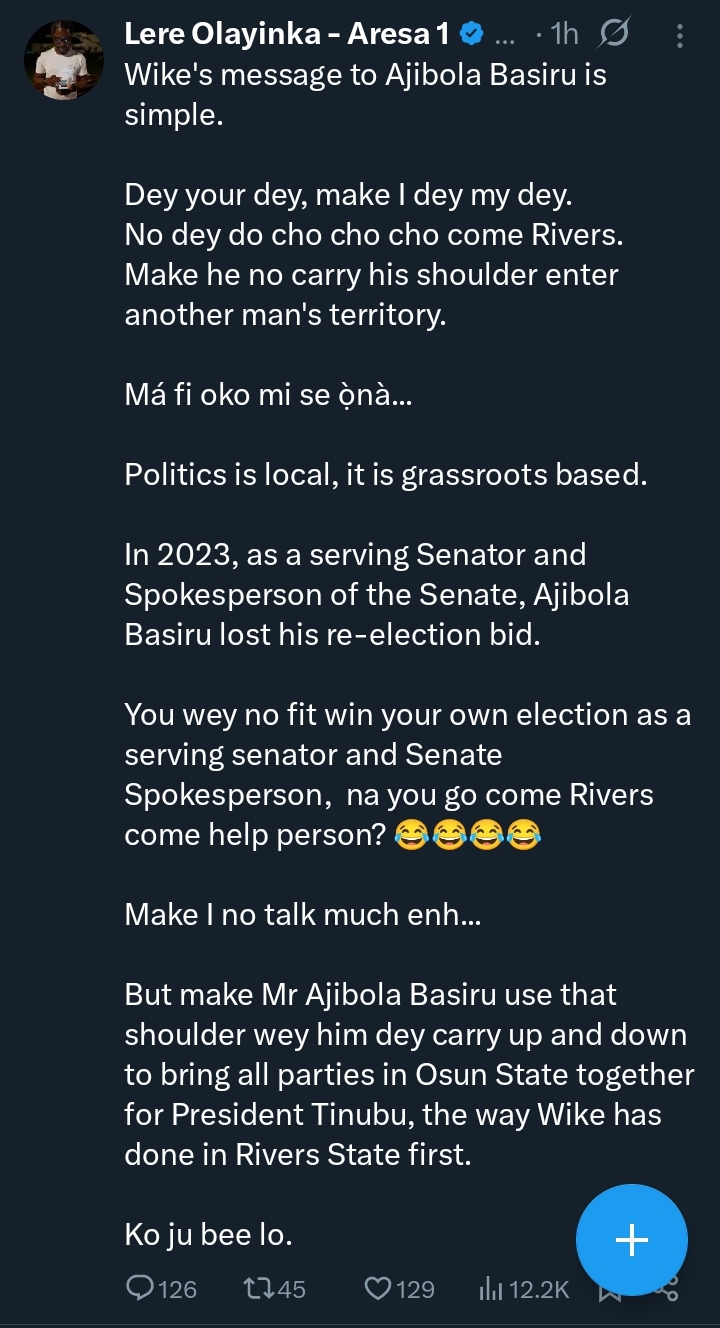
The Wike vs Basiru political feud escalated following Olayinka’s scathing social media attack. He accused Basiru of overstepping his bounds by commenting on Rivers State’s “local and grassroots-based” politics, directly challenging his authority. Olayinka’s post, laced with Nigerian Pidgin and Yoruba proverbs, underscored the bluntness of Wike’s message, ridiculing Basiru’s past electoral failures as a basis for his perceived incompetence in Rivers State matters.
At the heart of the broader conflict is the Siminalayi Fubara vs Nyesom Wike dynamic. Governor Fubara’s attempts to assert his independence and govern without the perceived overreach of his predecessor have been met with fierce resistance from Wike’s camp. Basiru’s intervention, defending Fubara’s right to respect as the state’s chief executive, inadvertently positioned him against Wike, igniting the FCT Minister’s ire and leading to the current public spat.
Basiru quickly countered Wike’s assertions, insisting that the FCT Minister lacks the locus standi to meddle in the internal affairs of the All Progressives Congress (APC), despite his ministerial role in an APC-led government. Basiru went as far as to demand Wike’s resignation from his federal position if he intended to pursue his “obsession” with Rivers politics, a clear challenge to Nyesom Wike political influence and his dual role in national and state politics. This exchange laid bare the internal friction within the broader political class.
This Rivers State political crisis explained reveals significant cracks within the APC, highlighting the challenges President Bola Tinubu’s administration faces in maintaining party unity. The conflict, initially localized, now has national implications, as key political figures align themselves with different factions. The substantial federal allocations to Rivers State, reportedly in the region of N600 billion, further complicate the situation, suggesting that economic interests are deeply intertwined with the political power struggle.
The Rivers State political news today continues to be dominated by these ongoing tensions, with each side issuing statements and counter-statements. The constant public back-and-forth between Wike’s allies and those defending Fubara, including Basiru, ensures that the crisis remains a top story. This relentless media coverage keeps the political temperature high, impacting governance and public perception of stability in the region.
Looking ahead, the Rivers State political forecast 2026 suggests that Wike’s powerful personality and entrenched political network will continue to shape the state’s trajectory. His influence, both within the state and at the national level, is a force that cannot be easily dismissed. The current clashes are merely chapters in a longer political narrative that will undoubtedly impact future elections and the overall governance structure of Rivers State.
This latest Wike Basiru clash update serves as a critical indicator of the evolving power dynamics within Nigerian politics, particularly concerning regional strongholds. Understanding Nyesom Wike influence 2026 is essential for comprehending the future political landscape of Rivers State and the broader implications for national party cohesion. The “dey your dey” mentality, while seemingly a simple proverb, encapsulates a complex struggle for power, control, and political relevance in a deeply contested environment.





![Fela: 'Wizkid is my padi' - Yeni Kuti reacts to singer's clash with Seun [VIDEO]](https://samony.com.ng/wp-content/uploads/2026/01/Fela-Wizkid-is-my-padi-Yeni-Kuti-reacts-to-1024x759.jpg?lm=69724CEC "Wizkid Fela Kuti Controversy Explained: Unpacking the Legacy Clash")


