

![[post_title]](https://samony.com.ng/wp-content/uploads/2025/11/1764380166_House-Democrats-Propose-Misguided-HSA-Reforms-1024x683.jpg?lm=692A4E09)
House Democrats Propose Misguided HSA Reforms: A Critical Look
House Democrats, spearheaded by Rep. Lloyd Doggett, are aiming to reshape Health Savings Accounts (HSAs) through the “HSA Consumer Protection Act.” The argument? HSAs are morphing into tax havens for the wealthy, losing sight of their original purpose: helping families manage healthcare expenses. While the intention may be laudable, a closer inspection reveals flaws in this approach.
The timing is peculiar. Millions of Americans already face soaring health insurance premiums. HSAs, for many, provide a crucial buffer against these rising costs. But, what exactly are HSAs, and why the sudden focus on them?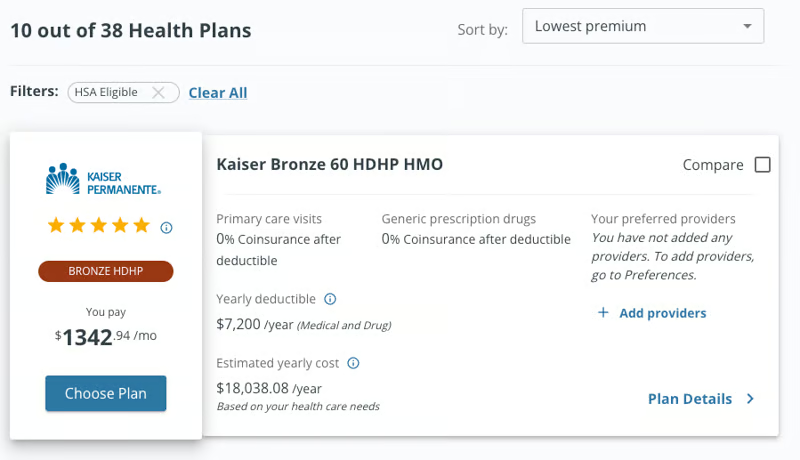 >
>
Essentially, HSAs, introduced in 2003, pair with high-deductible health plans (HDHPs). The goal was simple: lower premiums coupled with a tax-advantaged account to offset higher out-of-pocket expenses. They boast a triple tax advantage: contributions are tax-deductible, growth is tax-free, and withdrawals for qualified medical expenses are also tax-free. This makes them attractive, particularly for those who can afford to contribute consistently. By the close of 2023, HSAs held a considerable $123 billion.
Yet, the distribution of these benefits isn’t even. Data indicates that most contributions originate from higher-income households (over $100,000), while lower-income families struggle to benefit fully. Many HSAs hold less than $1,000, some even remain empty. This imbalance fuels the argument for reform.
So, what changes does this bill propose? It’s more than just tweaking the edges. The proposed changes would fundamentally alter how HSAs function. Key elements include: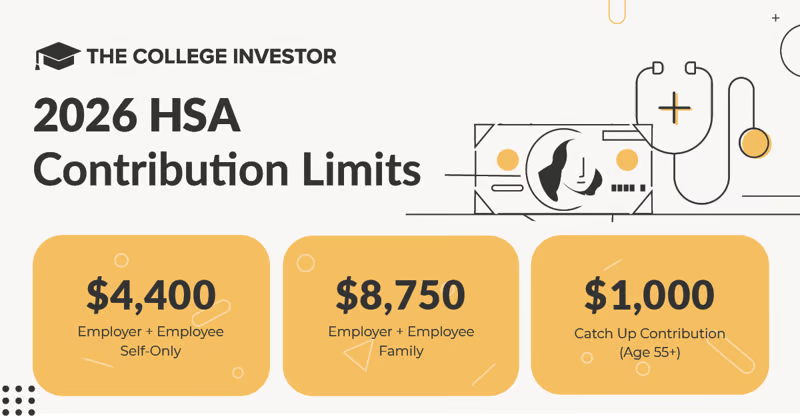 >
>
Eliminating penalty-free non-medical withdrawals after age 65: Currently, HSAs can be used for non-medical expenses after 65 (subject to income tax). This bill eliminates that flexibility, preventing HSAs from becoming de facto retirement accounts. Adding income limits to HSA contributions: A new income test would phase out the tax deduction for HSA contributions above certain income thresholds (starting at $150,000 for single filers and $300,000 for joint filers). Capping reimbursement at two years: Reimbursement for qualified medical expenses would be limited to within two years of the expense. Requiring real-time substantiation of distributions: HSA trustees would have to verify that withdrawals are for qualified medical expenses. Narrowing the definition of medical care: Certain expenses, like spa treatments, would no longer qualify. Penalizing “excessive” fees: Custodians charging “unreasonable” fees would face excise taxes.
While proponents frame these changes as measures against waste and fraud, the reality is more complex. These changes would reshape how people use HSAs.
In my view, this bill misdiagnoses the underlying issue. Sure, some high-income individuals utilize HSAs for investment purposes. However, this doesn’t warrant penalizing everyone. The crux of the matter is the affordability of healthcare itself, particularly HSA-eligible plans.
The bill seemingly disregards the economics of healthcare in America, specifically who can even afford HSA-eligible plans due to the Affordable Care Act.
HSA-eligible plans are only accessible to those enrolled in federally defined high-deductible health plans (HDHPs). Unfortunately, these plans come with high premiums. In several states, the cheapest HSA-eligible plan can exceed $1,300 – $1,800 monthly for a family.
Take California for instance. Looking at the 2026 health insurance marketplace, only 10 out of 38 plans qualify as HSA-eligible. The most affordable HSA-eligible option for a family of four comes in at $1,342.94 per month, translating to $16,115 annually. Given these figures, it’s clear many lower-income households are excluded even before they can consider the tax advantages.
Lower-income families aren’t rejecting HSAs; they are priced out. Savings are a luxury for many Americans. Surveys reveal that about 60% of Americans cannot handle a $1,000 emergency. It’s hardly shocking they can’t pour money into an HSA.
Deductibles are on the rise, outstripping household savings. Federal HDHP regulations mandate significant deductibles and out-of-pocket maximums. For 2026, deductibles stand at $1,700 (self-only) and $3,400 (family), with out-of-pocket maximums at $8,500 (self-only) and $17,000 (family). Meanwhile, HSA contribution limits haven’t kept pace. For 2026, a family can contribute a maximum of $8,750.
The two-year reimbursement window could create a financial crunch. Families may struggle to save enough to cover mandated out-of-pocket expenses within that timeframe.
Furthermore, the income limits create a benefit cliff. The bill phases out the HSA deduction starting at modified AGI of $150,000 for single filers and $300,000 for joint filers. These households often receive no ACA premium assistance, grapple with high premiums, and struggle to save.
The HSA deduction might be the only tax tool left to help individuals and families with ballooning healthcare costs.
Admittedly, the bill isn’t entirely without merit. The proposal to curb excessive HSA fees and enhance account transparency is arguably a step in the right direction. Requiring custodians to disclose details on maintenance charges and transfer fees could benefit lower- and middle-income users.
Still, even this aspect feels half-baked. A simpler approach would be to prohibit monthly maintenance fees and minimum balance requirements altogether.
If passed, the bill could have sweeping consequences. Retirees would lose the ability to use HSAs as quasi-retirement accounts. Those meticulously saving receipts for tax-free growth would see that strategy foiled by the two-year reimbursement window. People near the income thresholds could suddenly find themselves ineligible.
For now, the proposal may not advance. But this bill reflects a concerning mindset. It signals a willingness to penalize consumers for saving and planning. Those who rely on HSAs should pay close attention to this debate and understand their plan’s fees and record-keeping rules. Congress is notorious for abruptly changing the rules.

![[post_title]](https://samony.com.ng/wp-content/uploads/2025/11/Snowy-Mountains-farmers-call-for-support-in-managing-spread-of-300x169.jpeg?lm=692A4F3D "African Lovegrass: Australia’s Costly Weed Crisis")

![[post_title]](https://samony.com.ng/wp-content/uploads/2025/11/He-showed-zero-effort-Nkechi-Blessing-recounts-painful-dating-300x150.jpg?lm=692A4B41 "Nkechi Blessing’s Dating Story: Is She Right to Expect More “Effort?”")

![[post_title]](https://samony.com.ng/wp-content/uploads/2025/11/1764379359_Trump-administration-halts-all-asylum-decisions-in-wake-of-DC-300x200.jpg?lm=692A4AE2 "Asylum’s Pendulum: Balancing Security, Due Process, and the Refugee’s Plight")
![[post_title]](https://samony.com.ng/wp-content/uploads/2025/11/ATP-announces-Stefan-Edberg-Sportsmanship-Award-nominees-for-2025-300x168.jpeg?lm=692A4235 "ATP’s Sportsmanship Award: Real Class Acts, or Just Playing the Game?")

![[post_title]](https://samony.com.ng/wp-content/uploads/2025/11/Our-favorite-gear-from-Apple-Bose-Sony-and-more-is-1024x532.jpg?lm=692A4EAF "Decoding Black Friday 2025: Are Those “All-Time Low” Tech Deals Real?")
![[post_title]](https://samony.com.ng/wp-content/uploads/2025/11/Snowy-Mountains-farmers-call-for-support-in-managing-spread-of.jpeg?lm=692A4F3C "African Lovegrass: Australia’s Costly Weed Crisis")
