


Amidst stringent secrecy and a relentless conflict, Ukraine is significantly escalating its domestic arms production, exemplified by the development of sophisticated long-range cruise missiles like the “Flamingo.” Operating from undisclosed locations, production facilities are meticulously hidden, a critical measure following Russian strikes on previous sites belonging to manufacturers such as Fire Point. This strategic pivot towards self-reliance underscores Ukraine’s determination to bolster its defensive and offensive capabilities independently.
The “Flamingo” missile, a testament to Ukrainian ingenuity, is described as a deep-strike weapon with an impressive range of 3,000 kilometers, comparable to advanced Western systems like the US Tomahawk. Its design, reminiscent of the World War Two German V1 rocket, features a large jet engine affixed to a tube the length of a London bus. These domestically produced missiles are already deployed in combat, targeting Russian military and economic infrastructure, though specific operational details remain classified.
This surge in indigenous arms manufacturing marks a profound shift for Ukraine, which initially relied heavily on Soviet-era arsenals and Western military aid. President Volodymyr Zelensky has stated that over 50% of the weapons used on the front line are now domestically made, with almost all long-range armaments originating within the country. Ukraine is also emerging as a leader in unmanned systems, including drones and robots, crucial for modern warfare.
At the forefront of this industrial transformation is Fire Point, a major drone and missile manufacturer led by Chief Technical Officer Iryna Terekh. The 33-year-old, a former architecture student, now spearheads efforts to counter the Russian war machine. Her company’s motto, “if not us, then who,” encapsulates the urgency and resolve driving Ukraine’s defense sector, which did not even exist before the full-scale invasion.
Ukraine’s strategy increasingly targets Russia’s war economy to slow enemy advances along the extensive front line. General Oleksandr Syrskyi, head of Ukraine’s Armed Forces, estimates that long-range strikes have cost the Russian economy over $21.5 billion this year. Special Operations Forces officer Ruslan confirms this approach, stating the aim is “to reduce the enemy’s military capabilities and their economic potential” through hundreds of strikes on refineries, factories, and ammunition dumps deep within Russian territory.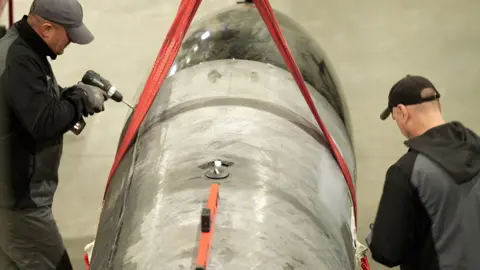
While Russia continues to launch a greater volume of strikes, averaging around 200 Shahed drones daily, Ukraine is rapidly scaling its response, currently at about half that number. Fire Point, for instance, now produces 200 drones daily, with its FP1 and FP2 models accounting for 60% of Ukraine’s long-range drone strikes. These drones are significantly more cost-effective, priced at approximately $50,000 each, three times cheaper than a Russian Shahed.
A cornerstone of Ukraine’s self-sufficiency drive is a deliberate decision to source as many components as possible domestically, expressly avoiding parts from China and the United States. Ms. Terekh explains this policy stems from a desire to maintain full control over their weapons systems, citing concerns about potential future disruptions in supply or political influence, particularly given the “emotional roller coaster” of US support.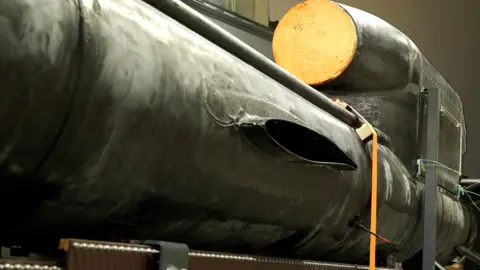
This cautious approach is underscored by the fluctuating nature of international military assistance. The United States, once Ukraine’s largest military backer, significantly curtailed its aid, forcing European allies to struggle to fill the void. Such experiences reinforce Ukraine’s belief that domestic production is the only reliable path to long-term security guarantees, dismissing ongoing peace negotiations as “capitulation talks.”
Chief designer and co-founder Denys Shtilerman emphasizes that Ukraine possesses no single “Wunderwaffe” or wonder weapon. Instead, he asserts that “the game changer is our will to win.” Ms. Terekh adds that Ukraine aims to “fight with brains and tactics,” hoping their resilience and innovation serve as a “bloody example” for Europe, urging other nations to learn from their experience in preparing for conflict.

![[post_title]](https://samony.com.ng/wp-content/uploads/2025/12/Senate-throws-weight-behind-state-police-300x147.jpg?lm=69434C10 "Nigerian Senate Backs State Police to Tackle Insecurity")

![[post_title]](https://samony.com.ng/wp-content/uploads/2025/12/1766015644_US-may-soon-reclassify-marijuana-to-allow-medical-research-What-300x158.jpg?lm=6943429D "US Mulls Marijuana Rescheduling to Boost Medical Research")
![[post_title]](https://samony.com.ng/wp-content/uploads/2025/12/Next-Gen-2027-Chevy-Silverado-Revealed-Thanks-to-Patent-Images.png?lm=69434112 "2027 Chevrolet Silverado Design Revealed in Patent Filing")
![[post_title]](https://samony.com.ng/wp-content/uploads/2025/12/1766014450_Yvonne-Jegede-clears-air-on-alleged-friendship-rumour-with-Annie-300x150.png?lm=69433DF4 "Yvonne Jegede Clarifies Relationship With Annie Idibia Amid Rumours")
![[post_title]](https://samony.com.ng/wp-content/uploads/2025/12/1766014768_Focus-more-on-security-less-politics-NLC-tells-FG-300x215.jpg?lm=69433F32 "NLC Urges Nigerian Government to Prioritise Security Amid Crisis")


![[post_title]](https://samony.com.ng/wp-content/uploads/2025/12/Senate-throws-weight-behind-state-police.jpg?lm=69434C0E "Nigerian Senate Backs State Police to Tackle Insecurity")
