

![[post_title]](https://samony.com.ng/wp-content/uploads/2025/12/1765505797_Trump-signs-executive-order-to-curtail-state-AI-laws.jpg?lm=693B7B05)
Former President Donald Trump has signed an executive order aimed at preventing individual states from establishing their own artificial intelligence regulations. The directive, issued on Thursday, asserts that a patchwork of varied state rules risks impeding the burgeoning US AI industry and undermining its competitive standing against rivals like China on the global stage.
This move by the Trump administration directly contrasts with widespread calls for increased oversight of the powerful technology. Both Republican and Democratic members of Congress, alongside civil liberties and consumer rights organizations, have consistently advocated for more robust regulation, arguing that current frameworks are insufficient to manage AI’s rapid development and societal impact.
Speaking from the Oval Office, Mr. Trump articulated a stark vision of the international AI landscape, stating, “there’s only going to be one winner” in the race for technological dominance. He specifically highlighted China’s centralized governmental approval process as a significant advantage for its domestic companies, implying a need for a unified US approach.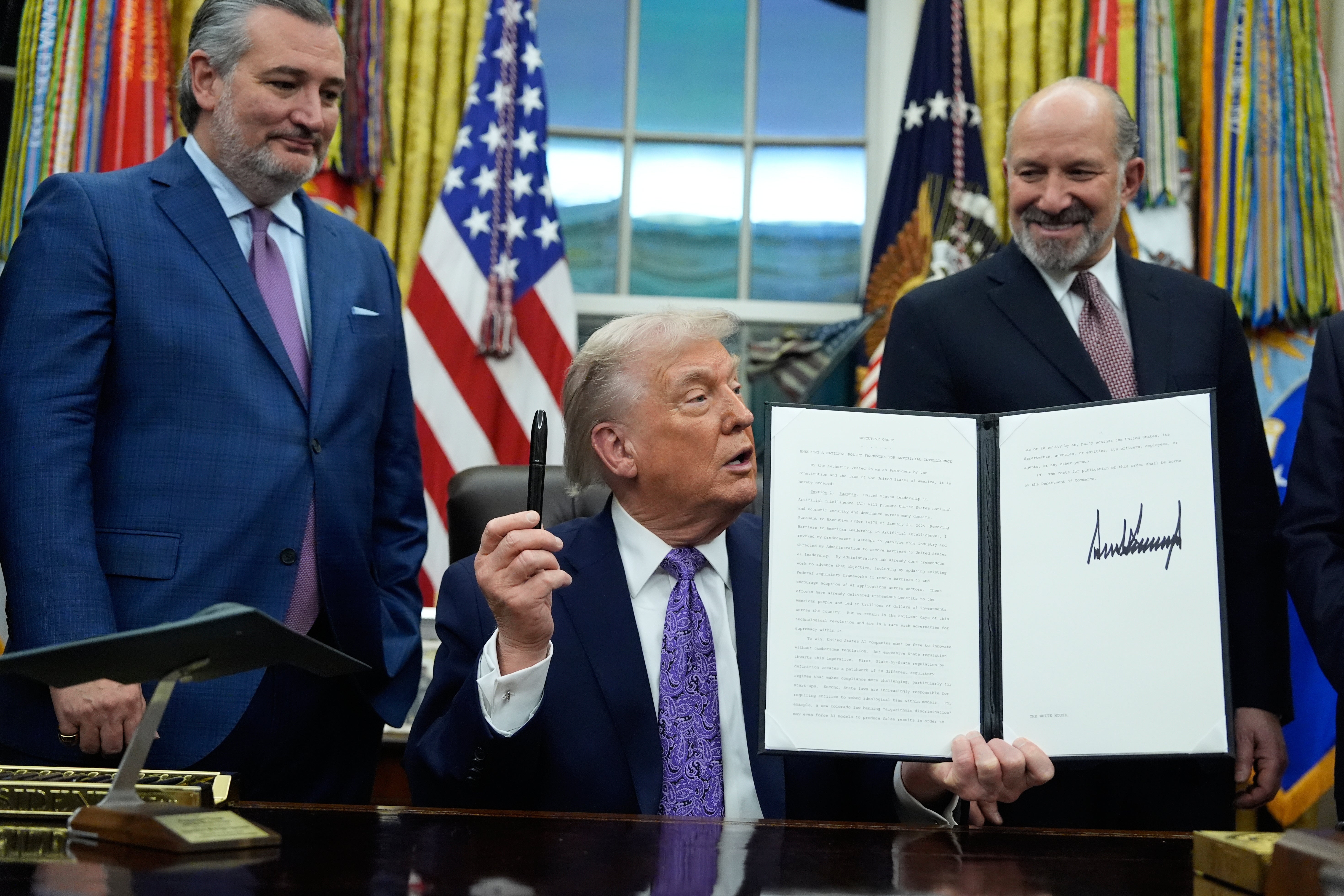
The former President emphasized the potential for bureaucratic hurdles, noting, “We have the big investment coming, but if they had to get 50 different approvals from 50 different states, you can forget it because it’s impossible to do.” This statement underscores his administration’s concern that diverse state-level regulations could stifle innovation and investment within the American AI sector.
The executive order mandates the Attorney General to establish a new task force specifically charged with challenging existing or proposed state laws deemed to conflict with federal objectives regarding AI. Concurrently, it directs the Commerce Department to compile a comprehensive list of state regulations identified as potentially problematic or overly burdensome to the industry.
Further applying pressure, the order includes provisions threatening to restrict federal funding from key programs, including a broadband deployment initiative and other grant opportunities, to states that implement AI regulations. This measure aims to disincentivize states from pursuing their own regulatory frameworks.
David Sacks, a prominent venture capitalist with substantial AI investments and a key advisor on Trump’s cryptocurrency and artificial intelligence policies, clarified the administration’s stance. He indicated that the pushback would target only “the most onerous examples of state regulation,” reassuring that measures concerning “kid safety” would not face opposition.
Despite the executive order, several states have already advanced their own AI legislative efforts. According to the International Association of Privacy Professionals, four states—Colorado, California, Utah, and Texas—have enacted laws establishing specific rules for AI within the private sector, addressing growing concerns.
These state-level initiatives typically include provisions limiting the collection of certain personal information by AI systems and mandating greater transparency from companies utilizing the technology. Such laws directly respond to AI’s increasing pervasiveness in daily life, where it influences critical decisions affecting individuals.
Artificial intelligence currently plays a significant role in determining outcomes for Americans across various sectors, including job interviews, apartment leases, home loan approvals, and even access to specific medical care. However, extensive research has documented instances where AI systems exhibit biases, leading to discriminatory decisions based on factors such as gender or race.
More ambitious regulatory proposals from states often require private companies to conduct thorough assessments of potential discrimination risks associated with their AI programs and to provide full transparency regarding their algorithms. These efforts aim to mitigate harmful biases before they impact individuals.
Beyond these sweeping rules, many states have also implemented targeted regulations focusing on particular aspects of AI use. Examples include prohibitions against the use of deepfakes in elections and for creating nonconsensual pornography, as well as establishing clear guidelines for government agencies’ own deployment of AI technologies.

![[post_title]](https://samony.com.ng/wp-content/uploads/2025/12/Australia-social-media-ban-Teens-navigate-new-world-without-social-300x169.jpg?lm=693B6C32 "Australia Social Media Ban for Under-16s Begins")
![[post_title]](https://samony.com.ng/wp-content/uploads/2025/12/Women-with-BBL-have-bad-character-Ruger-300x233.jpeg?lm=693B661A "Ruger’s BBL Remarks Fuel Debate on Body Image and Character")

![[post_title]](https://samony.com.ng/wp-content/uploads/2025/12/Asbestos-containing-wind-turbine-brake-pad-shipment-docked-at-Geelong-port-300x169.jpeg?lm=693B66B2 "Geelong Port: Asbestos-Laden Wind Turbine Parts Ignite Regulatory Scrutiny")



![[post_title]](https://samony.com.ng/wp-content/uploads/2025/12/Australia-social-media-ban-Teens-navigate-new-world-without-social-1024x576.jpg?lm=693B6C33 "Australia Social Media Ban for Under-16s Begins")
