


Dr. Mark Chavez, a California physician, has received a sentence of eight months of home detention and three years of supervised release for his involvement in the ketamine overdose death of “Friends” actor Matthew Perry. This sentencing marks the second individual to face legal consequences in the high-profile federal investigation surrounding the sitcom star’s passing in October 2023. The ruling underscores the serious legal ramifications for those implicated in the illicit supply chain that contributed to Perry’s death.
The federal inquiry into Perry’s death meticulously unravelled an extensive underground drug network operating within Hollywood. Investigators determined that Perry died from the “acute effects” of ketamine, with a post-mortem examination revealing a dangerously high concentration of the dissociative anaesthetic in his system. This comprehensive investigation has led to guilty pleas from five individuals, including two doctors and a prominent dealer known as the “Ketamine Queen.”
Earlier this month, Dr. Salvador Plasencia, identified as the direct supplier of ketamine to Matthew Perry, received a significantly harsher sentence of 30 months in federal prison. Plasencia’s conviction highlights his more direct role in providing the substance that proved fatal to the actor. Dr. Chavez admitted to supplying ketamine to Dr. Plasencia, who then funnelled it to Perry, establishing a clear link in the illicit distribution chain.
Dr. Chavez, a San Diego-based physician, confessed to obtaining ketamine from both his former clinic and a wholesale distributor through fraudulent prescriptions. He specifically admitted to submitting a false prescription for 30 ketamine lozenges under a former patient’s name, without their knowledge or consent, with the explicit intent to sell these to Dr. Plasencia for Matthew Perry. This illicit transaction formed part of a broader, more cynical scheme.
Prosecutors revealed disturbing text exchanges between Dr. Chavez and Dr. Plasencia, in which they openly discussed exploiting Matthew Perry’s well-documented addiction for financial gain. In one particularly callous message, Plasencia inquired of Chavez, “I wonder how much this moron will pay,” indicating a clear intent to profit from Perry’s vulnerability rather than provide legitimate medical care. This exchange painted a grim picture of their motives.
Matthew Perry, who had openly battled drug addiction and depression for many years, had been prescribed ketamine as part of his treatment regimen. However, his addiction led him to seek quantities far exceeding his prescribed allowance. This desperate search ultimately connected him with the illicit drug ring, which exploited his vulnerability and provided him with the lethal dose of the substance.
Kenneth Iwamasa, Perry’s live-in assistant, also played a crucial role in facilitating the actor’s access to the illicit supply. Prosecutors stated that Iwamasa worked in conjunction with both Dr. Chavez and Dr. Plasencia to provide Perry with more than $50,000 (£38,000) worth of ketamine in the weeks immediately preceding his death. His involvement underscores the pervasive nature of the network.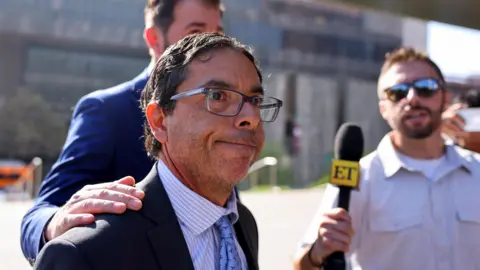
As part of his October 2024 plea agreement, Dr. Chavez, who initially faced up to 10 years in federal prison, surrendered both his medical license and his passport. This outcome reflects a significant professional consequence for his actions, effectively ending his career as a physician and preventing him from international travel.
The federal investigation continues, with three other individuals implicated in the network still awaiting sentencing. These include Perry’s assistant, Kenneth Iwamasa; Erik Fleming; and American-British dual national Jasveen Sangha, widely known as the “Ketamine Queen.” Their forthcoming sentencings are expected to further illuminate the full scope of the elaborate drug operation.
The case serves as a stark reminder of the dangers of illicit drug distribution and the exploitation of individuals struggling with addiction, particularly within the entertainment industry. Authorities have emphasized their commitment to dismantling such networks to prevent future tragedies and hold all involved parties accountable for their roles.

![[post_title]](https://samony.com.ng/wp-content/uploads/2025/12/1765915585_Traditional-cable-providers-see-subscribers-increase-for-the-first-time.png?lm=6941BBC1 "Cable Subscriptions Rise for First Time in Eight Years")
![[post_title]](https://samony.com.ng/wp-content/uploads/2025/12/1765914863_How-to-see-alien-spaceship-3IATLAS-yourself-as-it-makes-300x158.jpg?lm=6941B8F1 "Interstellar Comet 3I/ATLAS Makes Rare Close Earth Approach")
![[post_title]](https://samony.com.ng/wp-content/uploads/2025/12/Inician-las-semifinales-de-la-Copa-Pacena-Blooming-vs-Bolivar-300x300.jpeg?lm=6941BA47 "Paceña Cup Semifinals Commence: Teams Vie for Glory and Libertadores Spot")
![[post_title]](https://samony.com.ng/wp-content/uploads/2025/12/1765914418_Jarvis-confirms-breakup-with-Peller-300x198.jpeg?lm=6941B733 "Jarvis Addresses Peller Split, Urges Compassion Post-Livestream Crash")

![[post_title]](https://samony.com.ng/wp-content/uploads/2025/12/1765913910_Ned-Nwoko-Speaks-Out-Regina-Daniels-Must-Seek-Rehab-to-300x289.jpeg?lm=6941B537 "Regina Daniels Barred From Seeing Children Pending Rehab")


![[post_title]](https://samony.com.ng/wp-content/uploads/2025/12/1765914863_How-to-see-alien-spaceship-3IATLAS-yourself-as-it-makes-1024x538.jpg?lm=6941B8F2 "Interstellar Comet 3I/ATLAS Makes Rare Close Earth Approach")
