

![[post_title]](https://samony.com.ng/wp-content/uploads/2025/12/1766168205_Full-speech-of-President-Tinubu-during-2026-budget-presentation-1024x683.jpg?lm=6945968F)
President Bola Ahmed Tinubu on Friday presented Nigeria’s 2026 Appropriation Bill to a joint session of the National Assembly, unveiling a N58.18 trillion fiscal plan. Titled the “Budget of Consolidation, Renewed Resilience and Shared Prosperity,” the proposal aims to solidify recent economic gains and address long-standing structural weaknesses. President Tinubu acknowledged the immediate difficulties faced by citizens due to his administration’s necessary economic reforms, assuring the nation that these sacrifices pave the way for lasting stability and shared prosperity.
The President highlighted measurable economic improvements achieved through these reforms. Nigeria’s economy grew by 3.98 per cent in the third quarter of 2025, an increase from 3.86 per cent in the same period of 2024. Furthermore, headline inflation moderated for eight consecutive months, declining to 14.45 per cent in November 2025 from 24.23 per cent in March 2025. This deflationary trend is projected to continue into 2026, supported by stable food and energy prices, tighter monetary conditions, and improved supply responses.
Tinubu also cited enhanced oil production, bolstered by improved security, technology deployment, and sectoral reforms. Non-oil revenues expanded significantly due to better tax administration, contributing to stronger fiscal performance. Investor confidence has reportedly returned, evidenced by increased capital inflows, renewed project financing, and robust private-sector participation. Nigeria’s external reserves reached a seven-year high of approximately $47 billion last month, providing over ten months of import cover and a substantial buffer against economic shocks.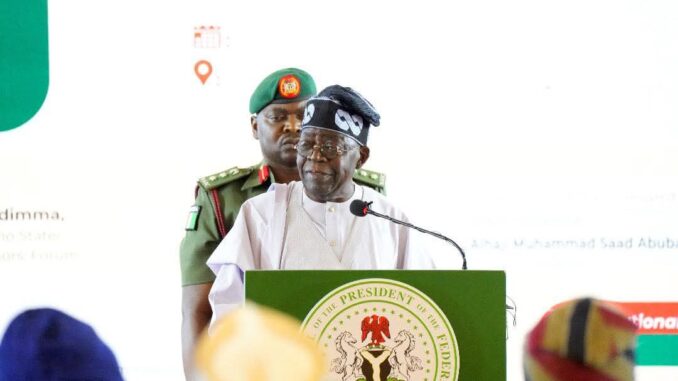
Reviewing the 2025 budget implementation, President Tinubu noted that as of Q3 2025, revenue collection stood at N18.6 trillion (61% of target) and expenditure at N24.66 trillion (60% of target). For 2026, the proposed budget projects total revenue of N34.33 trillion and a total expenditure of N58.18 trillion. This includes N15.52 trillion for debt servicing, N15.25 trillion for recurrent non-debt expenditure, and N26.08 trillion for capital expenditure. The projected budget deficit is N23.85 trillion, representing 4.28% of GDP.
The 2026 budget parameters are anchored on a conservative crude oil benchmark of $64.85 per barrel, with a projected crude oil production of 1.84 million barrels per day, and an average exchange rate of N1,400 to the US Dollar. President Tinubu outlined four clear objectives: consolidating macroeconomic stability, improving the business and investment environment, promoting job-rich growth and poverty reduction, and strengthening human capital development while protecting vulnerable populations. He affirmed purposeful spending and disciplined debt management.
Key sectoral provisions reflect the government’s “Renewed Hope Agenda.” A significant N5.41 trillion is allocated to defence and security, N3.56 trillion to infrastructure, N3.52 trillion to education, and N2.48 trillion to health. The President underscored the interconnectedness of these priorities, stating that investment requires security, and productivity needs educated, healthy citizens. This budget, he explained, is designed as a coherent programme for national renewal.
National security remains a cornerstone, with provisions for modernising the Armed Forces, intelligence-driven policing, and border security. President Tinubu announced a new national counterterrorism doctrine, aiming for a holistic redesign anchored on unified command, intelligence gathering, and counter-insurgency. He declared that any armed group or non-state actors operating outside state authority would be regarded as terrorists, vowing no mercy for perpetrators of violence, banditry, and kidnapping.
In human capital development, the budget strengthens investments in education, skills, healthcare, and social protection. The Nigerian Education Loan Fund has already supported over 788,000 students across 229 tertiary institutions nationwide. Healthcare investment constitutes 6 per cent of the total budget, supplemented by over $500 million in health interventions from a US government partnership. Food security also remains a national priority, focusing on input financing, mechanisation, irrigation, and agro-value chains. The Bank of Agriculture plans to cultivate one million hectares, creating jobs and growing export value.
The administration has initiated comprehensive procurement reforms, enhancing efficiency and generating significant cost savings by reducing processing times and enforcing stricter procedures. A new “Nigeria First Policy” mandates Ministries, Departments, and Agencies (MDAs) to prioritise Nigerian-made goods and local companies. This policy aims to foster self-sufficiency, support domestic industries, create jobs, and reduce reliance on imports.
President Tinubu concluded by emphasising that the most significant budget is not merely announced but delivered. For 2026, he pledged stronger discipline in budget execution, improved revenue performance through digitisation and new tax acts, and a commitment to sealing leakages and ensuring prompt remittances. He stressed that every institution must meet its revenue targets, forming core components of performance evaluations. The President sought the National Assembly’s partnership,

![[post_title]](https://samony.com.ng/wp-content/uploads/2025/12/1766164302_Tourist-says-she-suffered-concussion-and-neck-injuries-on-same.jpg?lm=6945874E "Tourist Sues Universal Orlando Over Ride Injuries After Fatal Incident")
![[post_title]](https://samony.com.ng/wp-content/uploads/2025/12/1766164350_David-Walliams-dropped-by-publisher-after-claims-he-harassed-female-300x158.jpg?lm=69458780 "David Walliams Dropped by HarperCollins Amid Harassment Allegations")

![[post_title]](https://samony.com.ng/wp-content/uploads/2025/12/1766167937_BREAKING-Kylie-Minogue-beats-WHAM-to-UK-Christmas-number-one-300x158.jpg?lm=69459582 "Kylie Minogue Claims Christmas Number One After 22 Years")

![[post_title]](https://samony.com.ng/wp-content/uploads/2025/12/1766165753_Is-Amazfits-99-subscription-free-tracker-a-challenger-to-Whoops-200.png?lm=69458CF9 "Amazfit Helio Strap: A $99 Challenger to Whoop’s Premium Fitness Data")

![[post_title]](https://samony.com.ng/wp-content/uploads/2025/12/WATCH-Court-Remands-Imo-Woman-For-Burning-5-Year-Old-Maids-Private.png?lm=6945845C "Imo Woman Remanded for Brutal Attack on 5-Year-Old Maid")
![[post_title]](https://samony.com.ng/wp-content/uploads/2025/12/1766164350_David-Walliams-dropped-by-publisher-after-claims-he-harassed-female-1024x538.jpg?lm=69458781 "David Walliams Dropped by HarperCollins Amid Harassment Allegations")
