


Former Nigerian presidential aide Bashir Ahmad has affirmed that Muslims are permitted to consume food served during Christmas celebrations, provided the items themselves adhere to Islamic dietary laws. Citing a fatwa attributed to renowned Islamic scholar Sheikh Ibrahim Khalil, Ahmad underscored that the permissibility of food in Islam is determined by its ingredients and preparation methods, rather than the specific occasion on which it is offered or consumed.
Sheikh Ibrahim Khalil’s fatwa, a formal legal opinion in Islamic law, offers crucial guidance for Muslims navigating diverse social and cultural environments. This clarification provides a nuanced perspective, distinguishing between the religious significance of an event and the inherent status of consumable items, thereby fostering an understanding that supports interfaith interactions.
The fundamental principle underpinning this ruling is the concept of ‘halal’ (permissible) versus ‘haram’ (forbidden) in Islam. The fatwa reiterates that foods inherently prohibited by Islamic law, such as pork products and alcoholic beverages, remain strictly forbidden regardless of the celebratory context. This maintains the integrity of core Islamic dietary injunctions, which are absolute and constant.
Ahmad’s statement explicitly referenced Qur’an 5:5, a pivotal verse often invoked in discussions concerning relations with other monotheistic faiths. This verse declares, “The food of the People of the Book is lawful for you, and your food is lawful for them.” This scriptural foundation provides a theological basis for the permissibility of sharing meals with Christians and Jews, who are recognized as ‘People of the Book’ in Islam.
The designation of ‘People of the Book’ (Ahl al-Kitāb) acknowledges a shared Abrahamic heritage and mutual respect among followers of Judaism, Christianity, and Islam. This verse not only facilitates dietary allowances but also promotes broader principles of communal harmony and mutual understanding, encouraging social interaction that transcends religious boundaries.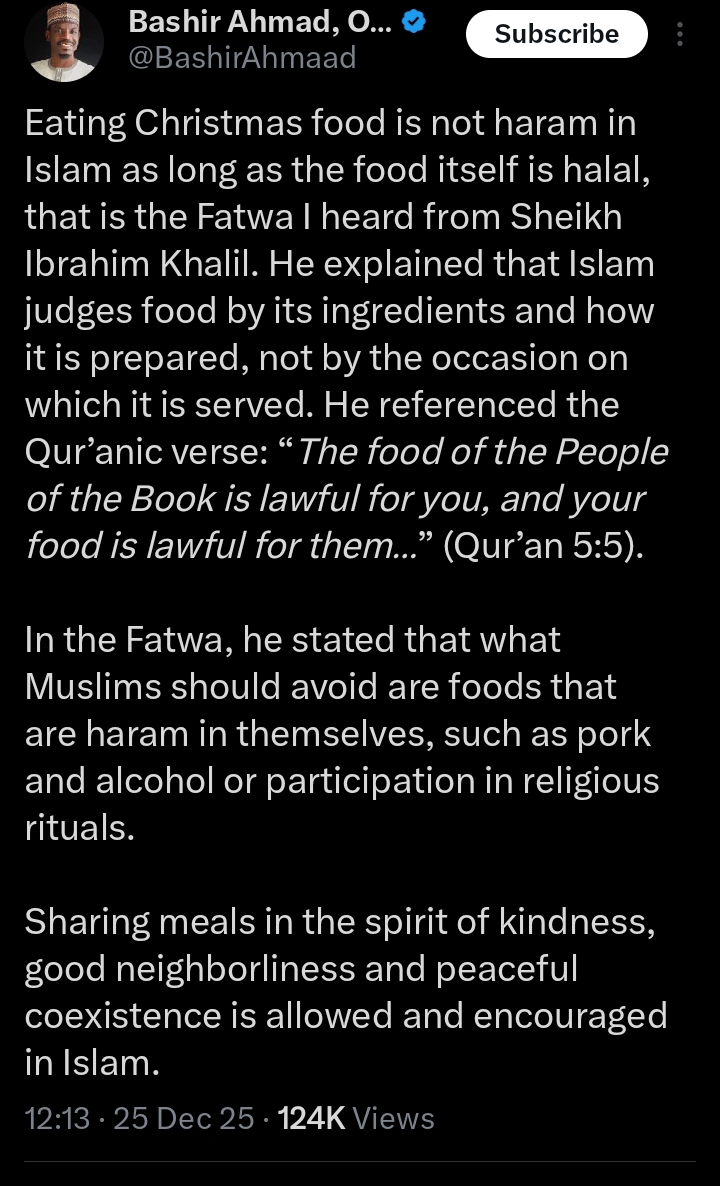
Crucially, the fatwa draws a clear distinction between consuming permissible food and participating in religious rituals that contradict Islamic beliefs. While sharing meals in a spirit of goodwill is encouraged, Muslims are advised to refrain from engaging in practices or ceremonies that might compromise their faith or imply endorsement of non-Islamic theological tenets. This balance allows for social integration without religious assimilation.
Beyond the specific dietary considerations, the guidance emphasizes the ethical and social values deeply embedded in Islamic teachings. Sharing meals is framed as an act of kindness, a demonstration of good neighborliness, and a pathway to peaceful coexistence. These values align with universal human principles, reinforcing Islam’s commitment to building strong, harmonious communities.
Such a pronouncement from a prominent figure like Bashir Ahmad carries significant weight, particularly in religiously diverse nations like Nigeria. It contributes meaningfully to ongoing dialogues about religious tolerance and the practical application of Islamic principles in contemporary multicultural societies, helping to dispel misconceptions and foster greater understanding between different faith communities.
Islamic jurisprudence has historically addressed questions of interaction with non-Muslims, with scholars consistently providing guidance on maintaining Islamic identity while engaging positively with the wider community. This fatwa reflects a continuity within this tradition, applying established principles to modern contexts and demonstrating the adaptability of Islamic law to promote social cohesion.
Ultimately, the message reinforces the Islamic value placed on shared humanity and strong social bonds, provided that core religious principles are upheld. It offers a practical and compassionate framework for Muslims to engage respectfully and harmoniously with their Christian neighbors during festive seasons, ensuring their actions remain consistent with their faith while promoting peace and mutual respect.






