


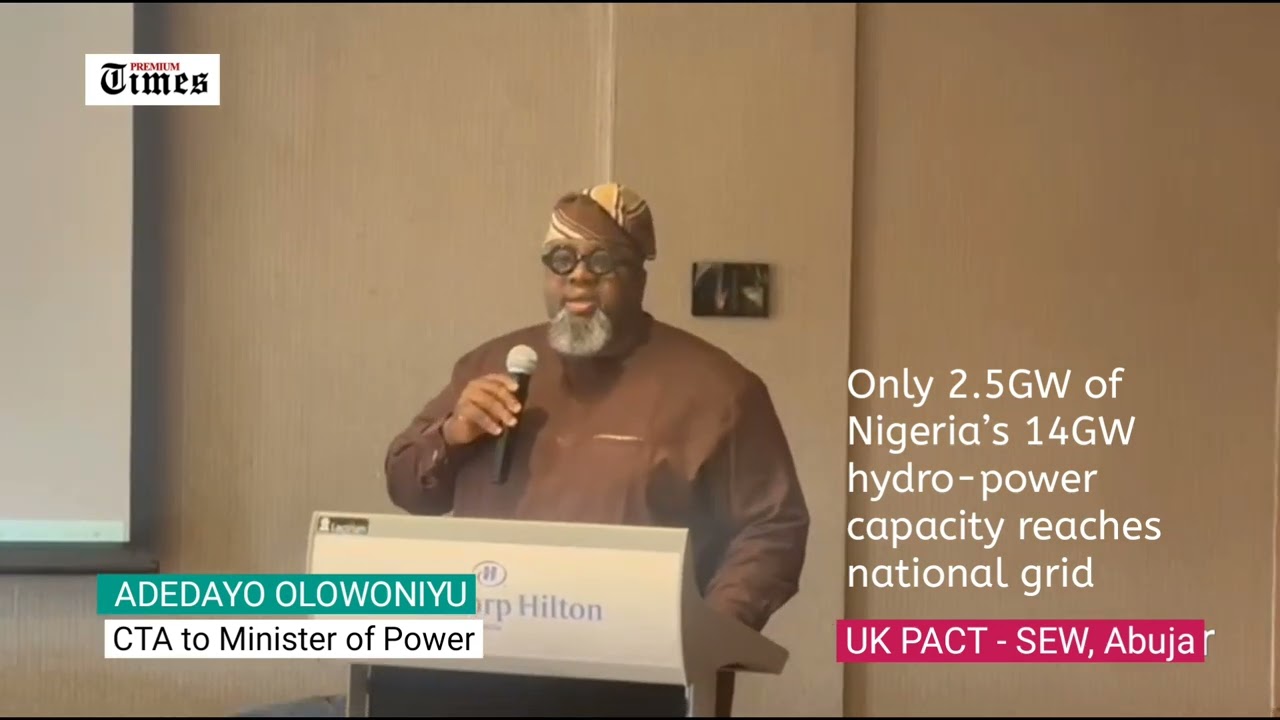
Nigeria possesses an estimated 14 gigawatts of hydropower capacity, yet only a fraction, approximately 2.5 gigawatts, currently contributes to the national grid. This significant underutilisation presents a substantial opportunity for the country to advance its clean energy ambitions and address climate goals, according to Adedayo Olowoniyi, Chief Technical Adviser to Nigeria’s Minister of Power. Speaking at a UK PACT (Partnering for Accelerated Climate Transition) stakeholder engagement workshop in Abuja, Mr. Olowoniyi emphasised the critical need to maximise every viable renewable resource.
The workshop, themed “Catalysing Run-of-River Small Hydropower for Nigeria’s Decentralised Energy Transition,” was organised by AP3, an Africa-focused public-private partnership and infrastructure finance advisory firm. Its objective was to align stakeholders on the technical, policy, and regulatory pathways necessary to accelerate the nationwide deployment of Small Hydropower (SHP). Mr. Olowoniyi highlighted that run-of-river small hydropower offers a major avenue for delivering clean, reliable energy with minimal environmental impact, aligning seamlessly with Nigeria’s energy transition objectives, rural electrification targets, and productive-use energy needs.
Amidst a global discourse on equitable clean energy transitions, particularly challenging for oil-producing nations like Nigeria seeking to reduce fossil fuel dependency, experts suggest small hydropower could play a transformative role. It offers a complementary solution to the rapid adoption of solar systems, providing a consistent and decentralised power source. Mr. Olowoniyi urged the development of scalable, replicable programmes designed to attract vital private investment into small dam development across the country, underscoring the timeliness of such initiatives.
This push for hydropower expansion forms part of the Nigerian government’s comprehensive, multi-pronged strategy to reposition its power sector for sustainability, efficiency, and growth. Mr. Olowoniyi detailed this strategy, which is supported by the UK PACT-funded Small Hydropower Programme, as spanning five key pillars: legislation, policy reforms, infrastructure development, energy transition and access expansion, and local content and capacity development. Each pillar aims to address longstanding challenges within the Nigerian Electricity Supply Industry (NESI).
Significant legislative progress includes the Electricity Act 2023, hailed as a milestone for strengthening governance and promoting competition. This act devolves regulatory powers to states, fostering private-sector participation in subnational electricity markets; already, 15 states have secured autonomy, with one market fully operational. On the policy front, the Integrated National Electricity Policy, approved in February, guides ongoing commercialisation efforts that have boosted sector revenue by 70 per cent to an impressive ₦1.7 trillion in 2024. President Bola Tinubu’s approval of a ₦4 trillion bond to clear verified generation and gas supply debts further stabilises the sector, alongside a developing targeted subsidy framework to protect vulnerable households.
Infrastructure development remains a core focus, with the Federal Government introducing targeted national programmes to accelerate the viability, expansion, and modernisation of the national grid. Progress under the Presidential Power Initiative (PPI) includes over 700MW of additional transmission capacity and contracts for Phase One, projected to deliver 7,000MW of operational grid capacity. The integration of the 700MW Zungeru Hydropower Plant, rehabilitation of NIPP plants unlocking 345MW, and the historic synchronisation of Nigeria’s grid with the West African Power Pool, encompassing 14 countries, underscore these advancements. Distribution efforts are also bolstered by the Presidential Metering Initiative (PMI), which has secured ₦700 billion to deploy 1.1 million meters by 2025 and an additional two million annually for five years, complementing the 3.2 million meters under the World Bank–supported DISREP programme.
Regarding energy access, over $2 billion has been mobilised in the past two years through initiatives like DARES, NSIA’s RIPLE platform, and JICA, aimed at expanding off-grid and mini-grid solutions to communities, schools, health facilities, and public institutions. Local content and capacity development are equally prioritised. The Ministry recently commissioned new training equipment at NAPTIN, and agreements activated at the Nigerian Renewable Energy Innovation Forum (NREIF) 2025 are set to bring nearly 4GW per annum of solar manufacturing capacity online. This scale positions Nigeria to meet domestic renewable energy targets and serve regional markets, as evidenced by recent exports of Nigeria-made solar panels to Ghana.
Gori Daniel, Managing Partner at AP3, underscored Nigeria’s pivotal moment in its energy transition. He noted that escalating demand and persistent energy deficits place immense pressure on the national grid, making the urgency for diversified, resilient, and low-carbon energy solutions paramount. Small Hydropower, particularly run-of-river systems, offers a unique and critical opportunity to bridge this gap, being clean, reliable, locally sourced, and climate-resilient. Backed by UK PACT funding, AP3 is implementing a comprehensive technical assistance programme to build a pipeline of technically sound, commercially viable, and policy-aligned SHP projects capable of attracting substantial public, private, and blended finance.

![[post_title]](https://samony.com.ng/wp-content/uploads/2025/12/Tomb-Raider-announces-two-new-games-300x157.png?lm=693B9F5C "Tomb Raider Unveils Dual Game Strategy: Remake and New Adventure")

![[post_title]](https://samony.com.ng/wp-content/uploads/2025/12/1765443966_What-we-know-about-flu-variant-AH3N2-K-The-strain.jpeg?lm=693A897E "Early Flu Season: A/H3N2 K Dominance Raises Health Concerns")
![[post_title]](https://samony.com.ng/wp-content/uploads/2025/12/1765513154_Ukraine-Russia-war-latest-Trump-says-US-will-attend-Ukraine-peace.jpeg?lm=693B97C2 "Trump Open to Ukraine Peace Talks, Demands ‘Action’")
![[post_title]](https://samony.com.ng/wp-content/uploads/2025/12/1765511724_Jimmy-Odukoya-Honors-Late-Mum-Bimbo-20-Years-After-Plane-300x128.jpg?lm=693B922E "Jimmy Odukoya Honours Mother Bimbo 20 Years After Tragic Crash")
![[post_title]](https://samony.com.ng/wp-content/uploads/2025/12/Teacher-33-in-court-over-sexual-act-with-16-year-old-boy.png?lm=693B90EB "Zimbabwean Teacher Faces Court Over Alleged Sexual Assault of Minor")

![[post_title]](https://samony.com.ng/wp-content/uploads/2025/12/22-year-old-arrested-with-friends-for-staging-self-kidnap.jpg?lm=693BA02A "Ondo Driver Staged Own Kidnap, Extorted N1.5m From Family")
![[post_title]](https://samony.com.ng/wp-content/uploads/2025/12/Tomb-Raider-announces-two-new-games-1024x536.png?lm=693B9F5C "Tomb Raider Unveils Dual Game Strategy: Remake and New Adventure")
