

![[post_title]](https://samony.com.ng/wp-content/uploads/2025/11/1764025328_Drama-as-relatives-of-abducted-villagers-allegedly-kidnap-bandits-families-1024x535.jpg?lm=6924E3F3)
Vigilante Justice in Nigeria: A Shifting Landscape of Security?
Reports are surfacing about a rather audacious turn of events in Katsina State, Nigeria. If social media whispers are anything to go by, relatives of villagers kidnapped by bandits reportedly retaliated by abducting the bandits’ families. The alleged outcome? The bandits released their captives and even offered some compensation.
It’s quite a story, and naturally, it’s ricocheting across the internet. While the details are still hazy and official confirmation is lacking, the incident, if true, highlights a critical shift in how communities are grappling with insecurity. It also points to the complex dynamics playing out in regions plagued by banditry and kidnappings.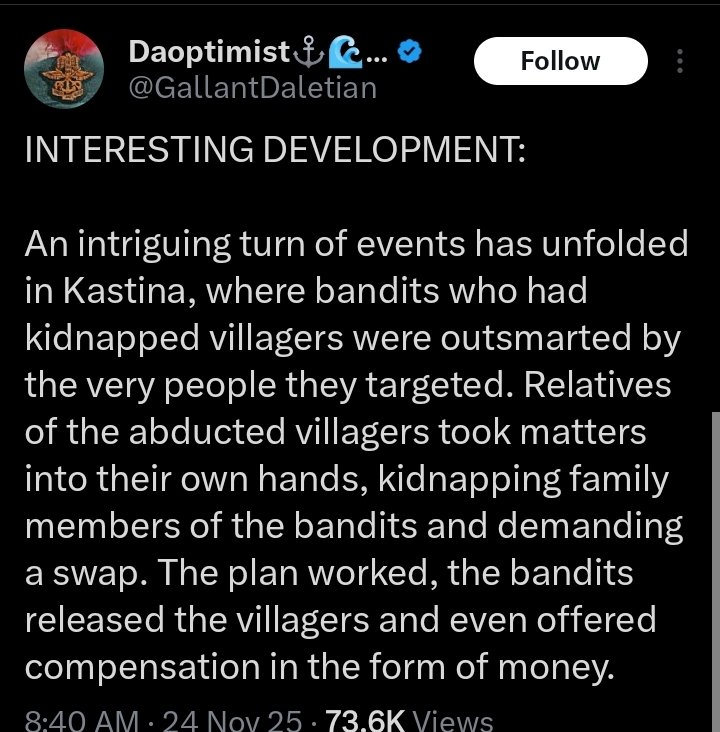 >
>
This isn’t happening in a vacuum. Just days earlier, news broke about the abduction of farmers in Borno State, allegedly by Boko Haram insurgents. This constant threat, a palpable sense of vulnerability, creates an environment where people feel compelled to take matters into their own hands.
Now, this reported vigilante action in Katsina sparks several questions. First and foremost, is it accurate? Social media reports are notoriously unreliable. We need verified sources and on-the-ground reporting to truly understand what occurred. Let’s just assume its accurate for arguments sake.
Second, what does this kind of action signify? Does it signal a complete loss of faith in the government’s ability to provide security? I’ve seen similar patterns emerge in other contexts where state authority erodes. Desperate people seek desperate solutions.>
Third, what are the long-term implications? Will this tit-for-tat escalation of violence lead to a more unstable and dangerous environment? Retaliation can easily spiral out of control, creating a vicious cycle of violence that’s hard to break.
I’ve seen firsthand how these situations unfold. The initial act of defiance might be celebrated as a victory, but the consequences can be far-reaching and devastating. Trust within communities can fracture, and the lines between victim and perpetrator can blur.
It’s worth noting that this alleged incident also raises some thorny ethical and legal questions. Does kidnapping the families of criminals justify their crimes? Where do we draw the line between self-defense and vigilantism? These are difficult questions with no easy answers.
The video circulating online claiming a similar situation lends some weight to the reports, but caution is still needed. Videos can be easily manipulated or taken out of context. To that end, we require a more thorough investigation before drawing definitive conclusions.
Given these facts, it’s essential to approach this news with a balanced perspective. A simple “good guys vs. bad guys” narrative is unhelpful. These situations are rarely black and white.
What we are witnessing, potentially, is a symptom of a deeper problem: the failure of the state to provide basic security to its citizens. When people feel abandoned and unprotected, they will find ways to protect themselves, even if those ways are legally questionable or morally ambiguous.
This challenge requires a multifaceted approach. Improved law enforcement, stronger judicial systems, and community-based initiatives are needed to address the root causes of insecurity. We must also tackle the socio-economic factors that drive banditry and other forms of crime. Poverty, lack of education, and unemployment can create fertile ground for criminal activity.
Ultimately, sustainable solutions must involve building trust between communities and the government. People need to believe that the authorities are committed to protecting them and upholding the rule of law. Without that trust, incidents like the one reported in Katsina may become more frequent, further destabilizing the region.
It’s understandable to empathize with the desperation of those who have been victimized by bandits. However, resorting to vigilantism risks creating a society where the law of the jungle prevails. It’s a slippery slope, and one that ultimately undermines the very fabric of society.

![[post_title]](https://samony.com.ng/wp-content/uploads/2025/12/1764846049_Everyones-complaining-about-Spotify-Wrapped-for-this-one-brutal-reason-300x158.jpg?lm=693169E5 "Spotify Wrapped 2025: Ageism in Your Algorithm?")


![[post_title]](https://samony.com.ng/wp-content/uploads/2025/12/Leadership-transition-at-Construction-Kaiser-ushers-in-Euchenhofer-as-CEO-300x171.png?lm=693168CC "CKL’s CEO Change: Navigating Nigeria’s Construction Realities, Not Just a Global Playbook")

![[post_title]](https://samony.com.ng/wp-content/uploads/2025/12/Why-Presidency-Is-Silent-Over-The-Controversy-On-Ambassadorial-List.jpg?lm=69316936 "Nigeria’s Ambassadorial List: Why the President Isn’t Talking—And What It Means.")

![[post_title]](https://samony.com.ng/wp-content/uploads/2025/12/Perth-Wildcats-Seek-Revenge-Against-Melbourne-United-in-Round-11-1024x576.jpg?lm=69317034 "Wildcats vs. United: Is This Perth’s Revenge Game?")

![[post_title]](https://samony.com.ng/wp-content/uploads/2025/12/1764846049_Everyones-complaining-about-Spotify-Wrapped-for-this-one-brutal-reason-1024x538.jpg?lm=693169E5 "Spotify Wrapped 2025: Ageism in Your Algorithm?")
