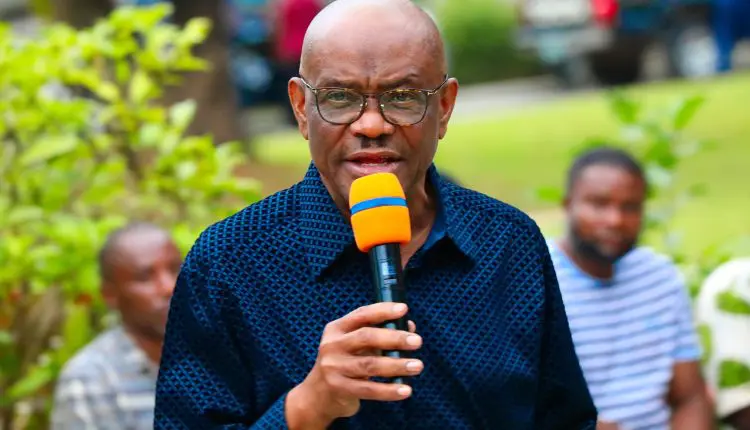
The ongoing Rivers State political power struggle has once again been thrust into the spotlight following a defiant declaration from the Minister of the Federal Capital Territory, Nyesom Wike. Addressing his supporters in Ahoada, Wike vehemently asserted that no individual, not even President Bola Tinubu, holds the authority to dictate his involvement in Rivers State politics. This bold statement underscores the complex and deeply entrenched political dynamics within the oil-rich state, highlighting a significant challenge to traditional political hierarchies and influences. His words send a clear message about his unwavering grip on the state’s political landscape.
Wike’s public pronouncement comes amid escalating tensions between himself and his successor, Governor Siminalayi Fubara. The political feud, which has simmered for months, recently saw Fubara defect from the Peoples Democratic Party (PDP) to the ruling All Progressives Congress (APC). This move further complicated the political calculations and power balance, transforming what was once a mentor-protégé relationship into a full-blown rivalry that captivates the nation’s political observers. The defection is widely seen as a direct challenge to Wike’s established dominance.
During his address, Wike dismissed reports suggesting presidential intervention in the state’s affairs, particularly concerning the 2027 general elections. He specifically debunked claims that President Tinubu had summoned him to discuss Rivers politics or to endorse Governor Fubara for an automatic ticket. “Let me tell you, there’s nothing like instruction as far as Rivers State is concerned. Nobody will call me,” Wike declared, emphasizing his autonomy and long-standing political clout that he believes transcends external directives.
What is the Rivers State political crisis? The Rivers State political crisis is an ongoing struggle for dominance between former governor and current FCT Minister Nyesom Wike and incumbent Governor Siminalayi Fubara. This conflict escalated following Fubara’s defection to the APC, challenging Wike’s long-held political control over the state’s affairs and resources. This power dynamic has significant implications for the region and national politics.
Governor Fubara’s defection to the APC, while a strategic move to secure his political future, has inadvertently intensified the Wike vs Fubara: Rivers State political power contest. His alignment with the ruling party could be interpreted as a bid to leverage federal might, yet Wike’s defiant stance suggests such a move might not easily dislodge his influence. Fubara now faces the dual challenge of consolidating his new political base while navigating the formidable shadow of his predecessor. The political landscape remains highly unpredictable.
While President Bola Tinubu is a significant figure in Nigerian politics, Wike’s assertion highlights the limits of even presidential authority in local political strongholds. The perception that Tinubu might intervene to mediate or impose a solution has been strongly refuted by Wike, indicating that the FCT Minister views Rivers State as his exclusive domain where external instructions hold little sway. This situation presents a delicate balance for the national leadership, which prefers stability.
The current imbroglio holds profound implications for Rivers State politics 2027 predictions. Wike’s warning that loyalty to the center does not guarantee an automatic governorship ticket serves as a direct challenge to Fubara’s aspirations. This suggests a fiercely contested election cycle, where political maneuvering and grassroots mobilization will play a far more crucial role than assumed endorsements. Observers anticipate intense political horse-trading and strategic realignments as the next election approaches.
Why is Wike influential in Rivers politics? His influence stems from years of strategic political positioning, grassroots mobilization, and a deep understanding of the state’s intricate political fabric. Having served as a local government chairman, chief of staff, and two-term governor, Wike meticulously built a formidable political structure that remains largely loyal to him, enabling him to dictate political outcomes and maintain significant control over party machinery and patronage networks.
A deeper dive into Nyesom Wike political strategy guide reveals a consistent pattern of assertive leadership, calculated risks, and a relentless pursuit of political dominance. His tactics often involve direct engagement with supporters, public declarations of intent, and a strong emphasis on loyalty. This approach has allowed him to withstand numerous political challenges and maintain his position as a central figure in Rivers State, often making him a kingmaker.
The defection of Governor Fubara has significantly altered the landscape of PDP vs APC in Rivers State politics. While the PDP traditionally held sway, Fubara’s move to the APC has created a new dynamic, potentially strengthening the ruling party’s foothold in a key South-South state. However, Wike’s continued influence within the PDP and his broader political network means the battle for supremacy between the two major parties in Rivers State is far from settled, promising a fascinating political spectacle.
This Nyesom Wike news update is a critical component of Rivers State politics news today, as it illustrates the ongoing struggle for power and influence. The political developments in Rivers State often set precedents for other regions, making the current events particularly noteworthy. Analysts are closely watching how this high-stakes political drama unfolds, as it could redefine political patronage and loyalty within Nigeria’s complex federal system.
Looking ahead, Wike’s political influence 2026 analysis suggests that his formidable power base will continue to shape the political narrative in Rivers State. Despite holding a federal position, his focus remains firmly on state-level politics, indicating a strategic long-term vision. His ability to rally supporters and challenge established norms will undoubtedly be a key factor in future elections and political appointments, making him a perpetual force to reckon with.
In conclusion, Nyesom Wike’s unwavering assertion of independence underscores the enduring and complex Rivers State political power struggle. His defiance of external instructions, even from the presidency, highlights the deeply personal and localized nature of political control in Nigeria. As the 2027 elections draw closer, all eyes will remain on Rivers State, where the battle for political supremacy promises to be a defining chapter in the nation’s democratic journey.
Keywords: What is the Rivers State political crisis, Why is Wike influential in Rivers politics, Wike vs Fubara: Rivers State political power, PDP vs APC in Rivers State politics, Rivers State political crisis explained, Nyesom Wike political strategy guide, Nyesom Wike news update, Rivers State politics news today, Rivers State politics 2027 predictions, Wike's political influence 2026 analysis