
Indie Game Devs’ New Sales Pitch: “Made By Humans, Not AI”
Nexon’s CEO, Junghun Lee, kicked off a firestorm earlier this month. His claim? “Assume every game company is now using AI.” Indie developers reacted swiftly and decisively. They called it untrue. Alex Kanaris-Sotiriou, from Polygon Treehouse, went further. He flatly stated, “It’s just not true.”
The social media backlash amplified the message. Many developers highlight avoiding generative AI, or GenAI, not merely from principle, but as a marketing tool. It assures players their games come from human hands. >
>
Kanaris-Sotiriou’s stance is clear. The very basis of GenAI – using others’ work without permission – feels fundamentally wrong. He’s not alone.
Lee’s comments join a chorus of gaming CEOs proclaiming GenAI as the future. Indie developers, however, aren’t buying it. This year, they took action. They designed a golden, cog-shaped seal: “This developer assures that no gen AI was used in this indie game.”
This image is freely available, a badge of honor displayed on websites, marketing materials, and storefronts. You can find it on Rosewater, Astral Ascent, Quarterstaff, and others. It’s a counterpoint to Steam’s AI disclosure rules, a clear statement of intent.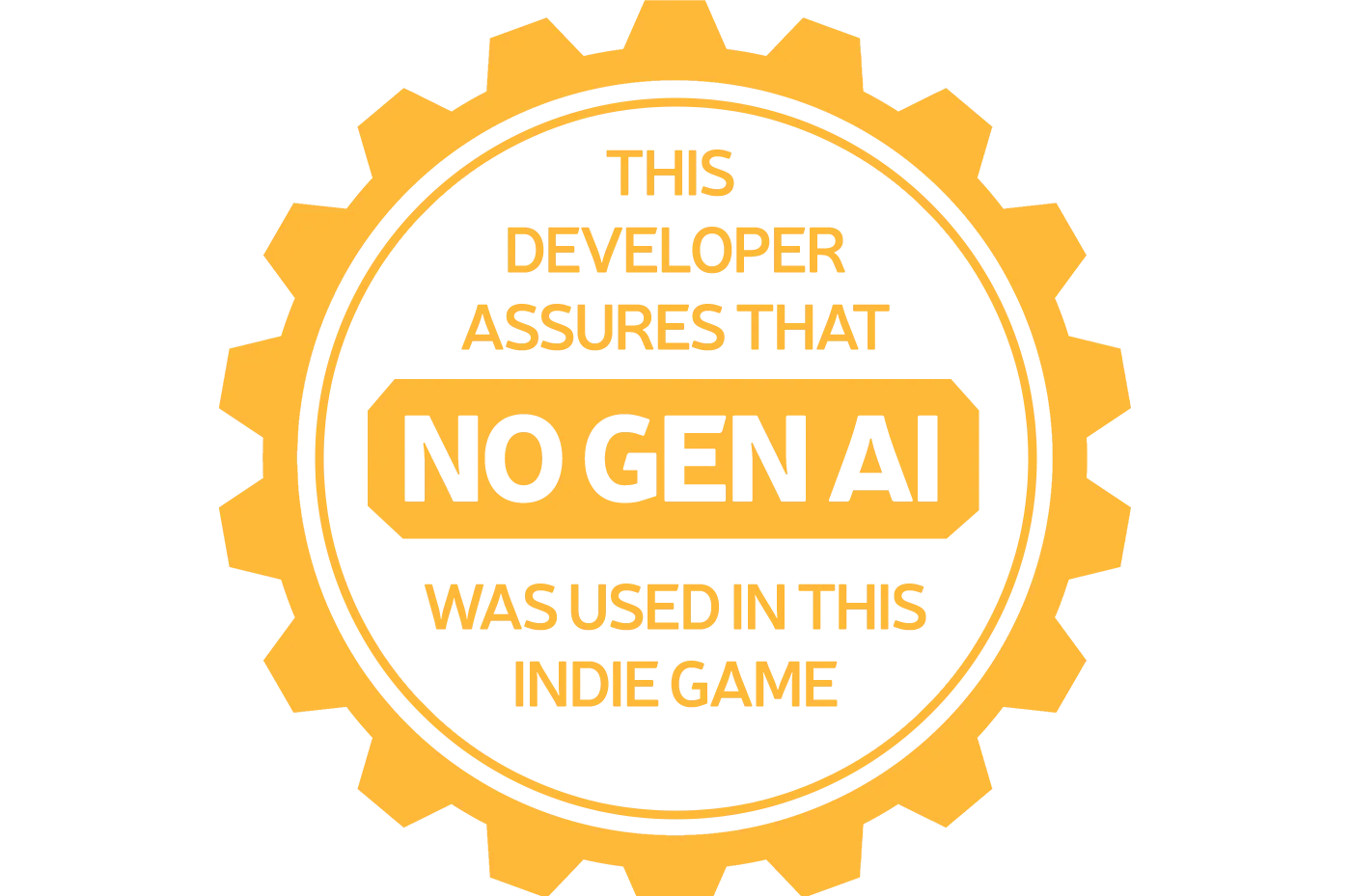 >
>
Some devs are crafting personalized anti-AI declarations.
D-Cell Games, for their upcoming title Unbeatable, states: “Absolutely everything in Unbeatable was created by human beings without any generative assistance.” Their graphic emphasizes the human element: every frame, word, model, line of code, song – flaws and all.
Jeffrey Chiao from D-Cell Games views GenAI as a waste. His team achieves their quality standards without it. This isn’t merely about ethics; it’s about creative control.
Proponents portray GenAI as unlocking creative potential, speeding up game development. EA is partnering with Stability AI. Microsoft leverages AI to generate gameplay. The lure of efficiency is strong.
Ubisoft’s CEO, Yves Guillemot, sees GenAI as revolutionary as the shift to 3D. Their Neo NPCs use GenAI for conversations, while Ghostwriter produces dialogue snippets. Krafton, publisher of Subnautica 2 and PUBG, is pushing an “AI-first” reorganization. GenAI assets appear in Call of Duty: Black Ops 6, Anno 117: Pax Romana, The Alters, The Finals, Arc Raiders, and InZoi, among others.
Game development budgets are rising, release timelines lengthening. GenAI becomes an attractive solution. This especially applies to the indie space, where funding is scarce. Indies are forced to wear multiple hats. Still, the strongest resistance originates from those who could ostensibly benefit most. It seems counterintuitive, right?
Kanaris-Sotiriou thinks indie constraints fuel creative solutions.
Tom Eastman from Trinket Studios, maker of Battle Suit Aces, agrees. He argues that the very problems GenAI seeks to fix are what make game development satisfying. He recalls during Battle Chef Brigade’s development, unfinished art pushed the team to use watercolors instead of their usual line art. These creative pivots, not “magic box” solutions, are what matter.
The developers I have listened to understand the pressure to adopt GenAI will only grow as the tech progresses. They also recognize the resonance of their anti-AI stance with their players.
Chiao notes that while GenAI will likely become ubiquitous, the core desires of their audience will remain unchanged. Therefore, they’ll stick to their methods, because, honestly, it’s more enjoyable.
This debate isn’t just about technology. It touches upon creativity, ethics, and the very soul of game development. The indie scene, often overlooked, might just be holding the line. They are demonstrating the power of human creativity, even when faced with the allure of AI-driven efficiency. In any case, their actions speak volumes. They are gambling that players value the human touch as much as they do. It is a bet that could define the future of indie games.

![[post_title]](https://samony.com.ng/wp-content/uploads/2025/12/1764666684_Lucy-Dare-has-spoken-about-her-battle-with-Crohns-disease-300x200.jpeg?lm=692EAD3F "Closing the Crohn’s Gap: From Diagnostic Bias to Patient-Centered Care")

![[post_title]](https://samony.com.ng/wp-content/uploads/2025/12/1764665117_Liz-Hurley-looks-25-in-teeny-string-bikini-as-she-300x158.jpg?lm=692EA720 "Liz Hurley’s Bikini Pics: What’s the Real Story With “Ageless” Beauty?")
![[post_title]](https://samony.com.ng/wp-content/uploads/2025/12/1764664559_Noni-Maduekes-damaged-relationship-with-Chelsea-star-after-Arsenal-incident-300x158.jpg?lm=692EA4F2 "Madueke’s Homecoming: Rivalry, Loyalty, and Football’s Shifting Sands")

![[post_title]](https://samony.com.ng/wp-content/uploads/2025/12/Helicopter-Vehicle-Used-For-Kidnapping-In-Catholic-School-In-Niger-300x169.jpeg?lm=692E5EF9 "Decoding Banditry’s Ascent: The Helicopter is a Symptom, Not the Disease")

![[post_title]](https://samony.com.ng/wp-content/uploads/2025/12/1764667822_Australia-dealt-Ashes-blow-as-star-is-ruled-out-of-1024x683.jpg?lm=692EB1B1 "Khawaja Injury Throws Australia’s Ashes Strategy into Turmoil")

![[post_title]](https://samony.com.ng/wp-content/uploads/2025/12/1764666684_Lucy-Dare-has-spoken-about-her-battle-with-Crohns-disease-1024x683.jpeg?lm=692EAD43 "Closing the Crohn’s Gap: From Diagnostic Bias to Patient-Centered Care")