The question of how to address a Yoruba king has recently come to the forefront following a stern warning from Oba Oloyede Adekoya Akinghare II, the Arujale-Ojime of Okeluse Kingdom. At just 22 years old, having ascended the throne at 16, Oba Akinghare II is the youngest monarch in Yoruba land. His palace has firmly stated that informal greetings like “bro” or “my blood” are unacceptable, emphasizing the paramount importance of respecting the regal title and the institution it represents. This directive highlights a crucial aspect of Yoruba culture and the enduring reverence for its traditional rulers.
Oba Akinghare II’s journey to the throne began in 2020 after the passing of his father, a testament to the deep-rooted hereditary nature of traditional leadership in Nigeria. Despite his youth, the monarch embodies centuries of tradition and authority. His recent graduation from secondary school in 2022 further underscores the unique position he holds, bridging the gap between ancient customs and contemporary life. The palace’s call for proper decorum, including specific guidance on how to address a Yoruba king, is not merely about personal preference but about upholding the dignity of the crown.
The warning issued by Prince Adefemi Olorunfemi, Chief of Staff to the monarch, underscores the growing need to educate the public on what is a Yoruba monarch’s title and the appropriate forms of address. Using casual or demeaning expressions like “bro” or “blood” diminishes the sacred office of an Oba. This stance reinforces the protocol that demands “His Royal Majesty” be used at all times, irrespective of social standing, age, or prior relationship. Such a firm measure aims to prevent further erosion of cultural respect.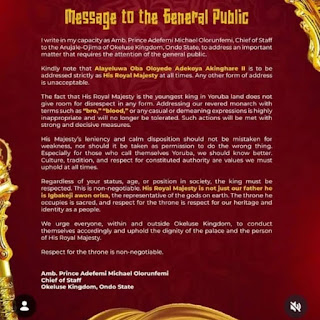
What is the proper way to address a Yoruba king? The answer is that a Yoruba king, or Oba, should always be addressed as “His Royal Majesty” (HRM) or “Kabiyesi,” a revered Yoruba term signifying “one who cannot be questioned.” These titles convey the utmost respect for their sacred position and the ancestral authority they embody within the community.
The historical significance of Yoruba Obas extends far beyond their administrative functions. They are seen as spiritual custodians, direct descendants of Oduduwa, the progenitor of the Yoruba people. Understanding this lineage is key to appreciating the deep cultural importance of a Yoruba culture etiquette guide, which often includes detailed instructions on how to address a Yoruba king. Their roles encompass maintaining peace, presiding over cultural festivals, and serving as a moral compass for their communities, solidifying their position as vital figures in society.
The call for respect for Nigerian traditional rulers is a reflection of a broader societal expectation. This includes understanding how to address a Yoruba king and other traditional leaders with appropriate deference. Across Nigeria’s diverse ethnic groups, traditional leaders hold significant sway and are often seen as bridges between the government and the populace. Their counsel is sought on matters ranging from land disputes to community development. Therefore, the way they are addressed is not just a formality but a recognition of their authority and the cultural heritage they represent.
When considering a Yoruba Oba vs Emir, one observes distinct cultural nuances in their roles and forms of address, yet both command immense respect within their respective domains. While Obas are primarily found in the southwestern Yoruba-speaking regions, Emirs lead in the northern Hausa-Fulani states. Both are powerful traditional figures, but the specific titles and cultural practices surrounding their address differ, highlighting Nigeria’s rich tapestry of traditional governance.
The unique position of Oba Akinghare II also brings to light the challenges faced by young monarchs. They must navigate modern education and global influences while strictly adhering to ancient traditions and expectations. This can sometimes lead to situations like the recent Oba Akinghare news, where a younger generation’s casualness clashes with established royal protocol. Balancing youth with the gravitas of the throne is a delicate act requiring both wisdom and firmness.
In an increasingly globalized world, the need for a comprehensive Yoruba culture etiquette guide becomes even more pronounced. Such a guide would serve as an invaluable resource for both indigenes and visitors, clarifying expectations regarding interactions with traditional rulers, including specific guidance on how to address a Yoruba king, elders, and community members. It would help bridge cultural gaps and ensure that ancient customs of respect are not lost amidst contemporary societal shifts.
Looking ahead to Nigerian traditional rulers 2026, there is an ongoing conversation about the evolving role of these institutions in a democratic society. While they no longer hold direct political power, their cultural and moral authority remains significant. Future discussions will likely focus on how traditional leaders can continue to contribute to community development, peacebuilding, and cultural preservation, adapting to modern challenges while maintaining their historical essence.
The Yoruba kings latest update regarding proper address serves as a timely reminder of the enduring power and influence of these revered figures. Such pronouncements often spark broader conversations about cultural identity, the importance of tradition, and the respect owed to those who embody the heritage of a people. Understanding how to address a Yoruba king correctly is fundamental to this respect. It reinforces the idea that cultural norms, particularly those surrounding leadership, are not static but require active reinforcement.
The distinction between a traditional ruler vs political leader Nigeria is crucial for understanding the country’s governance structure. While political leaders derive their authority from elections and constitutional mandates, traditional rulers draw theirs from heritage, ancestral lines, and cultural consensus. Although their functions are separate, they often collaborate on community issues, demonstrating the dual layers of leadership in many Nigerian societies.
A thorough understanding of what is a Yoruba monarch’s title goes