

![[post_title]](https://samony.com.ng/wp-content/uploads/2025/12/1766151171_Honda-wouldnt-even-be-in-top-10-without-mid-year-engine-1024x682.jpg?lm=69455406)
Honda’s impressive resurgence in the 2025 MotoGP season was critically dependent on mid-year engine upgrades, according to veteran rider Aleix Espargaro. He asserted that without these significant technical advancements, the Japanese manufacturer would not have secured a position within the top ten of the championship standings. This strategic advantage, facilitated by MotoGP’s concession system, allowed Honda to introduce crucial new components to its RC213V throughout the campaign, fundamentally altering its competitive trajectory.
As one of only two manufacturers benefiting from the most extensive allowances under MotoGP’s revised concession rules, Honda enjoyed a unique flexibility in development. This system permitted the brand to implement multiple engine upgrades during the season, a privilege denied to rivals such as Ducati, Aprilia, and KTM, whose engine specifications remained frozen from the start of the year. This regulatory framework proved instrumental in enabling Honda to address its performance deficits and enhance its machinery.
The impact of these developments translated into Honda’s most successful MotoGP season in several years. The team celebrated a memorable victory at the rain-affected French Grand Prix and secured coveted dry-weather podium finishes at circuits including Silverstone, Motegi, and Sepang. This strong performance culminated in Honda finishing fourth in the manufacturer championship with 285 points, a substantial improvement from the mere 75 points accumulated in the preceding year, and notably, ahead of its domestic competitor Yamaha.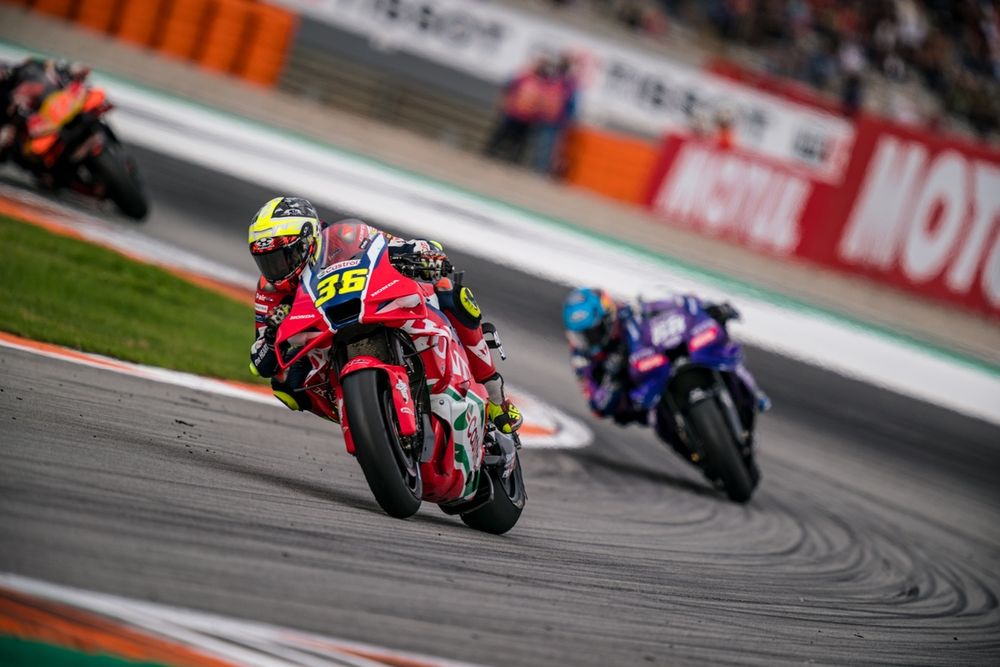
Aleix Espargaro, who joined Honda as a dedicated test rider after his retirement from active MotoGP racing, provided an insider’s perspective on the extensive development efforts. He lauded the team’s commitment, highlighting the “tons of material” introduced and the “hundreds of laps” he completed testing various configurations. Espargaro underscored the pivotal role of the test team, which enabled a rapid and continuous evolution of the bike over the crucial six-month period.
Espargaro specifically emphasized the transformative effect of the engine modifications. “We had three engine updates during the season, and the engine we have now is super fast,” he stated, drawing a stark comparison to rivals like Ducati, who faced restrictions on engine changes. He firmly believed that if factory riders Joan Mir and Luca Marini had competed with the engine specifications from the beginning of the season, they would have been unable to challenge for top-ten positions.
While LCR rider Johann Zarco delivered an early season highlight with his victory in France, the factory Honda team truly began to establish consistent front-running results after the summer break. A major in-season update significantly improved the fortunes of Mir and Marini, positioning them as regular top-five contenders from the Austrian Grand Prix onwards. This marked a clear turning point in their individual and collective performance.
For Joan Mir, the 2020 world champion, the latter half of the season represented a significant personal breakthrough. Since joining Honda in 2023, he had often struggled to find comfort with the RC213V, but the updated machinery allowed him to shine. Mir notably secured third-place finishes on Honda’s home turf in Japan and subsequently repeated this impressive result just weeks later in Malaysia, demonstrating a newfound synergy with his bike.
Mir attributed his improved performance to a holistic approach rather than a single component, acknowledging gains across multiple areas. “It was not a matter of one thing,” he explained, citing improvements in aerodynamics, engine performance, grip levels, and electronics, alongside a deeper understanding of the bike’s dynamics. This comprehensive development strategy was crucial in elevating Honda’s competitive standing.
Despite the multi-faceted improvements, Mir highlighted the specific impact of the updated engine’s delivery and character. He noted that these particular advancements worked exceptionally well for him, allowing him to distinguish his performance from other Honda riders due to his sensitivity to throttle control. Furthermore, he praised the enhanced front-end feeling, which contributed to better braking stability, bringing his confidence to a significantly improved level.

![[post_title]](https://samony.com.ng/wp-content/uploads/2025/12/1766151464_Anthony-Joshua-vs-Jake-Paul-ring-girl-is-perfect-model-300x158.png?lm=6945552B "Marissa Ayers: Rising Star and Ring Girl at Joshua-Paul Bout")
![[post_title]](https://samony.com.ng/wp-content/uploads/2025/12/Bangladesh-Violence-continues-after-youth-protest-leaders-death-300x169.jpg?lm=69455087 "Bangladesh: Media Outlets Attacked Amidst Ongoing Unrest")
![[post_title]](https://samony.com.ng/wp-content/uploads/2025/12/1766149667_Aitch-reveals-sweet-gesture-to-sister-after-Im-A-Celeb-300x158.jpg?lm=69454E25 "Aitch Fulfills Heartfelt Promise to Sister After Reality TV Stint")
![[post_title]](https://samony.com.ng/wp-content/uploads/2025/12/1766149615_Louvre-issues-major-update-after-staff-strikes-outside-museum.jpg?lm=69454DEF "Louvre Museum Reopens Amid Staff Disputes and Security Challenges")
![[post_title]](https://samony.com.ng/wp-content/uploads/2025/12/1766148466_9-Types-of-Insurance-You-Dont-Need-300x200.jpg?lm=69454974 "Navigating Insurance: Policies Consumers Often Do Not Need")
![[post_title]](https://samony.com.ng/wp-content/uploads/2025/12/Alleged-Christian-genocide-Terrorists-have-placed-a-bounty-on-my-300x150.jpg?lm=69454999 "Nigerian Cleric Alleges Terrorist Bounty Amidst Christian Massacres")

![[post_title]](https://samony.com.ng/wp-content/uploads/2025/12/Why-do-we-love-a-spooky-ghost-story-at-Christmas.jpeg?lm=69455331 "Christmas Ghost Stories: Unpacking the Psychology of a Festive Tradition")
![[post_title]](https://samony.com.ng/wp-content/uploads/2025/12/1766151464_Anthony-Joshua-vs-Jake-Paul-ring-girl-is-perfect-model-1024x538.png?lm=6945552C "Marissa Ayers: Rising Star and Ring Girl at Joshua-Paul Bout")
![[post_title]](https://samony.com.ng/wp-content/uploads/2025/12/Bangladesh-Violence-continues-after-youth-protest-leaders-death-1024x576.jpg?lm=69455087 "Bangladesh: Media Outlets Attacked Amidst Ongoing Unrest")
