

Manchester City’s recent 2-1 victory over Real Madrid at the Bernabeu has ignited discussions about their Champions League prospects, yet manager Pep Guardiola remains cautious. Despite securing a crucial away win against European football’s most decorated club, Guardiola underscored the necessity for significant improvement in the forthcoming knockout stages. This assessment comes as City, champions in 2023, grapple with an uncharacteristic unpredictability in their performances this season.
The triumph in the Spanish capital, typically a strong indicator of a team’s championship credentials, was met with Guardiola’s insistence that his side “have to play better” in the advanced rounds. This pragmatism follows their elimination by Real Madrid in the play-off round last season, a memory that undoubtedly tempers immediate celebrations. City now requires just four points to secure a direct path to the last 16, potentially avoiding a similar fate.
Beneath the surface of the scoreline, the match revealed moments of vulnerability. Real Madrid dictated play when leading 1-0, raising questions about City’s ability to recover from a larger deficit. Early struggles for makeshift full-backs, including Nico O’Reilly and Matheus Nunes, highlighted defensive gaps, with Rodrygo and Vinicius Junior exploiting their flanks. This contrasts sharply with Guardiola’s previous Champions League successes built on defensive solidity from repurposed centre-backs.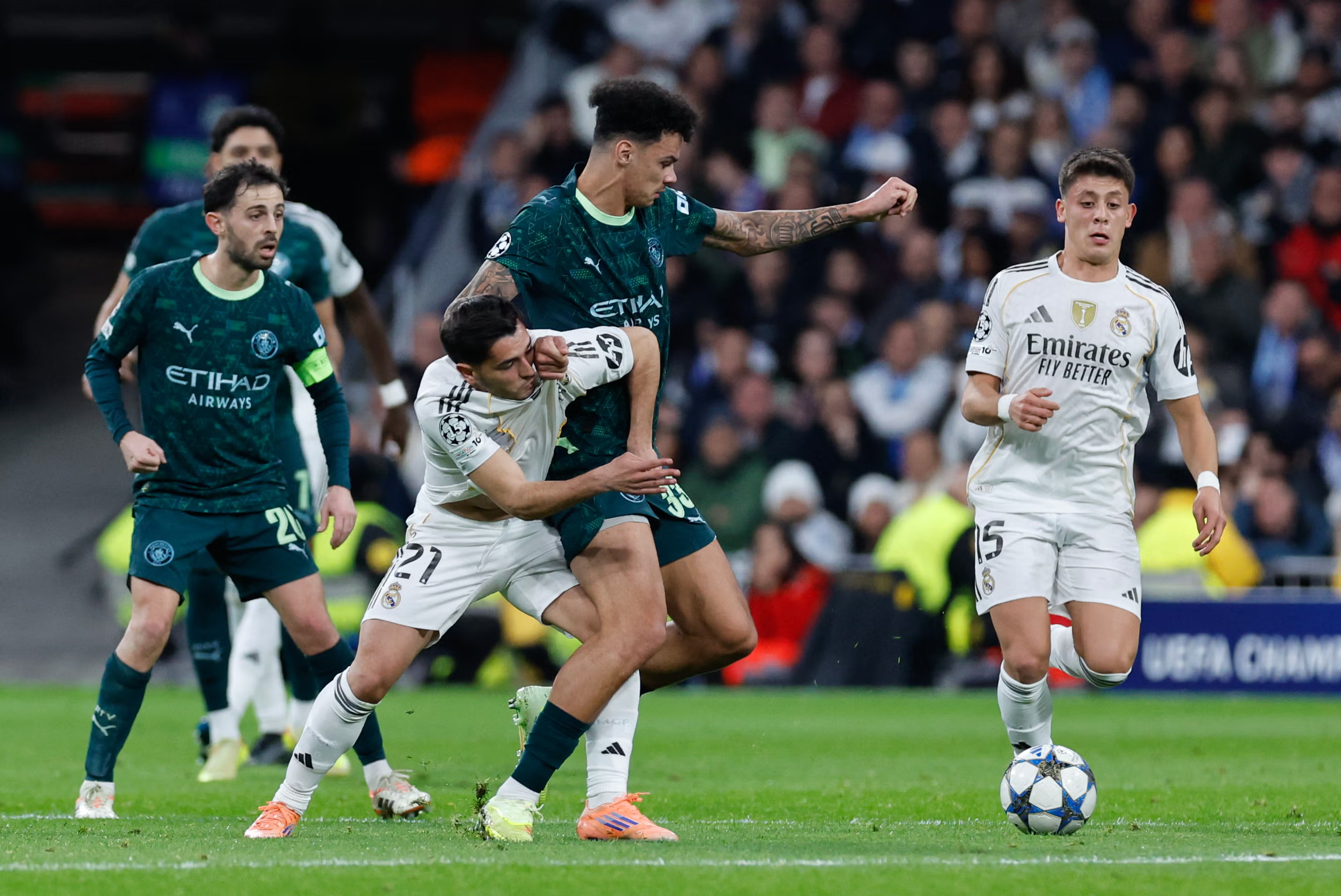
City’s defensive record this season further amplifies these concerns, with the team conceding 11 goals in their last six matches across all competitions. This period has seen them squander a two-goal lead against Leeds and ship four goals to Fulham, demonstrating a fluctuating resilience. While they withstood Real’s late pressure admirably, the overall trend suggests a departure from the disciplined control that defined their most dominant periods. This shift, while entertaining, raises questions about their ability to secure tight knockout ties.
A significant overhaul in City’s midfield has contributed to this altered dynamic. The departure of influential figures like Ilkay Gundogan and David Silva has left a void in ball retention and assured possession. New summer signings Rayan Cherki and Tijjani Reijnders, while offering dynamism as dribblers and runners, have not yet provided the same level of secure control. This creates a more attacking, yet less defensively robust, central unit, at times leaving players like Nico Gonzalez overworked at the base.
The team’s balance has also shifted with the impressive form of Jeremy Doku and the renaissance of Phil Foden, injecting fresh attacking impetus. However, this offensive focus sometimes comes at the expense of defensive stability, particularly when flying full-backs are more effective in attack than in recovery. This trade-off contributes to the entertaining spectacle of City’s play but diminishes their capacity to dictate the tempo of a game through sustained possession.
Despite these challenges, Manchester City possesses a formidable spine comprising proven Champions League winners. Key figures such as Erling Haaland, Phil Foden, Bernardo Silva, Rodri, and Ruben Dias have all lifted the coveted trophy with the club. Gianluigi Donnarumma, a European champion with Paris Saint-Germain, also adds to this experienced core, providing a foundation of elite talent amidst the newer, less seasoned players primarily found on the flanks.
The potential return and fitness of Rodri are considered pivotal to City’s ambitions. His absence has been keenly felt, underscoring his irreplaceable role in midfield. Guardiola’s optimism for improved performances in the spring knockouts likely hinges on Rodri being available and in Ballon d’Or-calibre form for the most critical matches. While Nico Gonzalez has emerged as a season highlight, he does not yet offer Rodri’s unique blend of defensive acumen and progressive play.
Erling Haaland remains another significant source of optimism for City. His prolific goal-scoring record in the competition this season is rivaled only by Kylian Mbappe, highlighting his immense individual threat. While simplistic to attribute wins solely to his presence, his absence, as seen in a loss to Bayer Leverkusen with a second-choice side, illustrates his profound impact and the team’s increased reliance on his clinical finishing.
This season’s Manchester City side appears closer to the competitive pack than in their previous dominant era, adding an element of unpredictability to their Champions League journey. Guardiola himself acknowledged that Real Madrid’s squad was hampered by injuries during their recent encounter, suggesting a potential rematch in the final would present a very different challenge. Real Madrid, more than City, have historically mastered the art of navigating the competition’s final stages.
Historically, City has often been lauded as the best team in Europe during seasons when they failed to secure the Champions League, sometimes losing out to Real Madrid. Currently, the perception is that they may not hold the undisputed title of Europe’s premier side, or even rank among the top few. Yet, their ability to defeat Real Madrid in their own stronghold, despite their current inconsistencies, hints at their latent capacity to conquer the continent.
The journey ahead for Manchester City is thus poised on a knife-edge, balancing moments of brilliance with periods of vulnerability. Their unpredictability, while making for compelling viewing, ultimately poses the central question for their Champions League campaign: can Guardiola harness this dynamic energy into a consistent, winning formula when the stakes are highest? The answer will define their season.

![[post_title]](https://samony.com.ng/wp-content/uploads/2025/12/1765452152_A-Tax-Diversification-Strategy-for-Your-Retirement-Income-300x169.jpg?lm=693AA97A "Strategic Tax Diversification for Secure Retirement Income")
![[post_title]](https://samony.com.ng/wp-content/uploads/2025/12/1765451298_Top-10-acts-of-kindness-Brits-perform-to-spread-joy-300x158.jpg?lm=693AA623 "British Festive Generosity Peaks in December, Study Reveals")


![[post_title]](https://samony.com.ng/wp-content/uploads/2025/12/1765448672_5-Great-Ways-Volunteering-in-Retirement-Leads-to-a-More-300x200.jpg?lm=693A9BE1 "Volunteering in Retirement: Enhancing Well-being and Purpose")

![[post_title]](https://samony.com.ng/wp-content/uploads/2025/12/Sky-Sports-Darts-host-Emma-Patons-rumoured-romance-and-fan-1024x682.jpeg?lm=693AA8F6 "Emma Paton Leads Sky Sports Darts Coverage for World Championship")
![[post_title]](https://samony.com.ng/wp-content/uploads/2025/12/1765452152_A-Tax-Diversification-Strategy-for-Your-Retirement-Income-1024x576.jpg?lm=693AA97A "Strategic Tax Diversification for Secure Retirement Income")
![[post_title]](https://samony.com.ng/wp-content/uploads/2025/12/1765451298_Top-10-acts-of-kindness-Brits-perform-to-spread-joy-1024x538.jpg?lm=693AA624 "British Festive Generosity Peaks in December, Study Reveals")
