

Analyzing the Rising Frequency of Extreme Weather Events: A Critical Look at the Insurance Industry
The recent tornado damage in Houston, impacting over 100 homes, serves as another stark reminder of our escalating climate reality. Looking at the insurance industry, especially property and casualty (P&C), these events aren’t just headlines; they’re potential balance sheet breakers. We’ve seen patterns emerge. It is not merely about reacting to isolated incidents anymore; it is a question of adapting business models to a world where “unprecedented” becomes routine.
Initial reporting often focuses on the immediate aftermath – the property damage, the relief efforts, the human impact. Yet, digging deeper, one finds a complex web of interconnected challenges facing insurers. Are we really prepared?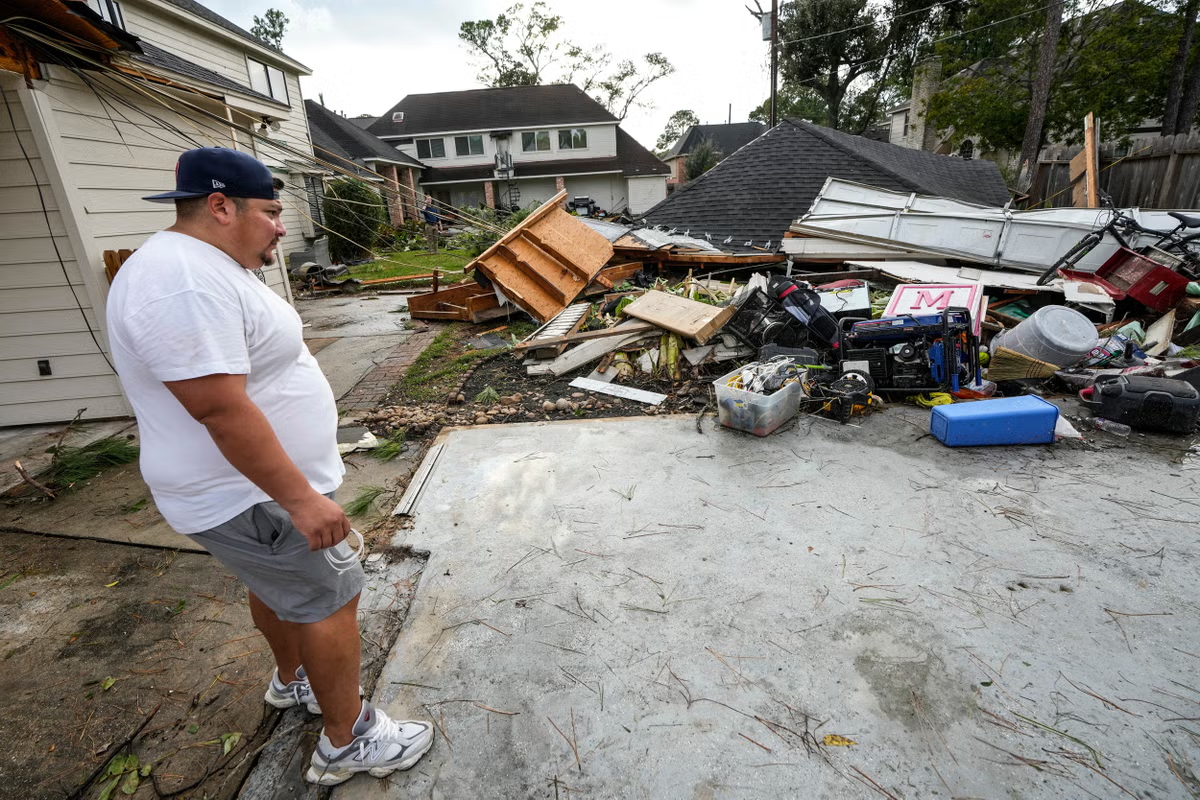 >
>
The Challenge of Predictability and Risk Modeling:
Traditional actuarial models rely heavily on historical data. But, increasingly, the past is no longer a reliable predictor of the future. The frequency and intensity of events such as severe storms, wildfires, and floods are outpacing these models. This creates a fundamental problem: accurately pricing risk becomes infinitely more difficult.
Consider the Houston tornado. While a tornado watch was issued, pinpointing the exact location and intensity remains challenging. This translates into potential underestimation of risk in the affected areas. It also casts doubt on the efficacy of current risk mitigation strategies. Better forecasting must happen.>
The Consequence: Shifting Insurance Landscapes:
What happens when insurers can’t accurately assess risk? Several responses emerge. One is increased premiums, effectively passing the cost onto policyholders. Another, more concerning trend, is the strategic withdrawal from high-risk areas. This leaves homeowners in vulnerable regions with limited or no insurance options, a situation already unfolding in some coastal communities.
We’re seeing this play out in real-time. Insurance companies are re-evaluating their exposure in regions prone to wildfires, hurricanes, and other extreme weather events. For example, some insurers are either drastically increasing premiums or outright refusing to renew policies in certain parts of California, Florida, and the Gulf Coast. The implications are far-reaching, potentially impacting property values, access to mortgages, and overall economic stability in those regions.
Technological Solutions and Their Limitations:
The industry is exploring technological solutions, such as advanced weather modeling, AI-powered risk assessment, and improved claims processing through drone imagery and satellite data. These offer some promise. Satellite imagery and drones can quickly assess damage after a storm, expediting the claims process and reducing costs. AI can assist with fraud detection and improve the accuracy of risk assessments.
Still, technology alone isn’t a panacea. The accuracy of weather models, for example, still faces limitations, especially when it comes to predicting localized, short-lived events like tornadoes. Data privacy concerns and the ethical implications of using AI in insurance also need attention.
The Need for Proactive Adaptation:
So, what can insurers do to adapt? Reactive measures, like raising premiums or withdrawing from high-risk areas, offer only short-term solutions. A more sustainable approach requires proactive adaptation. This means investing in:
Enhanced Risk Modeling: Developing more sophisticated models that incorporate climate change projections and account for non-linear changes in weather patterns. Resilience Building: Incentivizing policyholders to invest in mitigation measures, such as reinforcing homes against storms, improving drainage systems, and creating defensible space around properties. Public-Private Partnerships: Collaborating with government agencies and research institutions to share data, develop best practices, and fund resilience initiatives. Diversification: Reducing geographic concentration of risk by expanding into less vulnerable markets. Innovative Insurance Products: Exploring new types of insurance products, such as parametric insurance, that trigger payouts based on pre-defined weather events, rather than actual damage assessments. This offers faster and more transparent claims settlement.
Beyond Insurance: A Systemic Shift
The challenges facing the insurance industry reflect a broader systemic problem. Climate change is not just an environmental issue; it’s an economic one, a social one, and ultimately, a question of how we adapt our lives and infrastructure to a changing world.
I’ve observed that the insurance industry, despite its inherent conservatism, is becoming a key player in driving this adaptation. Insurers are uniquely positioned to influence behavior and incentivize resilience. After all, their bottom line depends on it.
Yet, the burden cannot fall solely on the insurance industry. Governments, businesses, and individuals all have a role to play in reducing emissions, building resilient communities, and mitigating the impacts of climate change. It is a collective responsibility.
Final Thoughts
The increasing frequency of extreme weather events like the Houston tornado demands a critical re-evaluation of how we understand and manage risk. The insurance industry is at the forefront of this challenge. While technology and innovative products offer some promise, proactive adaptation, coupled with broader systemic changes, is essential for building a more resilient future. The future calls for cooperation, innovation and planning.

![[post_title]](https://samony.com.ng/wp-content/uploads/2025/12/Setting-the-Record-Straight-On-The-Defamation-Case-Involving-Senator-300x150.jpg?lm=69348567 "Defamation in the Digital Age: Evidence Trumps Agitation")
![[post_title]](https://samony.com.ng/wp-content/uploads/2025/12/Allegations-baseless-entirely-untrue-Ex-Army-chief-Yahaya-on-links-300x200.jpg?lm=69348583 "Terrorism Financing Allegations: Separating Vendetta from Verifiable Facts")

![[post_title]](https://samony.com.ng/wp-content/uploads/2025/12/1765049341_How-pregnancy-is-being-criminalised-in-post-Roe-America-300x169.jpeg?lm=69348401 "Pregnancy Criminalized: America’s Post-Roe Reality")

![[post_title]](https://samony.com.ng/wp-content/uploads/2025/12/1765049531_George-Clarke-to-lose-place-in-Strictly-semi-final-as-worrying-300x158.jpg?lm=693484BF "Is George Clarke Doomed on Strictly? This TikToker’s “Jinx” Has Everyone Freaking Out")


![[post_title]](https://samony.com.ng/wp-content/uploads/2025/12/1765051311_Im-worried-Lady-releases-chat-with-Harrison-Gwamnishu-days-1024x535.jpg?lm=69348BB2 "Gwamnishu’s Arrest: Truth and Allegations")
![[post_title]](https://samony.com.ng/wp-content/uploads/2025/12/Setting-the-Record-Straight-On-The-Defamation-Case-Involving-Senator.jpg?lm=69348565 "Defamation in the Digital Age: Evidence Trumps Agitation")
![[post_title]](https://samony.com.ng/wp-content/uploads/2025/12/Allegations-baseless-entirely-untrue-Ex-Army-chief-Yahaya-on-links.jpg?lm=69348581 "Terrorism Financing Allegations: Separating Vendetta from Verifiable Facts")
