

Analyzing England’s Ashes Prep: A Critical Look Beyond the Headlines
England’s approach to preparing for the Ashes, specifically their decision to bypass the Prime Minister’s XI match in Canberra, has stirred up quite a debate. It’s tempting to immediately jump on the criticism bandwagon. Yet, taking a closer look reveals a more nuanced situation.
The core issue revolves around acclimatization: did England fumble by not giving their key players a chance to experience pink-ball cricket under lights before the actual Test? The surface-level answer appears to be yes. Any opportunity to get used to the pink Kookaburra seems valuable. >
>
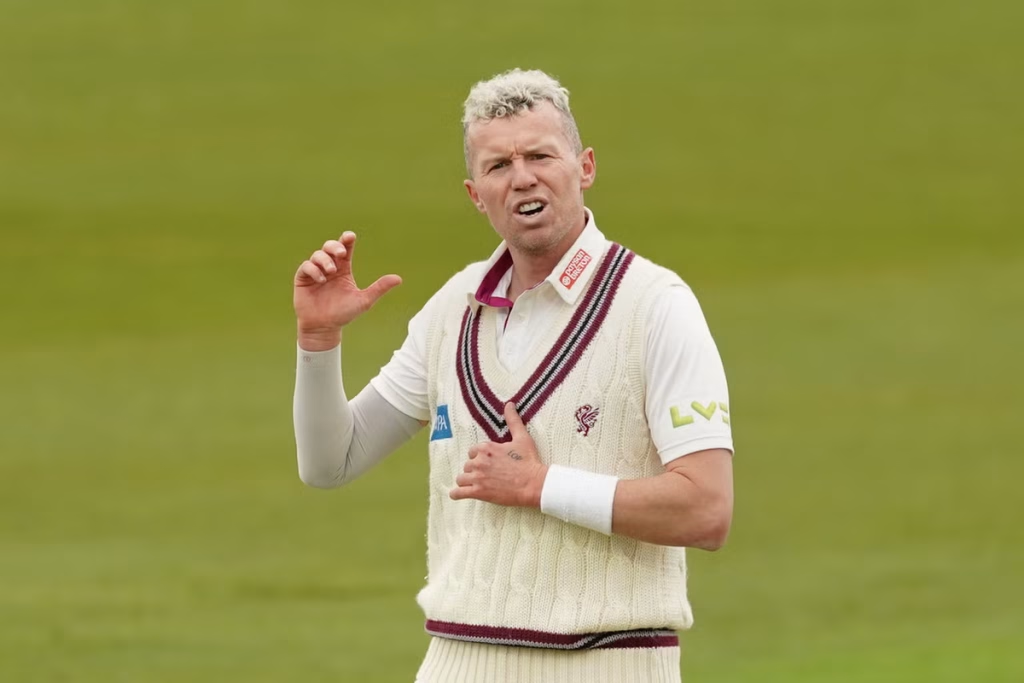
Still, Peter Siddle, an Australian veteran, raises a valid point. The conditions at Manuka Oval in Canberra don’t mirror those expected at the Gabba in Brisbane. We’re talking about potentially slow, low pitches versus the faster, bouncier tracks. So, how useful is practice in conditions that are dramatically dissimilar to those they will face? It is food for thought.
Stuart Law echoes that sentiment, emphasizing the potential detriment of adjusting to drastically different bounce levels. The risk is that players might develop habits that are counterproductive in the actual Test environment.
It is important to consider the context. These players aren’t machines; they’re coming off a long stretch of cricket, including a series in New Zealand for many. Fatigue, both mental and physical, is undoubtedly a factor. Is adding another potentially meaningless match the best way to prime them for the intensity of the Ashes? Maybe not.>
It’s tempting to assume that more practice is always better. This challenge is to figure out the right kind of practice that yields results. When I’ve seen teams prioritize rest and mental refreshment over grueling practice sessions, they often perform better. Perhaps England’s gamble is a similar calculation.
It’s worth noting the potential psychological aspect. England might be trying to project an air of confidence by downplaying the importance of a warm-up match. “We don’t need it,” they might be implying. Such tactics, while risky, can sometimes work wonders.
There are clear risks. England could be walking into the Gabba underprepared for the pink ball. However, there’s also a calculated logic behind their decision. They may want to minimize the risk of developing bad habits on a substandard pitch, and to guard against player burnout.
The criticism hurled at England hinges on a particular view of preparation: the more, the better. A contrarian perspective dares to suggest that targeted preparation, tailored to the specific challenges ahead, can be far more effective.
Analyzing this situation, I look to past trends. A team showing up battle-worn from endless practice often loses to a more nimble team with less time. The idea is that strategic preparation matters more than quantity.
Consider the financial implications. A full-strength team playing a warm-up match carries the risk of injury. An injury to a key player in a meaningless game can derail an entire Ashes campaign. Maybe this is a risk the England management wasn’t willing to take.
Given these facts, it is worth thinking about the alternative approach. They could have sent a second-string team to Canberra, allowing the first-choice players to rest and recuperate. Yet this comes with its own set of problems. A weak performance from the reserves might create a negative atmosphere. It’s a balancing act, to be sure.
This decision is not as cut and dried as some commentators might have you believe. Several competing factors exist, and the optimal strategy is far from obvious. There’s a case to be made that less is more.
To that end, only time will tell if England’s gamble pays off. However, dismissing their approach as sheer arrogance or incompetence is overly simplistic. A deeper analysis reveals a more complex calculation. It’s a risk, absolutely, but it’s a risk rooted in a specific understanding of the challenges they face and the resources at their disposal.

![[post_title]](https://samony.com.ng/wp-content/uploads/2025/12/1765855571_Seven-dead-after-Mexico-plane-crash-following-attempted-landing-on-300x158.jpg?lm=6940D154 "Seven Dead in Mexico Private Jet Crash During Emergency Landing")
![[post_title]](https://samony.com.ng/wp-content/uploads/2025/12/Year-end-festivities-push-monthly-inflation-to-4-month-high-300x184.png?lm=6940CFF3 "Nigeria Inflation Hits 4-Month High as Festivities Drive Food Prices")
![[post_title]](https://samony.com.ng/wp-content/uploads/2025/12/1765855365_Pellers-Benz-Crash-Linked-To-Carter-Efes-Rising-Fame-Man-300x128.jpg?lm=6940D087 "Peller Benz Crash Linked to Carter Efe’s Rising Fame")

![[post_title]](https://samony.com.ng/wp-content/uploads/2025/12/BudgIT-Urges-Transparency-As-FG-Defers-70-Of-2025-Capital-300x225.jpg?lm=6940CA2F "Nigeria’s FG Defers 70% Of 2025 Capital Projects To 2026")
![[post_title]](https://samony.com.ng/wp-content/uploads/2025/12/1765853378_NASCAR-US-news-How-NASCARs-new-charter-system-works-after-300x180.jpeg?lm=6940C8C4 "NASCAR Settles Antitrust Lawsuit, Grants Teams Permanent Charters")


![[post_title]](https://samony.com.ng/wp-content/uploads/2025/12/Roomba-Maker-iRobot-Files-for-Bankruptcy-and-Will-Go-Private-1024x683.jpg?lm=6940D347 "iRobot Files Bankruptcy, Cedes Control to Chinese Supplier")
![[post_title]](https://samony.com.ng/wp-content/uploads/2025/12/1765855571_Seven-dead-after-Mexico-plane-crash-following-attempted-landing-on-1024x538.jpg?lm=6940D154 "Seven Dead in Mexico Private Jet Crash During Emergency Landing")
![[post_title]](https://samony.com.ng/wp-content/uploads/2025/12/Year-end-festivities-push-monthly-inflation-to-4-month-high.png?lm=6940CFF1 "Nigeria Inflation Hits 4-Month High as Festivities Drive Food Prices")
