

![[post_title]](https://samony.com.ng/wp-content/uploads/2025/12/1764723204_Claudia-Black-Discusses-Star-Wars-Series-Season-2-More-1024x576.jpg?lm=692F8A05)
Claudia Black on “Ahsoka,” the Evolving Star Wars Universe, and Why Season 2 Didn’t Happen
Claudia Black, a name synonymous with genre excellence through roles in Farscape, Stargate SG-1, and video games like Mass Effect, recently dipped her toes into the Star Wars galaxy in Ahsoka. She portrayed the Nightsister Klothow, aligning with Grand Admiral Thrawn. Yet, what I find fascinating isn’t just another actor joining a franchise, but the shifts happening behind the camera that directly impact talent.
Black was set to reprise her role in Ahsoka season two. Then something changed.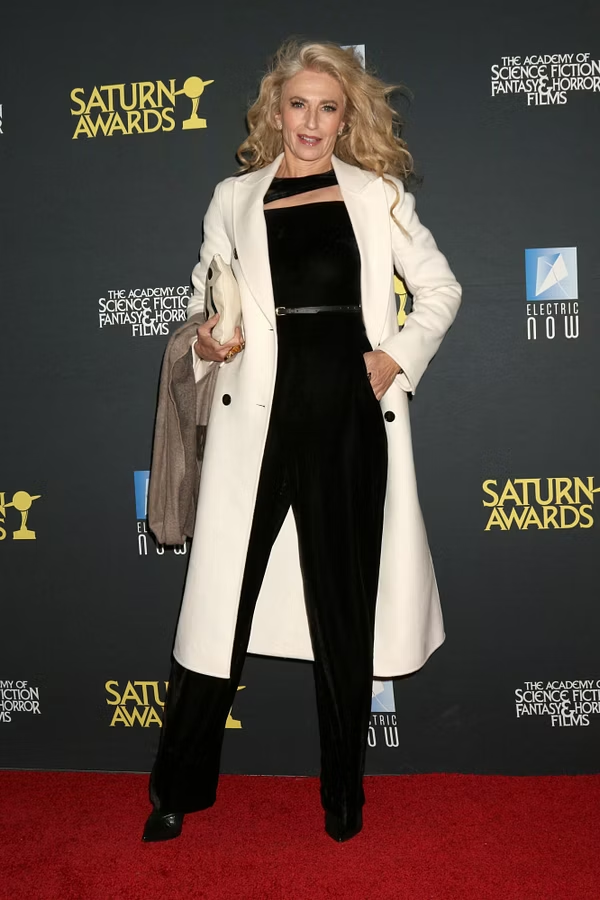 >
>
During a discussion about her upcoming project, Spartacus: House of Ashur, Black shared insights with Bleeding Cool about her experience as Klothow. She enjoyed working with Dave Filoni. She was intrigued by the cutting-edge technology used on set, “The Volume.” This technology allows for real-time background rendering, something George Lucas envisioned years ago. Her son’s enthusiasm for The Clone Wars added another layer of personal connection to the role.
It’s worth noting how “The Volume,” represents a real leap forward. It cuts down on location shoots and allows for more immersive performances. Still, even technological marvels can’t always overcome budgetary realities.
So, why no return for Ahsoka season two? >
>
Black was frank: Disney, while renewing her contract for season two, simply couldn’t meet her salary requirements. This wasn’t about ego or extravagant demands. As a single mother based in Los Angeles, filming in London presented logistical and financial hurdles that the offered compensation couldn’t clear. I understand where she is coming from. It’s a tricky balance.
This is where the narrative gets interesting. Black’s situation highlights a larger trend: the entertainment industry’s evolving economics. Streamers face pressure to cut costs, and even massive franchises aren’t immune. We’ve observed similar situations play out with other actors and shows, a quiet acknowledgment that even the Force can’t shield a project from financial realities.
She called it “show business” – 90 percent business, 10 percent show. That’s a sentiment I’ve heard echoed throughout my career. The financial aspect often dictates creative choices, and sometimes, talented individuals get caught in the crossfire. It is the ugly side of the beauty industry.
Black’s candor offers a rare glimpse behind the curtain. She acknowledged the market forces at play and the delicate state of the industry. “We all had to do our sums and move on,” she stated.
That statement resonates. Show business is experiencing what many industries are, and has to deal with the squeeze.
But here’s the brighter side. Black’s experience underscores the continuing appeal of the Star Wars universe. Her enthusiasm for the technology used on Ahsoka’s set and the joy she derived from sharing the experience with her son paint a picture of a franchise that still captivates, even amidst industry turbulence.
It also speaks to Dave Filoni’s influence. Filoni, a key figure in the Star Wars animated universe, has successfully transitioned characters and storylines into live-action. Black’s appreciation for his vision suggests a creative environment where actors feel engaged and valued.
Looking ahead, Ahsoka season two is slated for 2026. The storyline will continue, but without Klothow, and presumably, a revised narrative.
In any case, Black moves forward with Spartacus: House of Ashur, a different galaxy but a familiar territory for a performer who thrives in epic, character-driven stories. I believe this is a good thing, as sometimes these things work out for the best.
It’s tempting to view Black’s departure from Ahsoka as a setback. However, it’s more accurately a reflection of the entertainment industry’s complex ecosystem. It’s a reminder that even in the realm of Jedi and lightsabers, financial considerations and logistical constraints wield considerable power. Still, her brief but memorable turn as Klothow leaves a mark on the ever-expanding Star Wars saga.
Ultimately, this situation forces us to consider the sustainability of current production models. Studios need to balance creative ambition with financial responsibility, while ensuring that talent receives fair compensation. We cannot have a “show” without talent. Only time will tell how these dynamics evolve, but Black’s story serves as a stark reminder of the challenges and compromises that often define the entertainment landscape.

![[post_title]](https://samony.com.ng/wp-content/uploads/2025/12/1764722359_Stocks-Bounce-Back-With-Tech-Led-Gains-Stock-Market-Today-300x201.jpg?lm=692F86BA "AI-Fueled Rally: Hope or Hype?")
![[post_title]](https://samony.com.ng/wp-content/uploads/2025/12/Court-Discharges-Michael-Adenuga-Of-N5Bn-Fraud.webp-300x169.jpeg?lm=692F8734 "Adenuga Cleared in N5 Billion Fraud Case: Implications for Nigeria’s Anti-Corruption Fight")

![[post_title]](https://samony.com.ng/wp-content/uploads/2025/12/Commissioner-commends-PREMIUM-TIMES-investigation-as-Ogun-Lagos-launch-joint-300x178.jpeg?lm=692F8398 "Nigeria Lead Crisis: Industrial Pollution Sparks Regulatory Action")
![[post_title]](https://samony.com.ng/wp-content/uploads/2025/12/The-Polaroid-Flip-my-favorite-retro-instant-camera-is-cheaper-300x156.jpg?lm=692F82B5 "Polaroid Flip: Instant Photography’s Future in Focus")
![[post_title]](https://samony.com.ng/wp-content/uploads/2025/12/Police-debunks-report-alleging-mass-kidnapping-at-Ngor-Okpala-axis-in-300x225.jpg?lm=692F7EF0 "Imo Kidnapping Report: Truth, Fear, and the Digital Age")


![[post_title]](https://samony.com.ng/wp-content/uploads/2025/12/1764722359_Stocks-Bounce-Back-With-Tech-Led-Gains-Stock-Market-Today-1024x686.jpg?lm=692F86BB "AI-Fueled Rally: Hope or Hype?")
![[post_title]](https://samony.com.ng/wp-content/uploads/2025/12/Court-Discharges-Michael-Adenuga-Of-N5Bn-Fraud.webp.jpeg?lm=692F8733 "Adenuga Cleared in N5 Billion Fraud Case: Implications for Nigeria’s Anti-Corruption Fight")
