

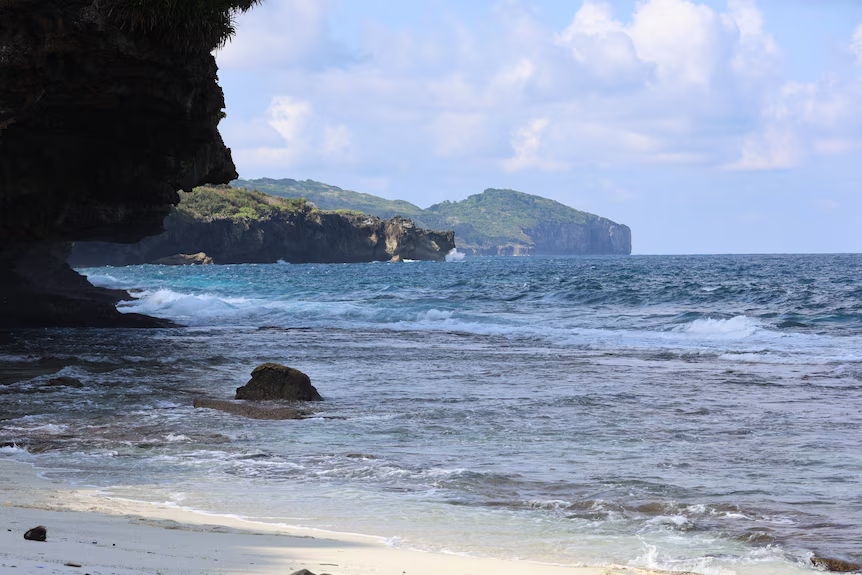
Christmas Island’s Greta Beach, a crucial nesting ground for endangered green sea turtles, is silently choking on a tsunami of plastic waste. For months each year, this remote paradise becomes a hazardous obstacle course due to tonnes of plastic debris washing ashore. Much of this rubbish is carelessly discarded by consumers thousands of kilometres away, creating a dire situation for marine life. The increasing waste makes nesting difficult for female turtles who struggle to find clear sand deep enough to incubate their eggs, often encountering sharp plastic, ropes, and discarded items. It is heartbreaking to witness their attempts to nest fail, leaving hatchlings struggling to reach the sea amidst mountains of unnatural objects that trap them. Community beach clean-ups are a constant battle, with thousands of kilos of plastic removed only to be replaced by the tides the next day, highlighting the insidious nature of this problem.
Lin Gaff, a volunteer with Island Care for 25 years, describes the situation as a “constant battle” for the turtles. She notes that most of their nesting attempts fail due to the overwhelming plastic. Even if eggs survive, the tiny hatchlings face a perilous journey over the rubbish to reach the ocean, with many not surviving the climb. The sheer volume of debris is staggering; in 2025, the Tangaroa Blue Foundation collected 2.8 tonnes of rubbish from Greta Beach, more than double the amount from 2023. This waste is transported to the island’s inland rubbish tip, but the problem persists.
A study published in the Marine Pollution Bulletin revealed that the majority of the debris originates from Indonesia and Malaysia, with only a small percentage coming from Christmas Island or the Australian mainland. Despite this, the small community of 1,700 residents bears the burden of this endless tide of waste. It is a shared responsibility, even though the rubbish does not originate locally.
What is the impact of plastic pollution on Christmas Island’s turtles?
The impact of plastic pollution on Christmas Island’s turtles is devastating. Female turtles struggle to find suitable nesting sites, often encountering sharp debris that prevents successful egg incubation. Hatchlings face an arduous journey to the sea, navigating mountains of plastic that trap and kill them. The continuous accumulation of waste on Greta Beach makes it increasingly difficult for these endangered creatures to survive and reproduce.
Kyoto University Associate Professor Dr. Saskia Abrahms-Kavunenko notes that many people are shocked to learn about the extent of this problem on Australian territory. She contrasts the reaction to potential pollution in Western Australia with the reality on Christmas Island, emphasizing that this is an Australian issue. Gaff agrees that many Australians are unaware of the severity of the plastic crisis affecting the island.
Data collected between 2023 and 2025 shows that debris deposition on Greta Beach is 50 times higher than on the island’s famous Dolly Beach, likely due to Greta Beach’s surrounding cliff formations. Dr. Abrahms-Kavunenko’s research since 2022 highlights that visible plastic is just the tip of the iceberg, with microplastics posing a significant, less visible threat by absorbing and spreading chemicals throughout marine ecosystems.
Communities in Indonesia face challenges managing plastic waste due to overproduction, making it a complex global issue. This problem extends to neighbouring islands like the Cocos (Keeling) Islands and even as far west as the Seychelles, demonstrating the vast reach of Indian Ocean currents carrying plastic debris.
Dr. Abrahms-Kavunenko emphasizes the necessity of limiting plastic production and establishing a Global Plastics Treaty. However, recent international talks have stalled, leaving the future of such a treaty uncertain. Federal Environment Minister Murray Watt has acknowledged the detrimental impact of plastic pollution on islands and pledged increased investment in recycling infrastructure for small islands.
Christmas Island itself lacks recycling facilities, as its only local workshop ceased operations in 2023. Statistics from the Australian Marine Debris Initiative (AMDI) paint a grim picture: in 2025, 55,723 pieces of hard plastics, 4,404 plastic lids and caps, and 4,142 pieces of foam insulation were collected from Greta Beach during clean-ups. The types of debris vary, with foam insulation fragments increasing significantly between 2023 and 2024, and rubber thongs recently inundating the beaches.
Artist Cecile Williams finds inspiration in the variety of debris, using it to create artworks that tell a story about the environmental destruction. Fifteen-year-old student Inayah Sultan Syed, involved in marine debris audits at Christmas Island District High School, collected 846 kilograms of rubbish in one clean-up in 2025, likening it to a “full truck” that returned the next day.
Williams’ exhibition explores the contrast between the island’s unique nature and its pollution, aiming to raise awareness. She believes that the more people discuss the issue, the more it will resonate globally, highlighting the island’s ecological significance as comparable to the Galapagos Islands.
Tangaroa Blue organizes annual volunteer trips to the Indian Ocean Territories to collect data and clean beaches. Polystyrene, often from food freight boxes, is a common problem. These boxes break down into microplastics, harming marine life. To combat this, Tangaroa Blue created Christmas Island’s esky library, repurposing boxes, and trialling recyclable packaging alternatives. Green Space Tech utilizes these boxes for hydroponic systems, turning them into an opportunity to grow fresh produce.
Tanya Cross of Eco Crab Industries hopes to revive her plastic-recycling workshop, which transforms shredded plastic into items like bowls and coasters. She believes stopping the flow of plastic is the biggest hope for solving this complex problem. Island Care volunteers also educate the community on reusable alternatives. Gaff remains hopeful, inspired by the baby turtles, believing that efforts to clean the island and change consumption habits are worthwhile. It is a global problem that requires everyone’s participation.







