


Australian Prime Minister Anthony Albanese has confirmed that the recent mass shooting at Bondi Beach, which claimed 15 lives, appears to have been motivated by “Islamic State ideology.” The devastating attack on Sunday, occurring during the Jewish festival of Hanukkah, sent shockwaves across the nation, prompting an immediate and extensive security investigation. Mr. Albanese underscored the gravity of the situation, describing the underlying motivation as an “ideology of hate” that culminated in mass murder.
The perpetrators of the horrific incident were identified as Naveed Akram, 24, and his father, Sajid Akram, 50. Authorities reported that the pair allegedly pledged allegiance to the Islamic State during their rampage, with flags associated with the designated terror group reportedly discovered inside their vehicle. Sajid Akram was fatally shot at the scene by law enforcement, while Naveed Akram, critically injured, is now under police guard in hospital and is expected to survive to face potential criminal charges.
A critical detail emerging from the investigation is that Naveed Akram had previously been the subject of a six-month inquiry by the Australian Security Intelligence Organisation (ASIO) in 2019. This investigation focused on his suspected connections to a Sydney-based Islamic State terrorist cell, with two individuals he was associated with later being jailed. However, ASIO concluded at the time that there was no indication of any ongoing threat or likelihood of him engaging in violence, a decision now under intense scrutiny.
Prime Minister Albanese further clarified that while the Akrams were clearly driven by an extremist ideology, current intelligence suggests they acted alone. “There’s no evidence of collusion, no evidence that these people were part of a cell,” the Australian leader told the national broadcaster, ABC. This assessment indicates that despite the ideological motivation, there is no immediate indication of a wider, organised terrorist plot behind the attack.
The brutal attack resulted in the tragic deaths of 15 innocent individuals, casting a pall over the vibrant Sydney community. Among the named victims were Matilda, a “bright” and “joyful” 10-year-old girl, Eli Schlanger, a 41-year-old British rabbi, and Holocaust survivor Alex Kleytman, whose stories highlight the profound loss. Beyond the fatalities, at least 27 people remain hospitalised, with six in critical condition, battling life-threatening injuries.
The injured include two police officers, one of whom was identified as Constable Scott Dyson, who sustained serious injuries but is reported to be in stable condition. Their involvement underscores the immediate danger faced by first responders. In a testament to human courage, Ahmed al Ahmed, a 43-year-old fruit shop owner, emerged as a hero, bravely tackling one of the gunmen and disarming him despite being shot in the arm and hand.
Mr. al Ahmed’s selfless act, which he recounted as “going down to save people’s lives” after ambushing one of the attackers, has resonated deeply with the public. Over $1.7 million (£844,000) has been raised in his honour, reflecting national gratitude for his extraordinary bravery. His father, Mohamed Fateh al-Ahmed, expressed immense pride, stating, “My son is a hero, he served with the police and in the central security forces, and he has the impulse to protect people.”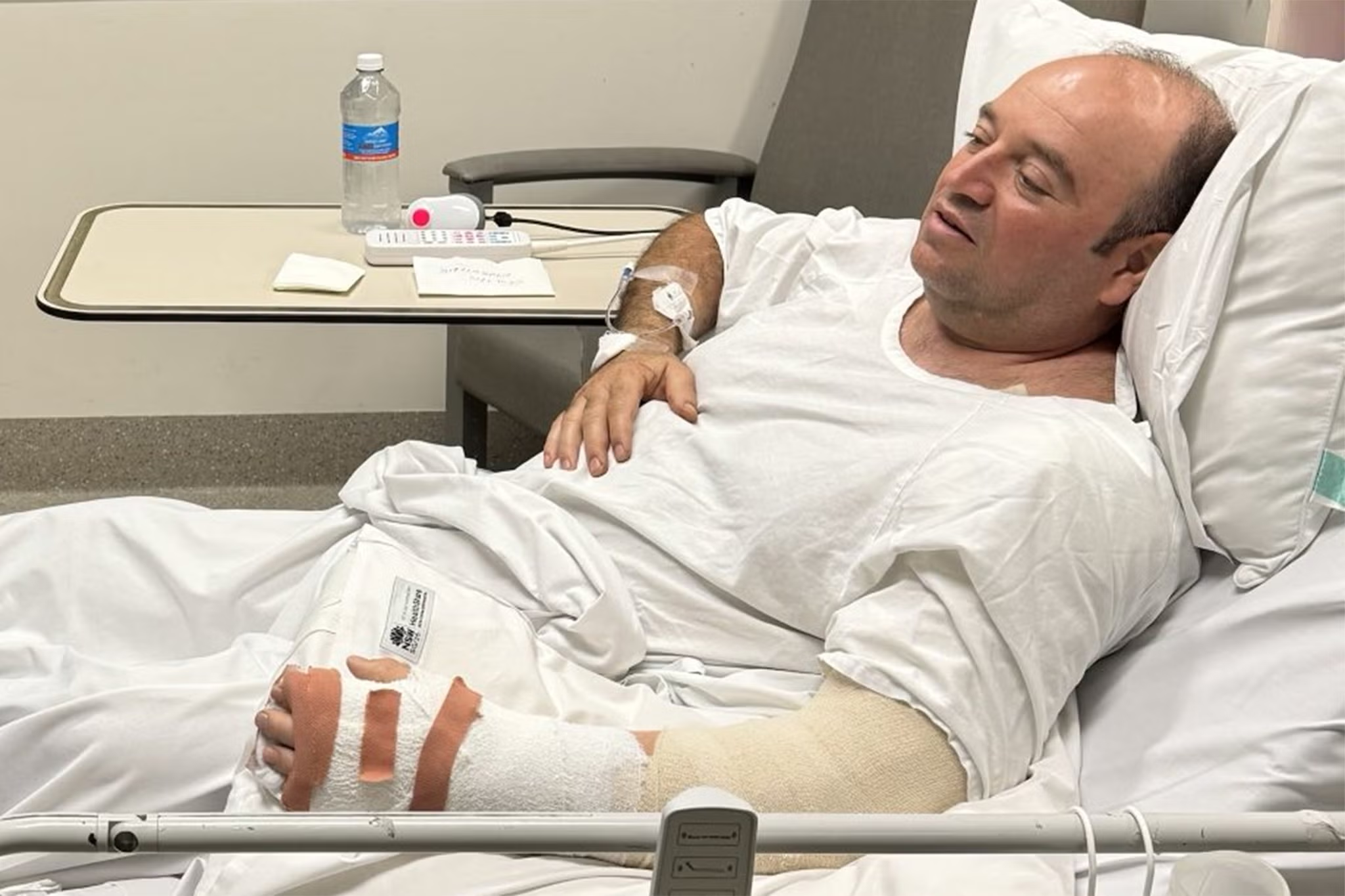
The tragic events have inevitably spurred an urgent re-evaluation of Australia’s existing gun laws. A significant point of concern is that Sajid Akram, one of the assailants, was a licensed weapons holder, possessing six registered firearms under a recreation category A/B license. This revelation has intensified calls for stricter regulations and oversight.
In response, Australia’s national cabinet convened and committed to “strong, decisive and focused action” on gun law reform as an immediate priority. Proposed actions include integrating criminal intelligence into the licensing process, imposing stricter limits on firearm ownership and certain types of guns, and mandating Australian citizenship as a prerequisite for obtaining a weapons license. These measures aim to prevent future tragedies and enhance public safety.
The international community has also reacted to the incident, with UK Labour leader Sir Keir Starmer explicitly describing it as an “appalling antisemitic attack.” He moved to reassure the Jewish community in the United Kingdom, pledging that authorities would take every possible step to ensure their safety and security. The attack serves as a stark reminder of the persistent threat posed by extremist ideologies and the importance of vigilance in safeguarding vulnerable communities worldwide.


![[post_title]](https://samony.com.ng/wp-content/uploads/2025/12/Breeding-logs-river-repair-and-restocking-keys-to-endangered-Mary-300x169.jpeg?lm=6940ADB0 "Mary River Cod Conservation Efforts Boost Survival Hopes")
![[post_title]](https://samony.com.ng/wp-content/uploads/2025/12/The-six-midlife-symptoms-that-could-put-you-at-high.jpg?lm=6940A9BE "UCL Study Links Midlife Depressive Symptoms to Future Dementia Risk")
![[post_title]](https://samony.com.ng/wp-content/uploads/2025/12/Funke-Akindeles-Behind-The-Scenes-crosses-N200-million-in-opening-300x160.png?lm=6940A7E3 "Funke Akindele Film Shatters Box Office Records")
![[post_title]](https://samony.com.ng/wp-content/uploads/2025/12/Supreme-Court-did-not-approve-dissolution-of-democratic-structures-under-300x171.png?lm=6940A4EA "Supreme Court Rejects Dissolving State Democracy During Emergencies")
![[post_title]](https://samony.com.ng/wp-content/uploads/2025/12/Ukraine-strikes-Russian-submarine-in-unprecedented-underwater-drone-attack.jpeg?lm=6940A64D "Ukraine Claims Drone Attack Disabled Russian Submarine")

![[post_title]](https://samony.com.ng/wp-content/uploads/2025/12/Raider-Nations-confidence-drops-heading-into-Week-15-1024x532.jpg?lm=6940B69A "Raiders’ Confidence Plummets Amidst Losing Streak, Pickett Takes Helm")
![[post_title]](https://samony.com.ng/wp-content/uploads/2025/12/Breeding-logs-river-repair-and-restocking-keys-to-endangered-Mary.jpeg?lm=6940ADAE "Mary River Cod Conservation Efforts Boost Survival Hopes")
