The world of augmented reality (AR) gaming is set to receive a significant boost with the official announcement of the groundbreaking Asus XREAL R1 gaming glasses. Unveiled at CES 2026, these innovative AR spectacles represent a strategic partnership between Asus and XREAL, aiming to redefine portable gaming experiences. Designed to seamlessly integrate with Asus’s popular ROG Ally handhelds, as well as a wide array of PCs and consoles, the R1 promises an immersive visual feast. This development follows Asus’s decision to terminate its Horizon OS headset project, signaling a clear shift in its extended reality (XR) ambitions towards more focused, gaming-centric AR solutions.
What are AR gaming glasses?
AR gaming glasses are wearable devices that overlay digital information, such as game interfaces, characters, or virtual screens, onto the real-world view of the user. Unlike virtual reality (VR) headsets that completely immerse users in a digital environment, AR glasses enhance reality by blending virtual elements with the physical world, creating a hybrid gaming experience.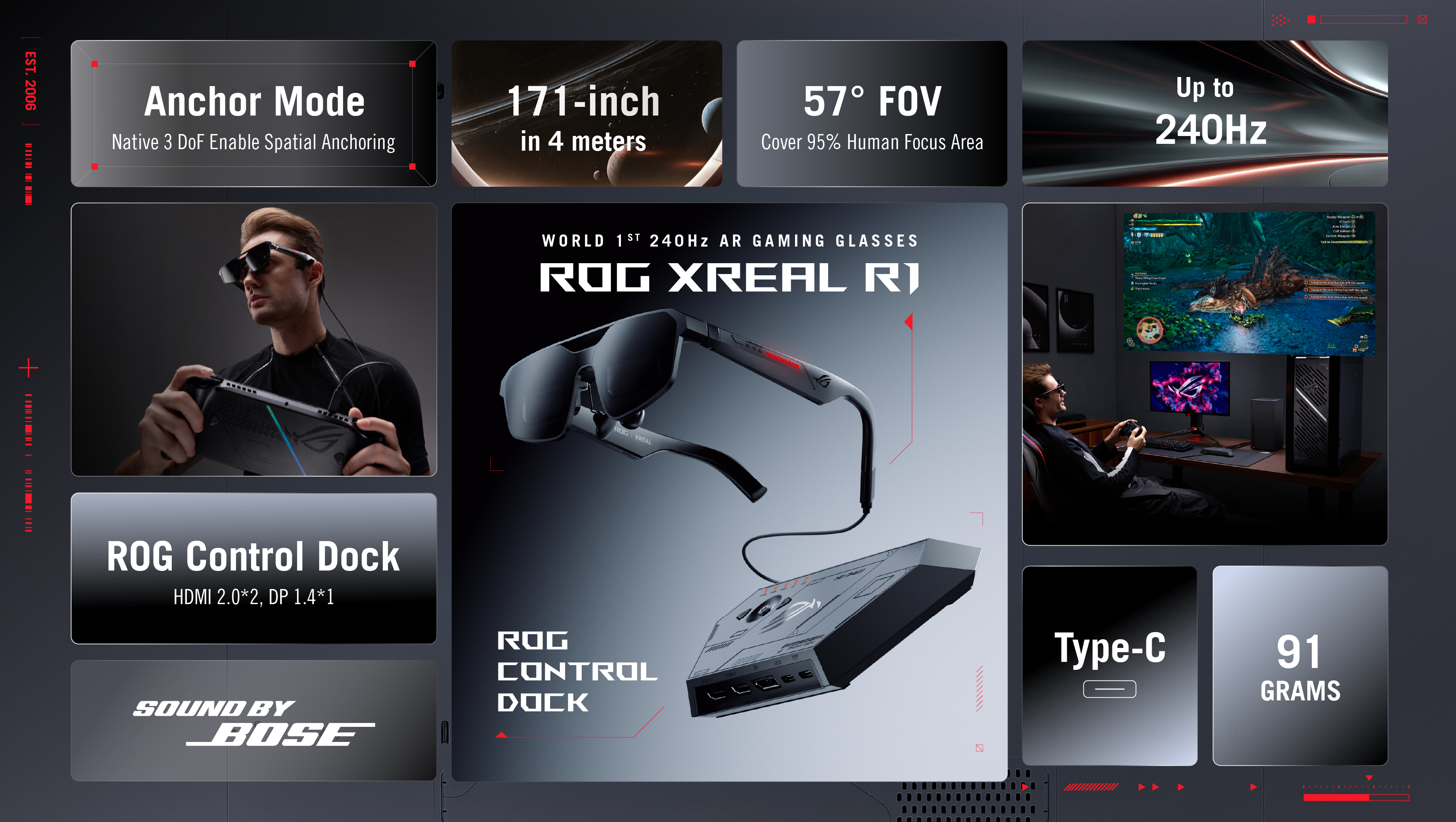
The Asus XREAL R1 gaming glasses boast an impressive set of specifications tailored for discerning gamers. At their core are full-HD (1,920 x 1,080) Sony 0.55-inch micro-OLED displays, delivering crisp visuals with a vibrant 700 nits peak brightness and a generous 57-degree field of view. These display characteristics, which align closely with the acclaimed XREAL One Pro glasses, suggest that the R1 will offer a crystal-clear image quality superior to many other smart specs available. For those keen on understanding the “XREAL R1 features 2026,” these high-fidelity screens are a standout.
How to connect AR glasses to PC, consoles, and handhelds is a crucial consideration for any gaming peripheral, and the Asus XREAL R1 addresses this with versatility. Users can directly connect the glasses to compatible devices, such as the ROG Ally, using a convenient USB-C cable, projecting a massive 171-inch virtual screen from just four meters away. Furthermore, the inclusion of the ROG Control Dock, featuring DisplayPort 1.4 and two HDMI 2.0 ports, allows for effortless switching between PC and console gaming with a single click. This makes them a strong contender for the “best AR gaming glasses for ROG Ally” users.
However, the most significant upgrade distinguishing these new Asus XREAL R1 gaming glasses is their phenomenal 240Hz refresh rate. This industry-leading refresh rate for wearable displays firmly plants the R1 in the ‘made for gamers’ category, ensuring an incredibly smooth and fluid frame rate essential for competitive and elite-level play. This high refresh rate significantly enhances the gaming experience, minimizing motion blur and providing a responsive visual feedback that discerning players demand.
Beyond the visuals, the Asus XREAL R1 gaming glasses also integrate premium audio and adaptive optics. They feature Bose-tuned audio, providing a rich soundscape that complements the immersive visuals, though headphones can always be used for enhanced privacy or audio fidelity. Additionally, the electrochromically dimmable lenses, a signature feature from XREAL, allow users to adjust the transparency of the lenses to suit various lighting environments, making the glasses suitable for both indoor and outdoor use.
While excitement builds, the exact pricing for the Asus XREAL R1 gaming glasses remains under wraps, with both XREAL and Asus yet to reveal the cost. Scheduled to ship globally in the first half of 2026, market analysts speculate a price point likely upwards of $649 / £579, based on their similarity to the XREAL One Pro. Those considering “XREAL R1 vs XREAL Air” will be eager to see how the pricing compares, especially given the R1’s enhanced gaming focus.
The announcement of the Asus XREAL R1 gaming glasses arrives amidst a backdrop of strategic shifts for Asus, particularly following the “Meta Horizon OS termination update.” This move signifies a clear pivot away from the broader, more general-purpose VR headset market, as represented by the Meta Horizon OS partnership, towards a specialized AR gaming niche that leverages Asus’s existing strengths in PC and handheld gaming hardware.
This decision suggests that “Asus AR glasses explained” as an ecosystem enhancement, rather than a standalone replacement for existing gaming platforms. Integrating AR glasses as an upgrade for devices like the ROG Ally makes more strategic sense for Asus than developing a full VR headset. This approach also subtly highlights the ongoing debate of “AR gaming vs VR gaming,” with Asus clearly staking a claim in the augmented reality space for its immediate future.
The absence of any mention of Android XR in the initial press release for the Asus XREAL R1 gaming glasses is notable, especially as XREAL has indicated future Android XR compatibility for its own specs. However, the proximity of XREAL to Android XR suggests that Asus might eventually explore this avenue, possibly through subsequent ROG-branded AR devices or even an in-house design. This exciting “Asus XREAL R1 news” could be just the beginning of a deeper dive into the AR world for Asus.
In conclusion, the Asus XREAL R1 gaming glasses represent a bold and focused step by Asus into the burgeoning AR gaming market. With their cutting-edge display technology, high refresh rate, and versatile connectivity, these glasses are poised to set a new standard for portable and immersive augmented reality gaming. As we look towards the “best gaming AR glasses 2026,” the R1 is undoubtedly a frontrunner, promising a transformative experience for gamers worldwide.