


The recent controversy surrounding the Alaafin rotational chairmanship in the Oyo State Council of Obas and Chiefs has ignited widespread discussion across Nigeria. This pivotal development emerged following Governor Seyi Makinde’s inauguration of the Olubadan of Ibadanland, Oba Rashidi Ladoja, as the council’s chairman. While the governorship initially suggested a rotational arrangement among the state’s three most prominent traditional rulers, the Alaafin of Oyo, Oba (Engr.) Abimbola Akeem Owoade I, swiftly rejected this proposition, asserting that his palace neither endorsed the rotation nor participated in any prior consultations on the matter. This stance has brought to light the intricate dynamics and historical precedents governing traditional leadership in the region.
What is rotational chairmanship in traditional councils? It is a system where the leadership of a council is periodically transferred among eligible members, typically on a fixed term or by agreement. This approach aims to ensure equitable representation and shared responsibility among powerful traditional rulers, preventing any single monarch from holding permanent sway over the collective.
The idea of a rotational chairmanship is often introduced to foster inclusivity and prevent the concentration of power, a principle sometimes favored in modern governance structures applied to traditional institutions. Such a system requires clear agreements and protocols among all participating monarchs and state authorities to function smoothly. Without consensus, as seen in the current Oyo State scenario, it can lead to significant friction and debate over protocol and historical rights.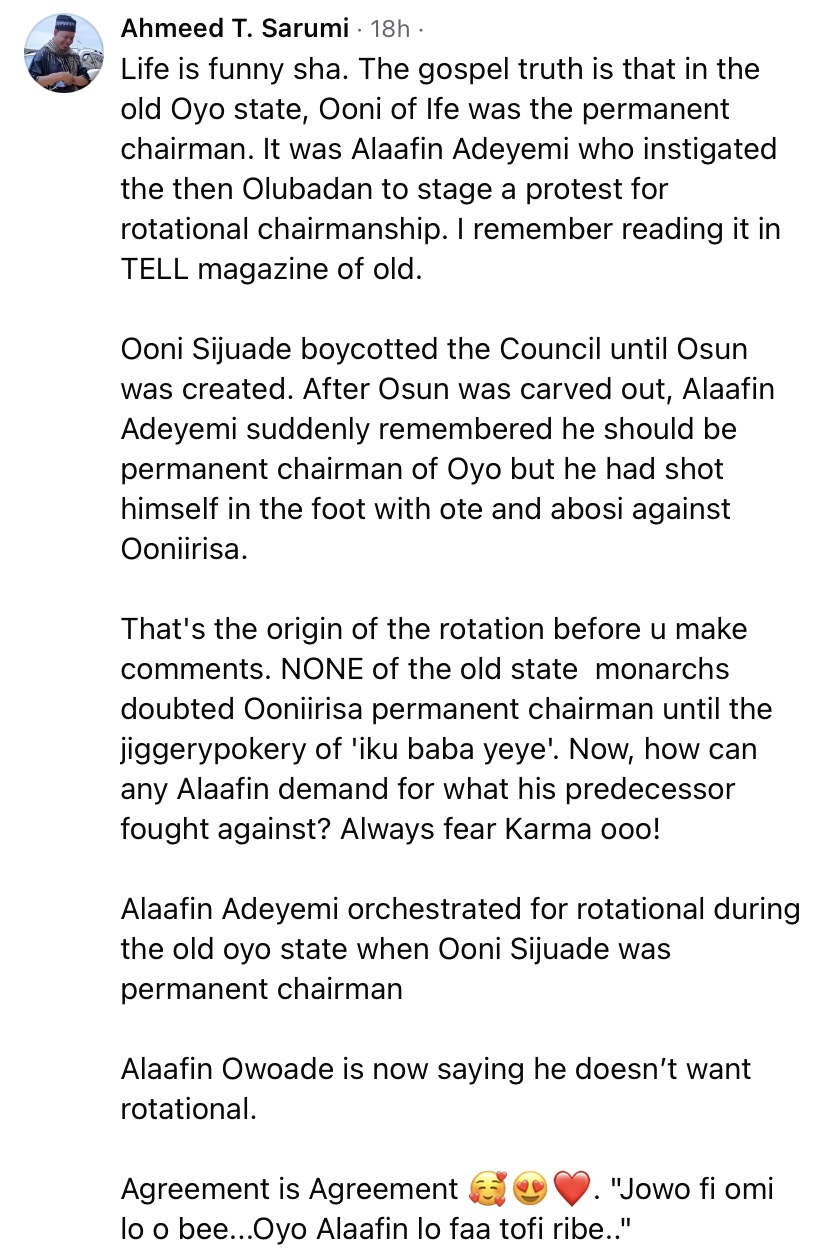
Governor Makinde’s decision to inaugurate the Olubadan of Ibadanland, Oba Rashidi Ladoja, as chairman marked a significant moment for the Oyo State Council of Obas and Chiefs. This move, intended to reorganize the state’s traditional leadership framework, was initially presented as a step towards a more inclusive governance model for the council. The Olubadan’s ascension to the chairmanship was widely reported, signifying a new phase in the council’s operations and interactions with the state government, emphasizing a potential shift from long-standing practices.
However, the swift and unequivocal rejection by the Alaafin of Oyo of the rotational arrangement introduced a major challenge. The Alaafin’s palace clarified that the monarch was not involved in discussions that led to the rotational decision, asserting that such a fundamental change to the council’s structure required extensive consultation and mutual agreement among all key stakeholders. This rejection underscores the deep-seated respect for tradition and the assertion of historical prerogatives held by the Alaafin, a revered figure in Yoruba land.
The historical context of this dispute is crucial for understanding the current tensions, especially concerning the Ooni of Ife vs Alaafin historical power. An elderly Nigerian man, Ahmeed Sarumi, provided compelling insights on Facebook, recalling that in the old Oyo State, the Ooni of Ife traditionally served as the permanent chairman of the council. Sarumi claimed that it was none other than Alaafin Adeyemi who, in an earlier era, instigated the then Olubadan to advocate for a rotational chairmanship, a move that now ironically stands in contrast to the current Alaafin’s position.
Sarumi’s recollection, drawing from historical accounts and publications like TELL magazine, suggests a complex legacy within the Alaafin lineage regarding the council’s leadership structure. His narrative highlights how previous Alaafins might have championed rotation when it served their interests, only for a successor to oppose it when it does not. This historical irony adds layers of complexity to the current Alaafin vs Olubadan council roles debate, making it more than just a contemporary political disagreement but a continuation of long-standing power dynamics.
Furthermore, Sarumi recounted how Ooni Sijuwade boycotted the council until the creation of Osun State, after which Alaafin Adeyemi reportedly sought to revert to a permanent chairmanship for Oyo. This historical maneuvering, if accurate, demonstrates the fluid nature of power and influence among traditional rulers over decades. It also provides a critical Oyo traditional council guide for understanding the intricate political calculations that have shaped these institutions.
Understanding how traditional councils work in Nigeria reveals that they are often a delicate balance of historical legacy, customary law, and modern governmental influence. These councils play significant roles in community cohesion, dispute resolution, and cultural preservation. Their leadership structure is therefore not merely ceremonial but deeply impactful on regional stability and traditional authority. Any changes to such structures must navigate both historical precedent and contemporary political realities.
For those interested in Nigerian traditional rulers for beginners, this incident serves as a prime example of the complexities inherent in their roles. It illustrates how the power and influence of monarchs are not static but are continually negotiated through historical claims, political alliances, and state interventions. The current Alaafin of Oyo news update further emphasizes that these institutions are living entities, constantly adapting, yet firmly rooted in their heritage.
The ongoing debate over the chairmanship, frequently featured in Oyo Obas Council latest news, has significant implications for traditional governance. It tests the boundaries of state authority versus traditional autonomy and highlights the need for clear, mutually agreed-upon frameworks for leadership succession within these vital institutions. The resolution of this issue will undoubtedly set a precedent for future interactions between traditional rulers and state governments across Nigeria, influencing how such councils operate in the years to come.
Ultimately, the discussion around the Alaafin rotational chairmanship is more than a local dispute; it is a microcosm of the broader challenges facing traditional institutions in a modernizing Nigeria. It forces a re-evaluation of historical agreements, customary practices, and the evolving relationship between traditional authority and democratic governance, underscoring the enduring power and influence of these revered monarchs in the nation’s social and political fabric.




![[post_title]](https://samony.com.ng/wp-content/uploads/2026/01/1768655301_Marquez-reveals-what-will-ultimately-cause-MotoGP-retirement-300x200.jpg?lm=696B89C8 "Why Marc Marquez’s Body Will End His MotoGP Career")





