The quest for effective and affordable warmth has driven human ingenuity for millennia. In an era where modern central heating systems often struggle with high energy costs and environmental concerns, exploring traditional heating systems offers invaluable insights. From ancient China to Korea and even Rome, our ancestors developed remarkably efficient methods to stay warm, lessons that hold significant relevance for today’s homeowners seeking sustainable and cost-effective solutions to heating their dwellings. Understanding these age-old techniques can illuminate new pathways to create comfortable living spaces without relying heavily on fossil fuels.
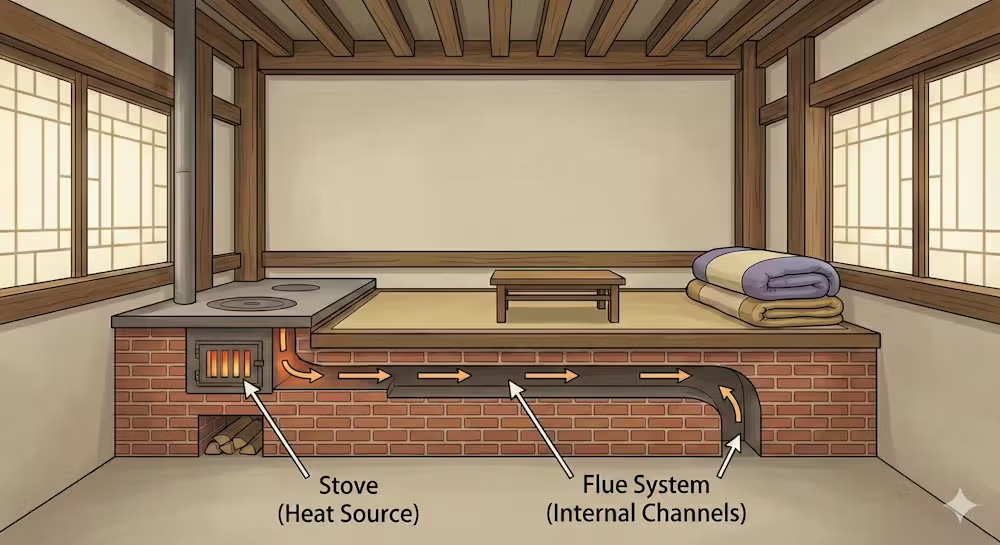
What is a Kang bed? A Kang bed is a traditional heated platform made of earth bricks, originating from northern China over 2,000 years ago. Connected to a family stove, hot air circulates underneath, warming the sleeping surface. This ancient heating system offers remarkable efficiency by localizing warmth and slowly releasing heat over many hours.
My earliest memories of winter in Harbin, a city where temperatures plunge to -30°C, involve waking up on a kang. This unique structure is less furniture and more an integral part of the building, a thick, raised slab connected to the kitchen stove. When the stove is lit for cooking, hot air travels through carefully designed passages beneath the kang, warming its entire mass. This ingenious design demonstrates a profound understanding of heat transfer and retention.
The magic of kang bed heating lies in its localized approach. Unlike conventional central heating, which attempts to warm the entire air volume of a home, only the kang surface itself is directly heated. People then warm themselves by lying or sitting on this radiant platform, often with thick blankets. Once warmed, the hundreds of kilograms of compacted earth slowly release heat over many hours, providing long-lasting comfort with minimal continuous fuel input. There are no pumps or radiators, and no energy is wasted heating empty rooms. Moreover, much of the initial heat is a byproduct of cooking fires, further enhancing its efficiency.
This philosophy of keeping heat close to the body and warming only essential spaces permeated East Asian cultures. In Korea, the ancient ondol system similarly channels warm air beneath thick floors, transforming the entire floor into a radiant heated surface. Japan developed the kotatsu, a low table covered by a heavy blanket with a small heater underneath, providing localized warmth for the legs and lower body. These systems represent clever heating solutions for cold climate heating.
Europe also possessed similar ingenious ancient heating guide principles. The Romans employed hypocausts, circulating hot air under floors to heat buildings. Medieval households used heavy tapestries to reduce drafts and enclosed sleeping areas to conserve warmth. These historical examples underscore a shared human understanding of intelligent thermal management long before the advent of modern fossil-fuel-intensive systems.
The widespread adoption of modern central heating in the 20th century marked a shift towards an energy-intensive paradigm: heating entire buildings to a uniform temperature. While convenient when energy was cheap, this model is unsustainable in an era of soaring energy bills and increasing climate change awareness. Many European homes, particularly in the UK, are poorly insulated, exacerbating the problem and leaving millions struggling to adequately warm their dwellings.
This highlights why understanding how to heat a home efficiently is more critical than ever. The lessons from systems like the kang and ondol demonstrate that true comfort does not necessitate consuming more energy. Instead, it arises from designing warmth more intelligently, focusing on radiant heat and localized comfort rather than blanket air heating. These methods offer compelling alternatives and complementary strategies to modern technologies like heat pumps.
For those seeking energy crisis heating solutions, revisiting these ancient practices provides a blueprint for resilience. By integrating principles of thermal mass, localized heating, and multi-functional heat sources, contemporary building design can move towards more sustainable heating methods. This approach not only reduces reliance on expensive fuels but also minimizes environmental impact, paving the way for truly energy efficient heating.
Ultimately, the wisdom embedded in traditional heating systems reminds us that innovative solutions often stem from looking back. By embracing the efficiency and ingenuity of ancient designs, we can forge a future where warmth is abundant, affordable, and environmentally responsible, ensuring comfortable homes for generations to come.