Intel has officially launched its new Core Ultra Series 3 CPUs, a significant development utilizing the company’s highly anticipated 18A manufacturing process. This new generation of processors is designed to enhance performance and efficiency for a wide range of computing tasks. The Core Ultra 3 chips adopt a sophisticated chiplet-based architecture, integrating multiple distinct silicon tiles onto a foundational base tile through Intel’s advanced Foveros packaging technology. The compute tile, which houses the CPU cores and the crucial neural processing unit (NPU), is a key component manufactured using the cutting-edge 18A process. This tile comes in two primary configurations, offering either a maximum of 16 CPU cores or 8 cores, catering to different performance needs.
The platform controller tile, responsible for managing most input/output operations, continues to be produced by TSMC. Similarly, the high-end 12-core version of the graphics tile is also sourced from TSMC. For a more budget-friendly graphics solution, a simpler four-core version of the graphics tile is manufactured using Intel’s established Intel 3 process, a technology previously employed for Intel’s Xeon server CPUs. This strategic use of different manufacturing processes allows Intel to optimize cost and performance across its product stack.
What is the 18A process? The 18A process is Intel’s next-generation manufacturing node, representing a significant leap in semiconductor fabrication technology. It is crucial for enabling the advanced features and performance of the new Core Ultra Series 3 CPUs, allowing for smaller, more power-efficient, and more powerful chips.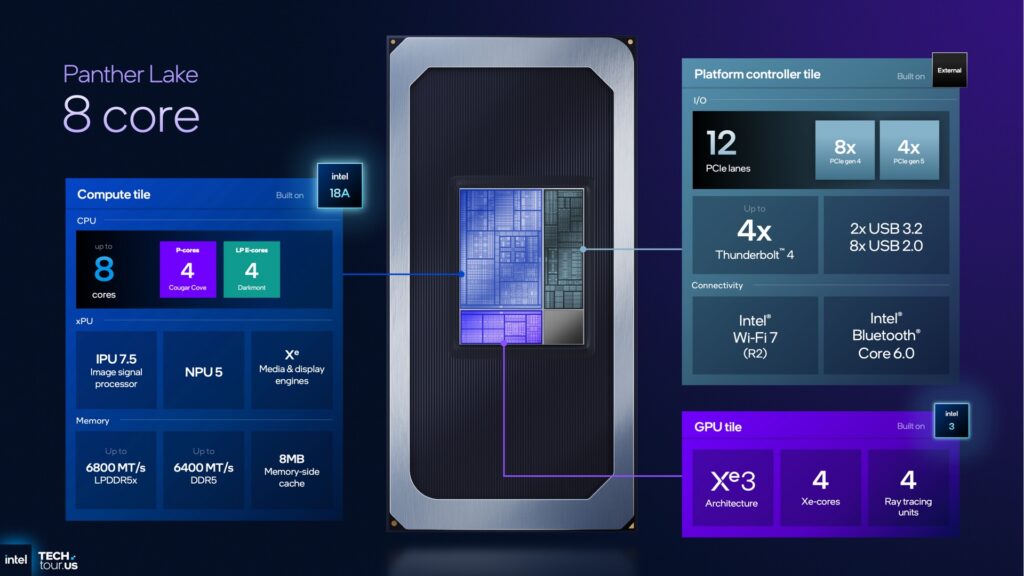
This innovative chiplet-based design enables Intel to create three distinct iterations of Panther Lake, the codename for these new chips. These configurations include a powerful combination of a 16-core CPU paired with a 12-core GPU, a slightly more balanced option of a 16-core CPU with a 4-core GPU, and a more power-efficient variant featuring an 8-core CPU and a 4-core GPU. Further variations within the Core Ultra Series 3 lineup are achieved by strategically disabling some CPU and GPU cores in these base configurations.
Intel is making bold performance claims for the top-tier Core Ultra Series 3 processors. They assert that these new chips can deliver up to 60 percent faster multi-core CPU performance when compared to the previous generation Core Ultra 200V chips. Furthermore, the integrated GPU performance is expected to see a remarkable improvement of up to 77 percent. These advancements promise a more responsive and capable computing experience for users.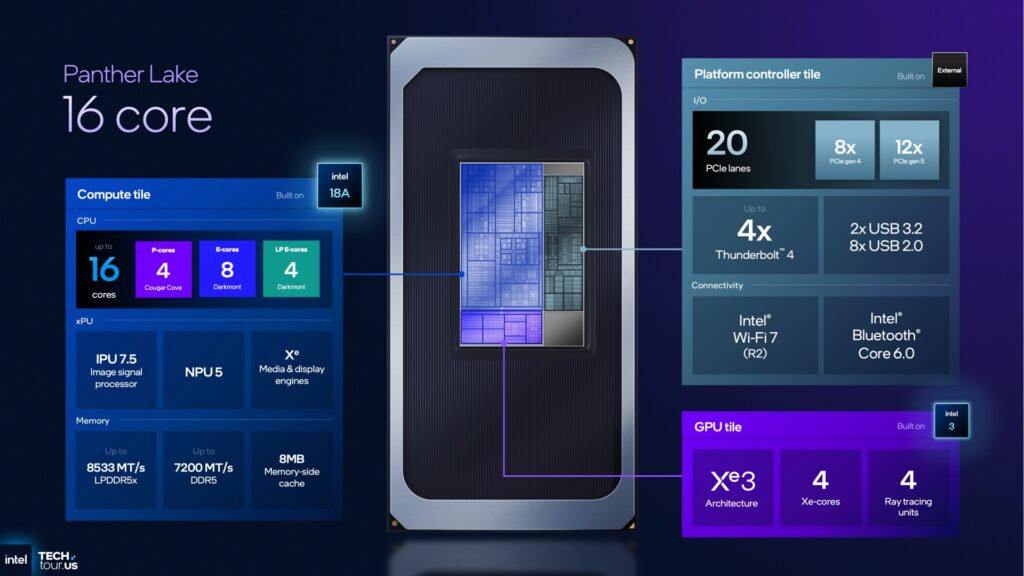
Intel also highlighted impressive battery life potential, citing a Lenovo IdeaPad reference design equipped with a Core Ultra X9 388H that managed to stream Netflix at 1080p for an extended 27.1 hours. While real-world battery life in consumer laptops will inevitably vary based on numerous factors like other system specifications and user settings, this figure indicates a substantial improvement in power efficiency.
All chips within the Panther Lake family will feature the same advanced neural processing unit (NPU). This NPU is capable of an impressive 50 trillion operations per second (TOPS). This level of performance is more than sufficient to meet Microsoft’s Copilot+ PC requirement of 40 TOPS, positioning these new CPUs favorably for the next wave of AI-enhanced computing. However, it does fall slightly short of the 60 TOPS claimed by AMD for its Ryzen AI 400 series and the 80 TOPS offered by Qualcomm’s Snapdragon X2 chips, indicating an ongoing race in the AI processing space.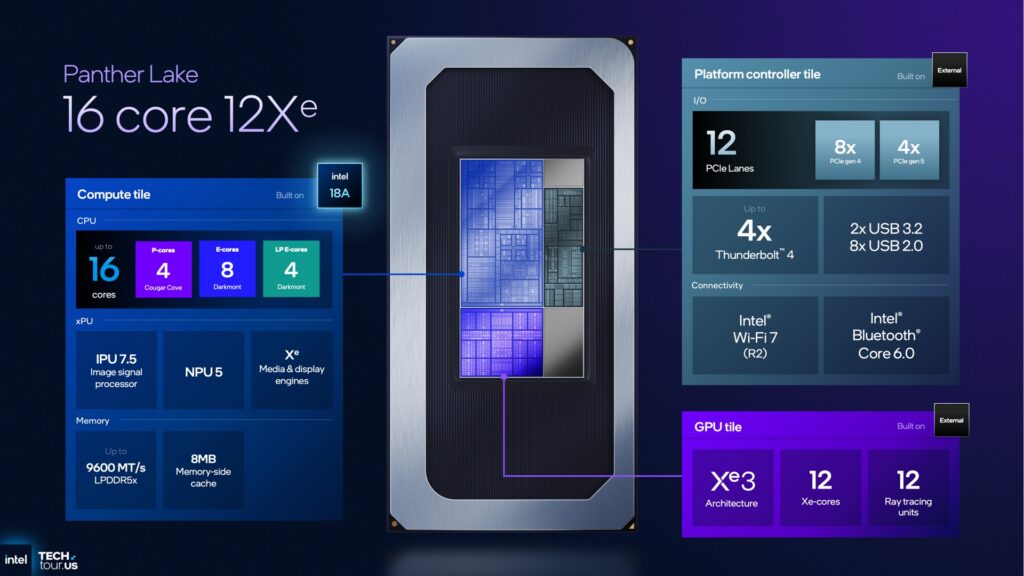
Connectivity is also a strong suit for the Core Ultra Series 3. These processors will support the latest Wi-Fi 7 standard and Bluetooth 6.0, ensuring rapid and reliable wireless communication. Additionally, they offer support for up to four Thunderbolt 4 ports, providing high-speed wired connectivity for a wide array of peripherals and external devices.
How does the Intel 18A process compare to TSMC’s nodes? The Intel 18A process is Intel’s entry into the most advanced semiconductor manufacturing nodes, aiming to compete with or surpass leading nodes from foundries like TSMC. Its development is critical for Intel’s strategy to regain manufacturing leadership and offer competitive performance and efficiency.
The launch of these Core Ultra Series 3 chips marks a crucial point for Intel. It remains to be seen whether this represents a sustained turnaround or a temporary resurgence amidst a history of manufacturing challenges. However, the timely release, only a month later than initially planned, suggests that Intel’s 18A fabrication facilities are operational. This opens the door for the company to pursue third-party chip manufacturing, a strategic initiative spearheaded by former CEO Pat Gelsinger nearly five years ago.
Is the Intel 18A process a game-changer? The successful implementation of the 18A process in commercial products like the Core Ultra Series 3 CPUs is a significant achievement for Intel. It demonstrates their capability to produce advanced chips and is a critical step towards their goal of regaining manufacturing superiority in the semiconductor industry.
Intel Core Ultra 3 vs. Core Ultra 200V: A Performance Leap
Intel’s new Core Ultra Series 3 CPUs, built on the 18A process, offer substantial performance gains over the outgoing Core Ultra 200V chips. Users can expect up to 60% faster multi-core CPU performance and an impressive 77% boost in integrated GPU capabilities, making these new processors a compelling upgrade for demanding applications and gaming.
Intel Core Ultra 3 CPU Guide: What to Expect
This guide provides an in-depth look at Intel’s latest Core Ultra Series 3 CPUs. We cover their architecture, performance improvements, AI capabilities via the NPU, and the significance of the 18A manufacturing process. Discover how these new chips are set to redefine laptop computing.
Intel Core Ultra 3 CPUs powered by 18A process are poised to make a significant impact on the computing landscape, offering enhanced performance, improved power efficiency, and advanced AI capabilities. The successful implementation of the 18A process is a testament to Intel’s renewed focus on manufacturing excellence and innovation in semiconductor technology.