


The harrowing experience of Tomi Akporoghene Wojuola in Asaba, Delta State, shines a stark light on the persistent issue of Nigerian police extortion and misconduct. What began as a selfless act to save a dying man quickly devolved into a nightmare of false accusations and financial exploitation, leaving Wojuola stripped of his savings and questioning the fundamental trust between citizens and law enforcement. This incident, shared widely, encapsulates the pervasive fear many Nigerians hold regarding interactions with the police, even when attempting to perform a civic duty.
Earlier this year, Wojuola encountered an unconscious young man collapsed on the road. Acting on advice from a medical doctor, he rushed the victim to a hospital, hoping to provide critical medical attention. Despite his immediate intervention and genuine concern, the young man tragically passed away upon arrival at the medical facility. This unfortunate turn of events set the stage for Wojuola’s subsequent ordeal, highlighting the unforeseen dangers of being a Good Samaritan in certain contexts.
Following protocol, Wojuola reported the death at the GRA Police Station in Asaba, explaining he was merely a concerned citizen who did not know the deceased. However, instead of commendation, he was met with suspicion and an accusation of murder. His statement was taken under caution, and he recounts being verbally threatened by the Divisional Police Officer, CSP Joseph Udoh. Udoh allegedly declared he “must deal” with Wojuola for “acting like Jesus,” a chilling statement that underscores a punitive mindset towards citizen intervention.
The situation escalated dramatically, with Wojuola facing severe legal jeopardy despite confirmation from the deceased’s family that their son had an underlying medical condition. It was only through the intervention of a very senior government official that the murder allegation was eventually withdrawn, and Wojuola secured his release. This reliance on external high-level influence for justice speaks volumes about the systemic issues within the force, where ordinary citizens often lack recourse.
Even after the charges were dropped and his innocence established, Wojuola’s ordeal was far from over. He alleged that police officers, under the directive of CSP Joseph Udoh, proceeded to empty his bank account, seizing all his money under the guise of bail. He was left with a meager ₦2,000, a stark reminder of the financial toll of Nigerian police extortion. This act of blatant financial exploitation, even post-release, exemplifies a pattern of abuse that erodes public trust and perpetuates a climate of fear.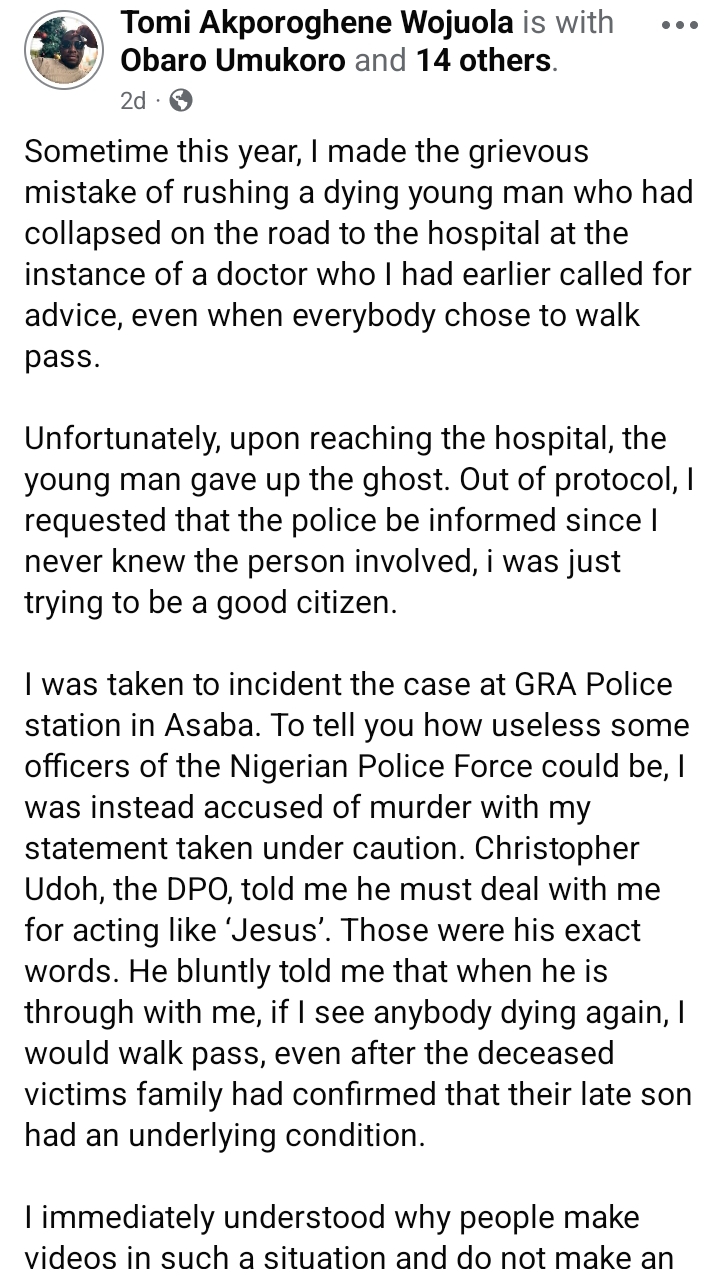
What is police extortion in Nigeria? Police extortion in Nigeria refers to the illegal demand and collection of money or other valuables by law enforcement officers from citizens, often under duress or threat of wrongful arrest, detention, or false accusation. It is a pervasive form of corruption that undermines the rule of law and public confidence in the police force.
Wojuola’s experience tragically illustrates the “Good Samaritan dilemma” prevalent in Nigeria, where the fear of being criminalized often outweighs the impulse to help those in distress. Many citizens now opt to record emergencies rather than intervene, a direct consequence of widespread police misconduct and the potential for wrongful accusations. This systemic issue contributes significantly to the broader problem of police brutality in Nigeria, fostering an environment where citizens are hesitant to engage with authorities, even for legitimate reasons.
The incident also brings to the forefront ongoing discussions about police reform. While there have been various initiatives over the years, the continuous stream of reports like Wojuola’s highlights the urgent need for tangible change. The latest developments in Nigerian police reform latest news often underscore the persistent challenges in implementing accountability mechanisms and reorienting the force towards community policing rather than intimidation and exploitation.
The ripple effect of such incidents is profound, eroding public trust and deepening the divide between the police and the communities they are sworn to protect. Citizens are left questioning the purpose of law enforcement when those meant to uphold justice become perpetrators of injustice. This environment makes it increasingly difficult for individuals to feel safe or empowered, even when seeking to report crimes or offer assistance.
In light of these challenges, many Nigerians seek guidance on how to navigate interactions with law enforcement. Understanding how to report police extortion in Nigeria is crucial, alongside practicing safety tips for interacting with Nigerian police. These measures, while not foolproof, can empower citizens to protect their rights and contribute to documenting instances of misconduct.
Distinguishing between a legitimate police arrest vs wrongful detention Nigeria is vital for understanding one’s rights. A lawful arrest requires probable cause and adherence to due process, whereas wrongful detention often involves arbitrary arrests, prolonged holding without charge, or detention used as a leverage for extortion. Knowing these differences can be a critical defense against unlawful police actions.
As we look towards the future, citizens are actively seeking best ways to avoid police harassment 2026. This includes advocating for stronger legal frameworks, increased police accountability, and public awareness campaigns about rights and responsibilities. The goal is to foster an environment where incidents like Wojuola’s become aberrations rather than common occurrences.
The ordeal of Tomi Akporoghene Wojuola serves as a powerful testament to the urgent need for comprehensive reforms within the Nigerian Police Force. Until systemic issues are addressed and accountability is genuinely enforced, the specter of Nigerian police extortion will continue to cast a long shadow over citizens’ willingness to engage in civic acts and trust their protectors.
Ultimately, the story is a call to action for both authorities and citizens to confront the deep-seated problems of Nigerian police extortion, ensuring that no one is punished for simply trying to save a life.









