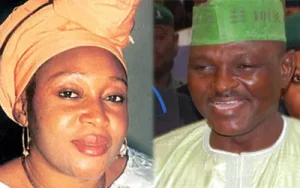
Ayodele Fayose, the former Governor of Ekiti State, has publicly criticised the leadership style of Seyi Makinde, the incumbent Governor of Oyo State. In a recent television interview, Fayose reportedly described Governor Makinde as a “small boy,” a remark that immediately ignited fresh political tension within the Peoples Democratic Party (PDP) across Nigeria’s South-West geopolitical zone. This public condemnation underscores deep-seated grievances and power struggles currently afflicting the party’s regional structure.
Fayose’s allegations extend beyond personal attacks, accusing Governor Makinde of a deliberate abuse of political authority and systematically dismantling established PDP structures throughout the South-West. He claimed that the Oyo State Governor has sidelined numerous loyal party stakeholders who were instrumental in his ascent to power, thereby alienating key figures and disrupting the party’s traditional hierarchy. These actions, according to Fayose, have fostered widespread discontent among long-serving members.
The former Ekiti governor further alleged that Governor Makinde has strategically taken control of vital state assets, purportedly for political convenience rather than public benefit. This move, Fayose insisted, has not only deepened internal grievances but also concentrated power unduly, undermining the collective leadership ethos within the PDP. Such centralisation of influence, he argued, contravenes democratic principles and internal party cohesion.
A significant portion of Fayose’s critique focused on specific incidents, particularly a primary election in Osun State. He alleged that an individual, who had not formally obtained the official PDP nomination form, inexplicably emerged as the party’s candidate. Fayose controversially referenced the candidate’s alleged connection to a past high-profile murder case, further questioning the integrity and transparency of the selection process within the party’s regional chapter.
Fayose also recounted a personal confrontation during his visit to Osun State to oversee a primary election, alleging that Governor Makinde orchestrated an attack against him using members of a drivers’ union. He further claimed that Makinde was responsible for the subsequent imprisonment of the individual involved. These accusations paint a picture of aggressive political tactics and a willingness to use coercive measures to assert dominance.
The “small boy” epithet, often used in Nigerian political discourse to denote a perceived lack of experience, respect for elders, or political maturity, carries significant weight. Fayose’s use of this phrase against an incumbent governor is a direct challenge to Makinde’s authority and legitimacy within the party, suggesting he views the Oyo State helmsman as an upstart who disregards established political norms and hierarchical structures.
This public spat has intensified existing internal divisions within the PDP, particularly in the South-West, where various factions are vying for control and influence. The region is a crucial battleground for national political parties, and sustained internal strife could severely hamper the PDP’s ability to present a united front and effectively compete in future elections. Observers note that such open conflicts are detrimental to party cohesion.
The Peoples Democratic Party has historically faced challenges maintaining unity across its diverse regional chapters, with personality clashes and power struggles frequently erupting into public view. This latest confrontation between two prominent figures from the South-West highlights the persistent struggle for leadership and direction within the party, particularly as it navigates its role as an opposition force.
The implications of Fayose’s statements resonate beyond the immediate individuals involved. They raise questions about internal party democracy, accountability, and the respect for due process in candidate selection. Such allegations, if left unaddressed, could erode public trust in the party and deter potential supporters or new members seeking a stable political platform.
While Governor Makinde’s office has not yet issued a formal response to Fayose’s detailed accusations, the silence itself may be interpreted in various ways by political analysts. The PDP’s national leadership faces the delicate task of intervening to quell the escalating tensions and mediate between the feuding factions to prevent further fragmentation within a critical geopolitical zone.
The ongoing dispute underscores the complex dynamics of power and loyalty within Nigerian political parties, where regional leaders often wield significant influence. The resolution, or lack thereof, of this particular conflict could set a precedent for how internal disagreements are managed in the run-up to future electoral cycles, impacting the PDP’s strategic positioning and overall political stability in the South-West.