

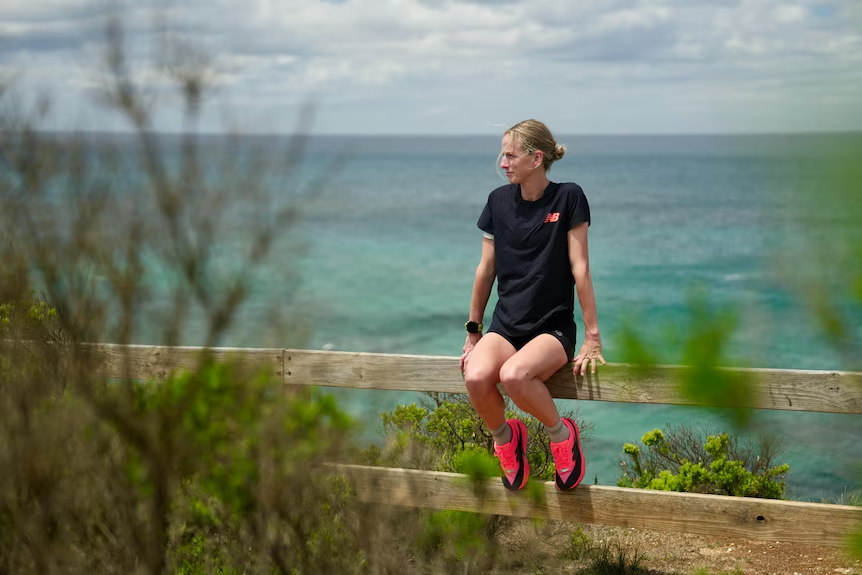
Australian female marathon runners are redefining the boundaries of elite sport, achieving peak performance and breaking national records after childbirth. Olympians like Ellie Pashley and national record-holder Jess Stenson exemplify a growing trend of mothers excelling at the highest levels of athletics, challenging long-held perceptions about age and parenthood in professional sport. Their success is increasingly supported by evolving policies designed to empower female athletes through pregnancy and postpartum recovery.
Jess Stenson, now Australia’s fastest-ever female marathon runner, initially considered stepping away from the sport in 2019 while pregnant with her first child, Billy. Conventional wisdom, based on outdated studies predominantly on men, suggested 28 was the peak age for marathon runners, followed by a decline. However, Stenson, a mother of two, shattered this notion by running a blistering 2:21:24 in Valencia earlier this month, surpassing the previous national record set by fellow mother-of-two Sinead Diver.
Stenson’s remarkable return to elite competition after becoming a parent was fraught with challenges. She navigated the discomfort of training while pregnant, the complex recovery from a C-section impacting crucial core muscles, and the demanding juggle of breastfeeding and infant care alongside rigorous training. Despite these physical and mental hurdles, her return to form was unexpectedly swift, leading her to a personal best in a 2021 marathon, a moment she describes as a realisation that “you can be your best as a mum.”
Ellie Pashley, a Tokyo Olympian and mother of two, is now setting her sights on the Los Angeles 2028 Games. Currently easing back into marathon training six months after the birth of her second child, Bobby, Pashley maintains a formidable pace, having recently won 10-kilometre events in Melbourne. She expresses strong determination to qualify for the 2028 Olympics, acknowledging the fierce competition but asserting that she feels “not quite done yet with running.”
Her journey after her first child, Tiggy, born in mid-2022, presented significant difficulties. Pashley admits she might have “rushed it” by resuming racing when Tiggy was just six months old, leading to injuries and disappointing results in crucial qualifying marathons. This previous experience informs her more measured approach this time, as she draws inspiration from the increasing number of mothers excelling at the pinnacle of Australian marathon running.
Crucially, this wave of success among elite mother-athletes has coincided with a significant overhaul in how Australia’s top sporting bodies support women through pregnancy and postpartum periods. Previously, pregnancy was often treated akin to an injury, leading to a withdrawal of funding and support, as Ellie Pashley recalls from earlier experiences in the sport.
Jess Stenson’s personal journey vividly illustrates this policy evolution. When she informed Australian Athletics (AA) of her first pregnancy in 2019, she was told her funding eligibility would cease, placing her on a medical support level. The response implied a lack of understanding regarding an athlete’s potential to return. However, four years later, ahead of her second pregnancy before the Paris Olympics, AA’s response was dramatically different, offering comprehensive support for her and her family if she aimed to qualify.
This shift reflects tangible policy changes, including AA’s progressive updates to its National Athlete Support Structure system, which now mandates the removal of “unreasonable barriers to participation in the sport that disadvantage [pregnant women].” Further bolstering this support, the Australian Olympic Committee (AOC) introduced a $10,000 grant in December for female athletes returning to Olympic sport after giving birth. Stenson herself qualified for the Paris Olympics just six months postpartum, running a marathon in little over 2 hours and 24 minutes, before setting Australia’s second-fastest Olympic marathon time at the Games.
These gradual but consistent improvements in athlete support are making it increasingly feasible for Australian women to combine elite running careers with starting a family. This progressive environment ensures that the next generation of female athletes, including Stenson’s own daughter, can envision a future where sporting excellence and motherhood are not mutually exclusive but can, in fact, be complementary.
The sense of community among these “marathon mums” provides mutual inspiration and encouragement. Ellie Pashley speaks of being emboldened by her peers who have returned to the sport faster than ever after childbirth, expressing pride in being part of this supportive network. Their collective achievements demonstrate a powerful narrative that challenges old paradigms and paves the way for a more inclusive and supportive era in elite Australian sport.






