


Volodymyr Zelensky, Ukraine’s President, has unveiled details of an updated 20-point peace plan aimed at resolving the protracted conflict with Russia. The proposal, agreed upon by US and Ukrainian envoys in Florida, offers Russia the potential for Ukrainian troop withdrawals from eastern territories, to be replaced by demilitarised zones. President Zelensky indicated a Russian response was anticipated following discussions with American officials.
Describing the framework as the primary pathway to ending the war, the plan outlines robust security guarantees from the United States, NATO, and European partners. These guarantees would include a coordinated military response should Russia initiate another invasion of Ukraine. This aspect seeks to establish a strong deterrent, mirroring collective defence principles.
A central element of the updated proposal addresses the contentious Donbas region in eastern Ukraine. Zelensky suggested that a “free economic zone” or a demilitarised zone represents a viable option for areas where Ukrainian forces might withdraw. He emphasised that any such zone would remain under Ukrainian administration and policing, rejecting the notion of “Russian police” involvement and insisting on international forces along the contact line to prevent infiltration.
Further detailing the territorial provisions, President Zelensky explained that if Ukraine were to pull back its heavy forces by five, 10, or 40 kilometres from the 25% of the Donetsk region it currently controls, creating an economic zone, Russia would be expected to reciprocate with similar withdrawals. Russian troops are currently positioned approximately 40 kilometres east of key Ukrainian “fortress belt” cities like Sloviansk and Kramatorsk, having recently captured Siversk.
Despite the proposed compromises, Russian President Vladimir Putin has previously stated that Russia intends to seize control of the entire east of Ukraine by force if Ukrainian troops do not withdraw. However, Zelensky expressed confidence that Russia would find it difficult to outright reject the US-backed plan, especially with former US President Donald Trump actively pushing for a resolution to the nearly four-year-old full-scale war. Zelensky warned that obstruction by Russia could lead to significant US military aid for Ukraine and intensified sanctions.
The plan also mandates a national referendum to approve the entire peace initiative, including any potential free economic zone in Donbas. Beyond the eastern territories, Zelensky insisted that Russia must withdraw its troops from four other Ukrainian regions – Dnipropetrovsk, Mykolaiv, Sumy, and Kharkiv. Furthermore, an economic zone would need to be established around the Russian-occupied Zaporizhzhia nuclear power plant, with Ukraine maintaining sole operational control, rejecting any joint US-Ukraine-Russia management.
Reaffirming Ukraine’s sovereignty, the peace framework proposes a non-aggression pact between Russia and Ukraine, complete with a robust monitoring mechanism. The security guarantees are designed to mirror NATO’s Article Five, which obliges members to defend an attacked ally, and would allow Ukraine to maintain a substantial military strength of up to 800,000 personnel during peacetime.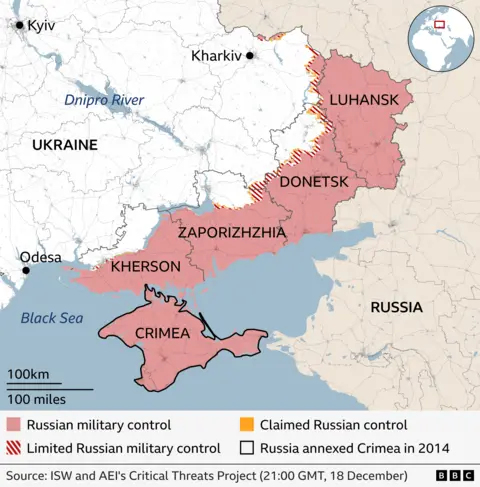
Notably, the updated plan deviates from earlier drafts by making no reference to barring Ukraine from joining NATO, a consistent demand from Moscow in previous negotiations. Instead, the latest framework explicitly proposes Ukraine’s accession to the European Union, specifying a defined date for membership, positioning it as a significant step towards European integration.
Financial support for Ukraine is also a key component, with plans for a substantial Ukraine investment fund estimated at approximately $200 billion (£150 billion), involving both US and European contributions. This fund aims to facilitate post-war reconstruction and economic recovery.
Finally, the comprehensive plan includes a requirement for Ukraine to hold elections as soon as feasible after the peace agreement is signed. Both Russia and the US have advocated for these elections, despite Ukraine currently operating under martial law due to a full-scale invasion.









