

![[post_title]](https://samony.com.ng/wp-content/uploads/2025/12/1766587765_Forgetting-about-the-championship-transformed-my-MotoGP-form-1024x682.jpg?lm=694BFD78)
Pedro Acosta attributes his remarkable mid-season transformation in the 2025 MotoGP campaign to a pivotal shift in mindset, rather than significant technical advancements on his KTM machine. The young Spaniard, who ended the season a strong fourth in the overall standings, believes that letting go of early championship aspirations allowed him to consistently extract maximum performance from his package, ultimately turning him into a regular podium contender. This mature approach marked a stark contrast to his earlier struggles and underscored his rapid development as a top-tier rider.
Acosta’s sophomore season began with considerable challenges, as an underdeveloped bike and ongoing financial constraints at KTM hampered his initial performance. Despite these hurdles, a gradual but steady improvement became evident. He broke into the top five for the first time at the French Grand Prix before securing his maiden podium finish with a third place at the Czech Grand Prix, signaling a turning point in his trajectory.
The true surge in his form, however, materialized after the summer break. This period coincided with the introduction of a new aerodynamic package for the RC16, which offered some marginal gains. Yet, Acosta firmly maintains that the most significant factor was his enhanced mental resolve and a noticeable reduction in the crashes that had often disrupted his rookie campaign, demonstrating a newfound maturity both on and off the track.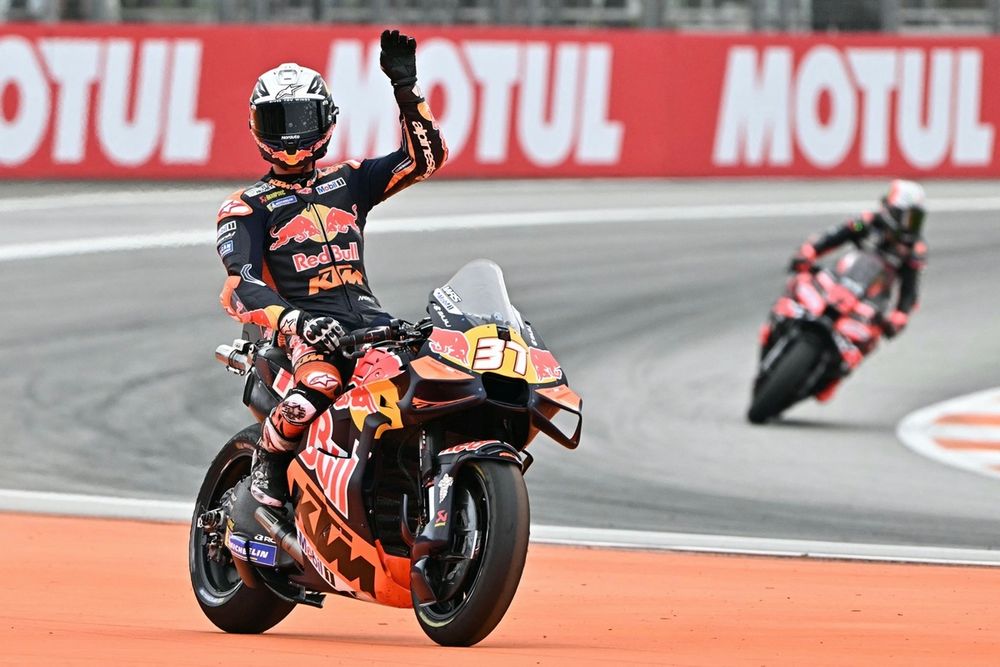
Speaking after the Valencia finale, Acosta candidly discussed the extent of the technical improvements. “To be honest, the bike didn’t improve a lot because we don’t change so much,” he stated, downplaying the impact of mechanical modifications. He acknowledged that “the fairing was helping, the swingarm was helping a bit,” but quickly pointed out persistent issues such as high tyre consumption and a lack of initial grip, which made competitive starts challenging.
Acosta articulated how this technical stagnation, paradoxically, fueled his mental reset. “For this, it’s true that at the moment that I start to forget about the championship dream, I start to just try to get 100% of my package,” he explained. This pragmatic focus on maximizing his current capabilities, race by race, allowed him to adapt more effectively. He noted that some days yielded a top-five finish, while others presented more significant struggles, but crucially, he found himself consistently fighting for podiums, particularly in sprint races.
The young rider emphasized that his psychological growth far outstripped any mechanical evolution of his KTM. “Maybe my mind is the one that grew the most,” he reflected, highlighting the internal transformation. While he admitted to feeling “better with the bike” over time, he reiterated that this was not due to substantial mechanical alterations. He briefly mentioned an arm pump surgery after the Jerez test, which led to “different things” being discovered, but not a dramatically altered machine.
The statistical evidence powerfully illustrates Acosta’s mid-season resurgence. After the initial 11 rounds of the season, he languished in ninth place with a modest 99 points. However, in the latter half of the year, he amassed an impressive 208 additional points, transforming him into one of the most consistent and formidable performers on the grid. This dramatic points haul propelled him to fourth in the championship, notably leapfrogging Ducati’s Francesco Bagnaia in the final race at Valencia with his seventh sprint podium.
Reflecting on the challenging start, Acosta confessed, “The first part of the season was one to forget.” He acknowledged the team’s initial struggle to understand their issues. He detailed how a collective “clearing of our mind” and a strategic shift in objectives enabled them to find greater consistency. The revised goal was to become a better, more adaptable rider, which ultimately unlocked improved performance, even if “some ups and downs” persisted after the summer break.
Despite his personal triumphs, Acosta remains realistic about KTM’s position within the competitive MotoGP landscape. He conceded that the team still trails behind dominant manufacturers like Ducati and Aprilia, which have shown significant improvements. Nevertheless, his season demonstrated the profound impact of mental resilience and strategic adaptation in overcoming technical limitations, setting a strong foundation for future campaigns.








