

![[post_title]](https://samony.com.ng/wp-content/uploads/2025/12/1766137230_Grifin-Review-Invest-Where-You-Shop-1024x536.jpg?lm=69451D8F)
Grifin, an automated investment application, is transforming how individuals engage with the stock market by linking everyday spending to direct equity purchases. Launched in 2017, the fintech platform aims to simplify investing for beginners, enabling users to automatically invest $1 into a company’s stock each time they make a qualifying purchase. This innovative approach, which boasts over 500,000 registered users, seeks to embed investment habits into daily routines, making the process feel natural and accessible.
The core mechanism of Grifin involves connecting a user’s credit or debit cards and a primary bank account via Plaid, a secure third-party platform. Grifin then monitors spending at publicly traded companies. At the end of each week, the app calculates the total number of qualifying transactions and withdraws a corresponding $1 for each purchase from the linked bank account. These funds are subsequently invested automatically into the respective companies where the user has shopped.
Grifin’s proprietary “Adaptive Investing” technology is designed to align investments with evolving consumer habits, eliminating the need for market timing or manual stock selection. While automated, the platform offers users considerable control. Individuals can pause weekly investments, adjust the per-transaction investment amount from $1 to $99, and even block specific companies they prefer not to own stock in, despite making purchases there. Furthermore, Grifin assigns risk levels—Conservative, Moderate, or Aggressive—to individual companies, ensuring investments align with a user’s predetermined risk tolerance.
The platform provides access to over 400 individual stocks, though its system interacts with more than 3,500 businesses by recognizing subsidiaries; for instance, a purchase at Whole Foods translates into an investment in Amazon stock. Companies available for investment span various sectors, from technology giants like Microsoft and Amazon to consumer brands such as Starbucks and Coca-Cola. For stocks that pay dividends, these earnings are deposited into the user’s investible cash balance, requiring manual reinvestment as Grifin does not support automatic Dividend Reinvestment Plans (DRIP).
Grifin operates on a transparent fee structure, charging a flat monthly subscription of $5, totaling $60 annually, with no additional commission fees on trades. Users can cancel this membership at any time. The security of user funds and data is paramount, with brokerage services facilitated through Alpaca Securities, LLC, and Apex Clearing Corporation. Both entities are registered with the Securities Exchange Commission (SEC) and are members of FINRA and SIPC, providing regulatory oversight and investor protection. Plaid’s industry-standard security protocols further safeguard linked bank accounts.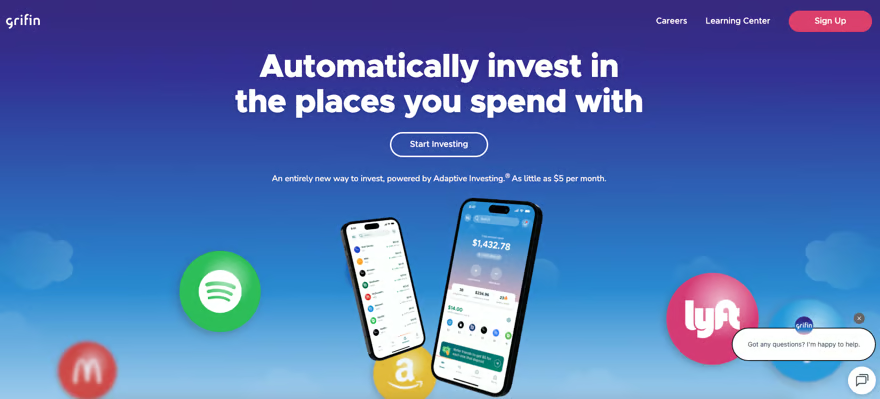
Grifin distinguishes itself from other beginner-friendly investment apps like Acorns and M1 Finance. Acorns primarily utilizes round-ups from purchases to invest in diversified, low-cost ETFs, catering to a long-term strategy without offering individual stocks. M1 Finance presents a hybrid model, allowing customizable portfolios of individual stocks and ETFs with fractional shares and automated contributions, offering more complexity and customization than Grifin. While all three platforms employ a fee-based model without trading commissions, Grifin’s unique focus on individual stock purchases tied to spending habits sets it apart.
Despite its innovative approach to habit formation, Grifin faces significant limitations as a primary investment vehicle. Investing solely in individual stocks, particularly for beginners, inherently carries higher risk and makes achieving optimal diversification challenging. The platform’s classification of individual stocks as “Conservative” regardless of industry raises concerns for financial experts. Most professional advice advocates for diversified, professionally managed portfolios, such as those offered by ETFs or robo-advisors, as a more prudent strategy for long-term wealth accumulation.
Consequently, while Grifin serves as a low-barrier entry point for individuals seeking to build a rudimentary investing habit, it is not broadly recommended as a foundational platform for serious long-term investment planning. Its strength lies in demystifying initial stock purchases and integrating them seamlessly into daily life. For investors aiming for robust, diversified growth, alternatives like Acorns or M1 Finance, which prioritize broader market exposure and professional management, typically present a more suitable and lower-risk pathway.

![[post_title]](https://samony.com.ng/wp-content/uploads/2025/12/1766136220_Man-with-worlds-biggest-penis-challenges-men-to-outdo-his-300x158.jpg?lm=6945199E "London Man Claims World’s Largest Medically Verified Penis")

![[post_title]](https://samony.com.ng/wp-content/uploads/2025/12/1765557443_Epstein-files-live-updates-New-photos-from-personal-collection-show.jpeg?lm=693C44C3 "DOJ Confronts Deadline for Release of Thousands of Epstein Files")
![[post_title]](https://samony.com.ng/wp-content/uploads/2025/12/Davido-to-perform-at-AFCON-2025-official-kick-off-concert-300x169.jpg?lm=69451579 "Davido to Headline AFCON 2025 Kick-Off Concert in Rabat")

![[post_title]](https://samony.com.ng/wp-content/uploads/2025/12/Man-proposed-to-his-two-girlfriends-during-a-live-football-300x150.jpg?lm=6945107C "Viral Double Proposal Stuns Fans at Mexican Football Match")

![[post_title]](https://samony.com.ng/wp-content/uploads/2025/12/Baddies-are-the-one-winning-good-girls-are-losing-1024x512.jpg?lm=69451EC4 "Viral Debate: Are Assertive Women Thriving More Than Traditional Peers?")
![[post_title]](https://samony.com.ng/wp-content/uploads/2025/12/1766136220_Man-with-worlds-biggest-penis-challenges-men-to-outdo-his-1024x538.jpg?lm=6945199E "London Man Claims World’s Largest Medically Verified Penis")
