

![[post_title]](https://samony.com.ng/wp-content/uploads/2025/12/1766037882_Safety-report-released-into-power-bank-fire-on-Virgin-flight.jpeg?lm=6943997A)
Australia’s transport safety regulator has issued renewed warnings regarding power bank use on aircraft, following a significant fire incident aboard a Virgin Australia flight earlier this year. The Australian Transport and Safety Bureau (ATSB) report into the July 21 event, where a lithium-ion power bank ignited in an overhead locker, has prompted Virgin Australia to implement stringent new regulations for carrying and using such devices. This incident marks the first time a power bank fire has occurred on an Australian aircraft.
The incident unfolded approximately ten minutes before the Virgin Australia Airlines Boeing 737-800, flying from Sydney to Hobart, was due to land. As cabin crew conducted routine final checks, a distinctive “popping and hissing sound” was heard. Crew members swiftly identified the source as flames and white smoke emanating from an overhead compartment, prompting immediate action to ensure passenger safety.
Passengers seated near the affected locker were promptly instructed to relocate to other available seating within the aircraft. A crew member then opened the overhead compartment, discovering a backpack engulfed in flames. The crew successfully extinguished the fire and continued to douse the backpack with water until all smoke dissipated, ensuring the situation was fully contained before the aircraft’s safe landing.
Post-landing inspections revealed minor fire damage to the overhead locker itself. Firefighters boarded the aircraft shortly thereafter, confirming the presence of a severely burnt power bank inside the backpack, which was identified as the origin of the blaze. This confirmed the initial suspicions of the crew regarding the nature of the emergency.
The ATSB’s comprehensive investigation concluded that the lithium-ion battery within the power bank experienced a “thermal runaway.” This phenomenon describes a rapid, uncontrolled increase in temperature, often initiated by a short-circuit within a battery cell, creating a dangerous chain reaction. The power bank’s owner informed Virgin Australia that the device, purchased in 2024, had no prior damage, was fully charged, and had not been exposed to moisture, heat, or drops before the flight.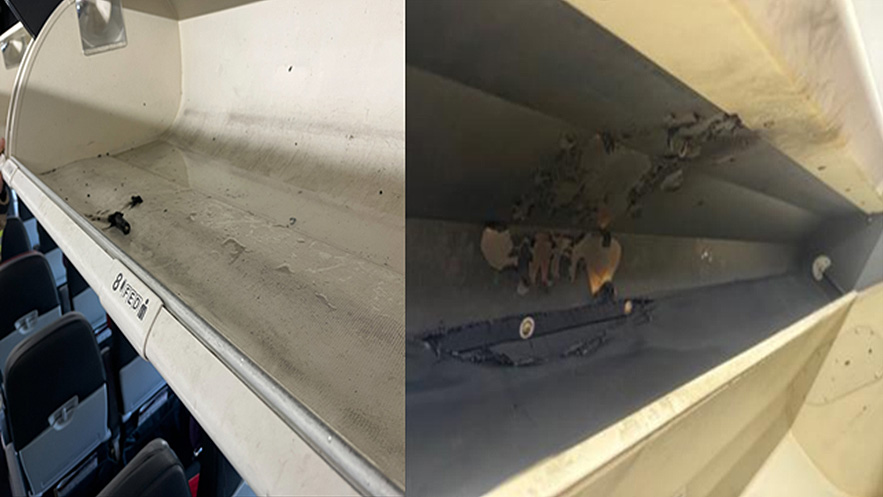
The report also highlighted challenges faced by cabin crew when attempting to use the provided protective breathing equipment, noting difficulties during fitment rendered it ineffective in this specific incident. While this was Australia’s first in-flight power bank fire, previous reports of smoke from such devices on planes have occurred. Globally, several significant power bank fires have been recorded, including one in January that led to the evacuation and destruction of a South Korean aircraft.
The ATSB further noted that over the past decade, four in-flight fires on Australian carriers involved mobile phones. Three of these incidents were attributed to lithium battery damage caused by phones being crushed in seats, while the precise cause of the fourth remains undetermined. These historical events underscore the inherent risks associated with lithium-ion battery technology in aviation environments.
In response to the incident and the safety findings, Virgin Australia has comprehensively revised its policies concerning the carriage and use of power banks and spare batteries. Previously, while these items were restricted to carry-on luggage, there were no specific limitations on their use or storage within bags once on board. The new rules aim to mitigate future risks by imposing stricter controls.
Effective December 1, Virgin Australia now mandates that all power banks, spare, and loose batteries must be stowed either in the seat pocket, directly under the seat in front, or kept in a passenger’s hand. Critically, these devices are explicitly prohibited from storage in overhead lockers and are no longer permitted for use on board the aircraft at any time during the flight.
Furthermore, each battery and power bank must be individually protected to prevent short-circuiting. This can be achieved by retaining original retail packaging, placing items in separate plastic bags or protective pouches, or by insulating exposed terminals with tape. Passengers are also required to only bring clearly labelled devices from reputable manufacturers.
Unlabelled, damaged, leaking, or counterfeit batteries and power banks, along with those subject to product recall, are strictly forbidden from being brought onto the aircraft. These measures are designed to ensure only safe and compliant devices are transported, reducing the likelihood of hazardous events.
The revised policy also explicitly prohibits the use of power banks to charge other devices while on board the aircraft. Passengers must remove all cables and USB connections from power banks and batteries, even when the devices are not in use. Additionally, recharging power banks or batteries using the aircraft’s power supply is now strictly forbidden, reinforcing a commitment to enhanced safety protocols.

![[post_title]](https://samony.com.ng/wp-content/uploads/2025/12/1766037038_Tinubu-nominates-Eyesan-Mohammed-as-Dangotes-allegations-rock-NMDPRA-NUPRC-300x163.jpg?lm=69439630 "Tinubu Replaces Petroleum Regulators Amidst Dangote’s Allegations")
![[post_title]](https://samony.com.ng/wp-content/uploads/2025/12/1766037189_Rachel-Reeves-budget-blamed-for-Pep-Guardiolas-restaurant-shutting-down-300x158.jpg?lm=694396C6 "Manchester’s Tast Catala Restaurant Closes Amid Rising Costs")
![[post_title]](https://samony.com.ng/wp-content/uploads/2025/12/Fubara-Visits-APC-Headquarters-Meets-National-Secretary-Aviation-Minister.png?lm=69439380 "Rivers Governor Fubara Visits APC Headquarters")
![[post_title]](https://samony.com.ng/wp-content/uploads/2025/12/The-ChatGPT-app-store-is-here-300x157.jpg?lm=69439225 "OpenAI Launches ChatGPT App Directory and SDK for Developers")

![[post_title]](https://samony.com.ng/wp-content/uploads/2025/12/1766033849_Heisman-voter-rips-Vanderbilt-QB-Diego-Pavia-after-explicit-message-300x169.jpg?lm=694389BB "Heisman Voter Slams Vanderbilt QB’s Expletive-Laden Reaction")


![[post_title]](https://samony.com.ng/wp-content/uploads/2025/12/1766037038_Tinubu-nominates-Eyesan-Mohammed-as-Dangotes-allegations-rock-NMDPRA-NUPRC-1024x555.jpg?lm=69439630 "Tinubu Replaces Petroleum Regulators Amidst Dangote’s Allegations")
![[post_title]](https://samony.com.ng/wp-content/uploads/2025/12/1766037189_Rachel-Reeves-budget-blamed-for-Pep-Guardiolas-restaurant-shutting-down-1024x538.jpg?lm=694396C6 "Manchester’s Tast Catala Restaurant Closes Amid Rising Costs")
