![[post_title]](https://samony.com.ng/wp-content/uploads/2025/12/1765819647_What-creature-is-the-Grinch-really-An-anatomist-explains.jpg?lm=694044FF)
The Grinch, a pervasive figure of the festive season, transcends his origins as Dr. Seuss’s 1957 misanthrope to become a quintessential part of holiday traditions. This grumpy, green, fur-covered character, infamous for his plot to sabotage Christmas, now ironically embodies the very spirit he once despised. Beyond his iconic snarl and verdant fur, however, lies a creature whose biological makeup has long piqued curiosity, even baffling his creator.
An anatomist’s perspective offers a unique lens through which to examine the Grinch, considering what his skeletal structure, musculature, and neurological pathways might reveal about his extraordinary origins. This scientific inquiry moves beyond mere fictional portrayal, delving into the hypothetical physiology that underpins his distinct appearance and behavior. Such an analysis illuminates the intricate blend of traits that make the Grinch a truly singular entity, unlike any found in Whoville or on Earth.
The Grinch’s most distinctive feature, his face, suggests a skull structure that remarkably fuses both primate and canine characteristics. This hypothetical cranium would feature a short, broad snout, a high-domed cerebrum, and powerful jaws, all contributing to a face uniquely adapted for exaggerated expression. These traits enable his infamous sneers, gloating grimaces, and ultimately, his genuine, heartwarming smiles, showcasing a remarkable range of emotional conveyance.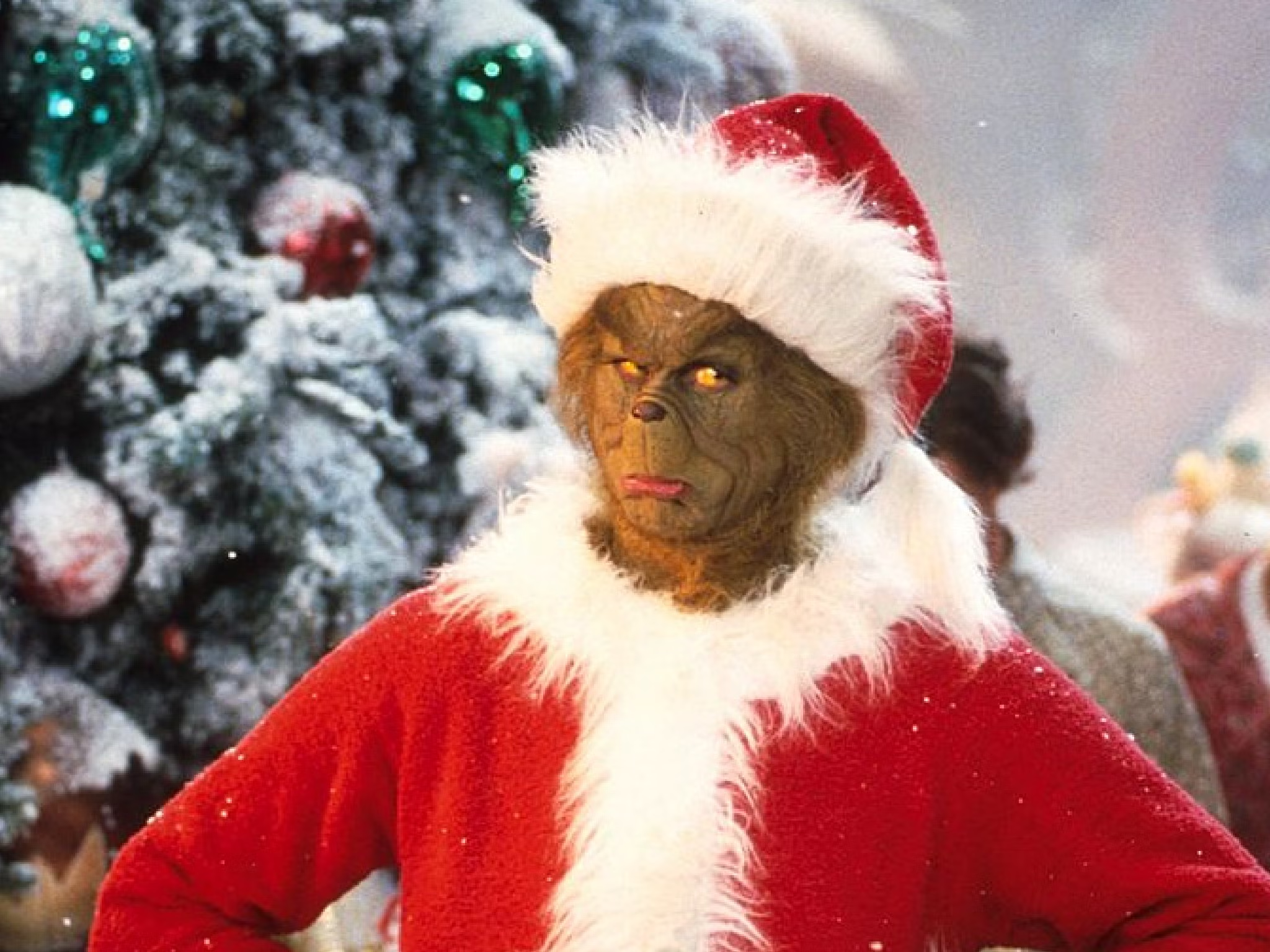
His broad, flared zygomatic arches, or cheekbones, would accommodate robust zygomaticus major muscles, essential for lifting the corners of his mouth into that iconic, mischievous smirk. Beneath his intense yellow eyes, a large bony canal would transmit nerves to whisker-like facial hairs, providing exquisite tactile sensitivity. These sensory appendages, akin to a cat’s whiskers, would allow him to detect subtle air currents, crucial for stealthily navigating Whoville or sensing approaching residents. His chimp-like teeth, with sharp canines for tearing “roast beast” and sturdy molars for grinding, complete his formidable oral anatomy.
The Grinch’s vivid yellow eyes, set in large, forward-facing sockets, strongly indicate a crepuscular existence, meaning he is most active during dawn and dusk. This adaptation, common in animals like owls and cats, utilizes yellow pigment to filter blue light and enhance contrast, sharpening his perception of movement in low-light conditions. Such visual acuity would be indispensable for a nocturnal gift thief, complementing a highly attuned sense of smell, suggested by his tall, narrow nasal aperture and constant twitching nose, capable of detecting festive aromas from a considerable distance.
His posture, upright yet fluid and almost serpentine, points to a spine that combines the flexibility of a gibbon with the sinuous grace of a cat. An extended, highly mobile lower back would facilitate his characteristic slouch and coiled stance, while gently curved thoracic vertebrae would create his hunched silhouette, ideal for skulking. Elongated cervical vertebrae would grant him an exaggerated capacity for tilting and craning his head, further enhancing his expressive range.
Furthermore, the Grinch’s digitigrade stance, walking on the balls of his feet and toes rather than his soles, ensures a softened, agile gait. This anatomical adaptation, similar to felines, minimizes sound, enabling the quiet, stealthy movement necessary for his Christmas Eve escapades. Though his pelvis supports an upright posture, his center of gravity remains slightly forward and low, positioning him anatomically between human and primate forms, perfectly balancing mobility with bipedalism.
The Grinch’s early behavior, marked by rash decisions and a lack of foresight, offers clues to his neurological architecture. His relatively small frontal lobes, particularly the prefrontal cortex, would explain his flat forehead and initial deficiencies in planning, impulse control, and moral reasoning. Conversely, his large and active temporal lobes would excel in processing sound and memory, crucial for recognizing (and despising) Whoville’s carols, alongside powerful olfactory processing for sniffing out hidden Who-Hash.
His well-developed occipital and parietal lobes would support the sharp vision, coordination, and spatial awareness essential for his acrobatic feats of climbing, leaping, and sliding down chimneys. The amygdala, a brain region central to emotion, would likely be hypertrophied, accounting for his profound emotional volatility, paranoia, and exaggerated reactions. This heightened limbic system activity would render him a creature largely governed by intense passions and reactive impulses.
The iconic moment when the Grinch’s “heart grew three sizes” presents a fascinating anatomical paradox. Biologically, such a rapid expansion, known as cardiomegaly, would be catastrophic, leading to severe cardiac dysfunction in mammals. A real heart cannot instantaneously enlarge due to emotional revelation. Instead, this profound transformation is more plausibly interpreted as a neurological shift, reflecting increased activity and connectivity within his brain.
This neurological re-wiring would involve enhanced communication between the prefrontal cortex, responsible for empathy and emotional regulation, and the limbic system, the seat of emotion and reward. Therefore, the “growing heart” serves as a powerful metaphor for his brain’s rapid evolution towards greater social attunement and compassion, rather than an anatomical impossibility. His physical transformation, from sneering misanthrope to festive participant, aligns with this internal neurological change.
To anatomists, the Grinch transcends mere Christmas folklore; he represents a compelling case study in the intricate relationship between form and function, behavior and biology. His ultimate redemption arc, where the muscles once powering a sneer now facilitate a genuine smile and hands that stole presents now carve roast beast, beautifully illustrates this alignment. The Grinch’s story, through an anatomical lens, powerfully conveys the enduring message that profound change, both internal and external, is always within reach.