

Premier League Developments: Observations on Recent Football Trends
The Premier League continues its captivating dance of upsets, tactical shifts, and off-field drama. This past week offered some intriguing narratives, raising a few eyebrows and prompting further examination of the sport’s direction.
Chelsea, despite playing with ten men, managed to secure a draw against Arsenal. Arsenal’s Mikel Arteta, while acknowledging the week’s challenges, expressed a tinge of disappointment, suggesting a win slipped through their fingers. It makes you wonder about the mental fortitude required to consistently perform at the highest level, particularly when key players are sidelined. Do teams need to focus more on mental resilience strategies, or is it simply part of the game’s unpredictable nature?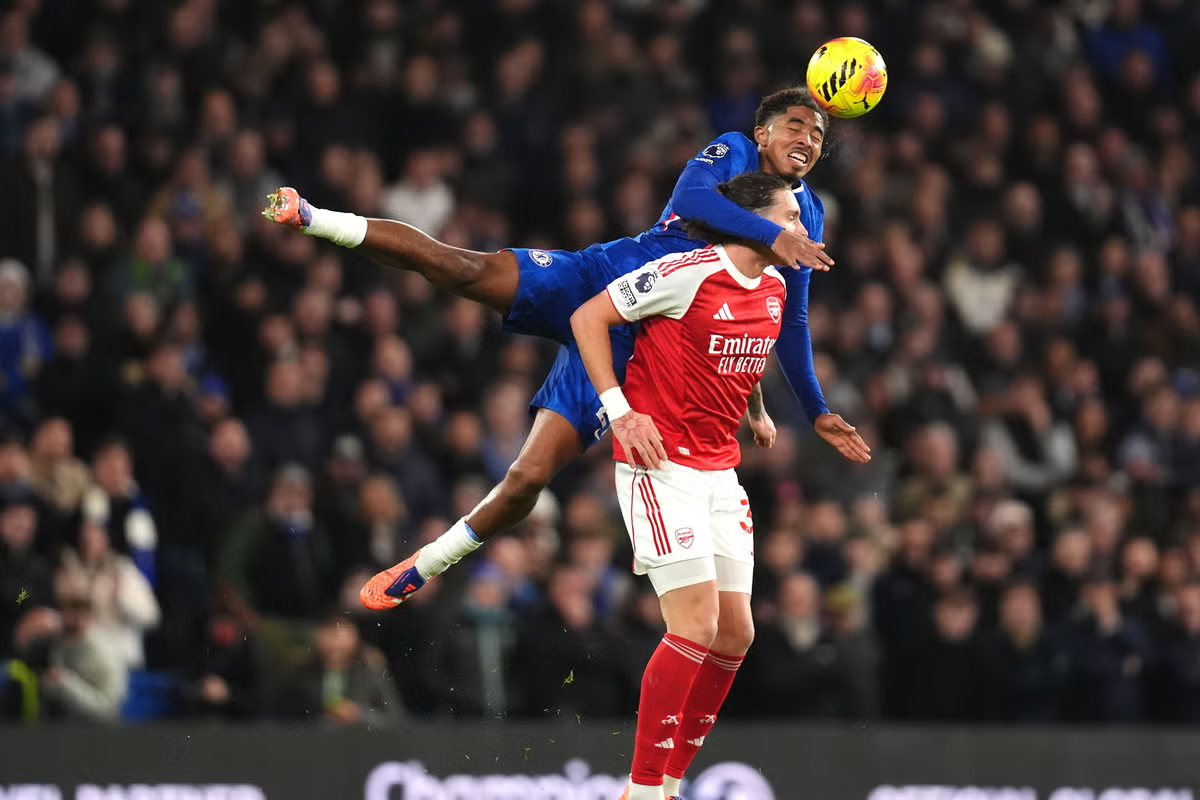 >
>
Manchester United, on the other hand, found their winning touch against Crystal Palace, relying on set-piece routines. Manager Ruben Amorim’s joking admission of “stealing” set-piece strategies highlights a growing trend: the meticulous analysis and adaptation of tactics among Premier League teams. In modern football, innovation isn’t just about groundbreaking formations, it’s in pilfering and refining even the subtlest of advantages. Everyone is copying everyone, and the cycle continues.
Liverpool’s victory provided Arne Slot with some respite. Alexander Isak’s goal, particularly meaningful, underscores the importance of confidence for players, especially those carrying a heavy price tag. The psychological aspect of football often gets overshadowed by discussions of tactics and formations, yet it can make or break a player. Slot’s handling of Mohamed Salah is interesting. Sometimes, a manager’s bold decision to bench a star player sends a powerful message to the squad.
Speaking of player psychology, Lucas Paqueta’s outburst after his red card, accusing the Football Association of a lack of “psychological support,” reveals a concerning gap in player welfare. His earlier spot-fixing allegations certainly cast a shadow. The pressure on these athletes is immense, and navigating investigations while maintaining peak performance is a Herculean task. It seems clearer than ever that clubs and governing bodies need to invest more heavily in mental health resources for players. The cost of ignoring this is becoming too high.>
It’s worth considering the evolving landscape of talent identification and development. Are clubs prioritizing mental fortitude alongside technical skill? Are academies adequately preparing young players for the psychological demands of professional football? These are questions that will become increasingly crucial in shaping the future of the Premier League.
From a broadcasting perspective, the relentless schedule can be a double-edged sword. While it provides a constant stream of content for viewers, it also contributes to player fatigue and increases the risk of injuries. The league must find a way to balance the commercial demands with the need to protect its most valuable assets: the players themselves.
Turning to Birmingham and Watford, their clash in the Championship highlights the intense competition for promotion. The financial rewards of reaching the Premier League are astronomical, driving clubs to invest heavily in players and infrastructure. However, this also creates a volatile environment, with clubs often facing financial difficulties if they fail to achieve their goals.
The transfer market also plays a significant role. Premier League clubs continue to spend exorbitant sums on players, often driving up prices across Europe. This creates a disparity between the haves and have-nots, making it increasingly difficult for smaller clubs to compete.
Given these facts, the Premier League’s future hinges on several factors. How will the league address the issue of player welfare? Can it find a way to create a more level playing field? Will it continue to prioritize commercial interests over the long-term sustainability of the sport?
It’s worth noting that there’s a growing sentiment among fans that the game is becoming increasingly disconnected from its roots. The relentless pursuit of profit, the constant media attention, and the influx of foreign ownership have all contributed to this sense of alienation. To that end, the league must strive to preserve the traditions and values that have made it so popular in the first place.
This challenge requires a delicate balancing act. The Premier League must continue to innovate and adapt to the changing landscape of global football, while also remaining true to its core identity. Ultimately, the success of the league will depend on its ability to navigate these complexities and create a sustainable future for all stakeholders.
The patterns are there if you look closely. How the Premier League reacts to these patterns will dictate its standing in the years to come. One thing is for sure, though: the game never stops evolving.


![[post_title]](https://samony.com.ng/wp-content/uploads/2025/12/1764561601_Bandits-abduct-pastor-wife-parishioners-in-Kogi-300x124.jpg?lm=692D12C3 "Nigeria’s Banditry Crisis: From Reactive Measures to Root Cause Solutions")
![[post_title]](https://samony.com.ng/wp-content/uploads/2025/12/Here-are-50-standout-deals-under-100-were-eyeing-for-300x156.jpg?lm=692D16FB "Here are 50 standout deals under $100 we’re eyeing for Cyber Monday")
![[post_title]](https://samony.com.ng/wp-content/uploads/2025/12/Australias-cervical-cancer-breakthrough-faces-major-challenge.jpg_s1024x1024wisk20csnB8Q5F6NUt2HSyRp-300x148.jpeg?lm=692D17A3 "Australia’s cervical cancer breakthrough faces major challenge")
![[post_title]](https://samony.com.ng/wp-content/uploads/2025/12/1764561478_Lisa-Riley-Im-A-Celeb-moment-leaves-fellow-Emmerdale-star-300x158.jpg?lm=692D1249 "Lisa Riley I’m A Celeb moment leaves fellow Emmerdale star Dominic Blunt heartbroken")
![[post_title]](https://samony.com.ng/wp-content/uploads/2025/12/1764559998_EFCC-disowns-Peter-Okoyes-800k-fraud-claim-against-brothers-Jude-300x169.png?lm=692D0C81 "EFCC Casts Doubt on Peter Okoye’s $800k P-Square Fraud Claim")

![[post_title]](https://samony.com.ng/wp-content/uploads/2025/12/1764563741_Do2dtun-accuses-US-embassy-of-enabling-ex-wife-to-relocate-kids-1024x683.jpg?lm=692D1B1F "Dotun Accuses US Embassy of Child Relocation: Custody Fight Erupts")
![[post_title]](https://samony.com.ng/wp-content/uploads/2025/12/1764561601_Bandits-abduct-pastor-wife-parishioners-in-Kogi-1024x422.jpg?lm=692D12C4 "Nigeria’s Banditry Crisis: From Reactive Measures to Root Cause Solutions")
