![[post_title]](https://samony.com.ng/wp-content/uploads/2025/11/1764294451_U-Dey-Crase-Davido-Slams-Fan-Who-Proposed-Structuring-His-1024x435.jpg?lm=6928FF36)
Davido, Fanbase Structure, and the Evolving Artist-Fan Relationship: A Critical Look
Davido’s recent sharp response to a fan’s suggestion about structuring his fanbase sparked a fascinating debate. The fan, posting on X, suggested a more organized system with key accounts coordinating with Davido’s team. Davido’s reply? A blunt dismissal emphasizing financial success over formalized online engagement. “U Dey crase,” he retorted, adding, “We Dey stack millions of $ … u Dey talk about group chat. FEM.” This seemingly simple exchange exposes deeper shifts happening within the music industry, particularly how artists manage (or don’t manage) their fan relationships in the digital age.
The incident is interesting because it highlights a disconnect. On one hand, the fan’s proposal reflects a desire for increased engagement, a feeling of ownership, and a structured channel for support – things many modern fanbases actively seek. We’ve seen organized online communities wield significant influence, driving streaming numbers, trending hashtags, and even impacting award nominations. Yet, Davido’s reaction underscores a different viewpoint, one where monetary success eclipses the perceived need for formalized fan management.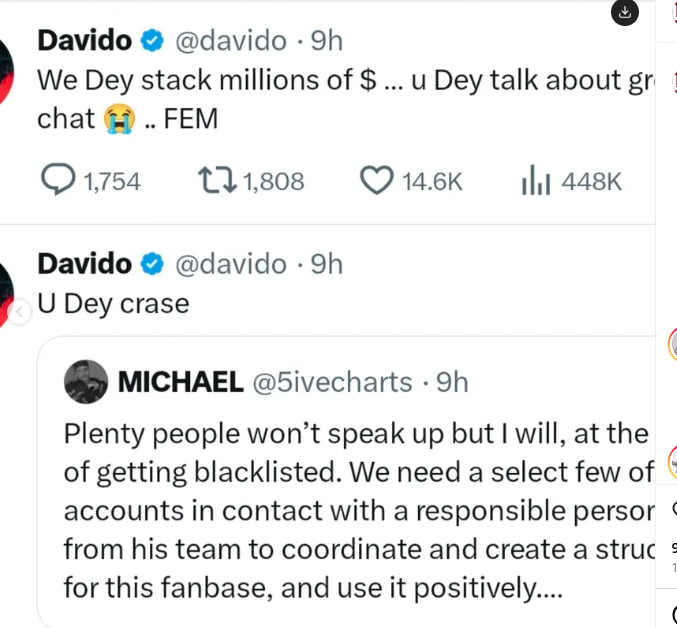 >
>
It is fair to say that, Davido’s perspective isn’t unique. Many artists, especially those at his level, likely prioritize revenue streams and creative output over the intricacies of online community building. They may view structured fan groups as potential sources of drama, demanding expectations, or even brand control conflicts. He might believe that organic growth and genuine enthusiasm, fueled by his music and public persona, are more valuable than engineered support. After all, he’s built a global brand without meticulously managed fan forums.
Still, ignoring the potential of a well-organized fanbase seems like leaving money on the table. Think about the BTS ARMY, Taylor Swift’s Swifties, or Beyoncé’s Beyhive. They’re not just fans; they are marketing machines, grassroots promoters, and fiercely loyal defenders. These groups can mobilize rapidly, amplify an artist’s message, and even shape public perception. This level of influence doesn’t happen by accident; it often requires nurturing and strategic engagement.
Perhaps the key lies in finding the right balance. Maybe Davido’s team already employs subtle strategies to cultivate his fanbase without the formal structure the fan suggested. Maybe a direct, top-down approach doesn’t align with his brand’s authenticity. Maybe the perceived effort outweighs the potential return on investment, especially when “stacking millions of $.” >
>
Then we should consider cultural nuances. Afrobeat, while undeniably global, thrives on a different energy compared to some Western pop genres. The relationship between artist and fan may be less about meticulously crafted online interactions and more about live performances, shared experiences, and a general sense of community. To that end, what works for a K-pop group in South Korea might not translate seamlessly to an Afrobeat artist in Nigeria.
Separately, the story involving Sophia Momodu, Davido’s baby mama, adds another layer of complexity. Rumors circulating online accused her of preventing their daughter, Imade, from attending family events. Her subsequent statement, clarifying her position and addressing the issue of child support, casts a shadow on the seemingly glamorous world of celebrity and highlights the challenges of co-parenting in the public eye. It also shows how easily social media speculation can escalate into personal attacks.
This challenge of balancing family life with fame isn’t new, but social media has undoubtedly amplified its intensity. The constant scrutiny and the ease with which opinions are shared online can create a breeding ground for misinformation and unwarranted criticism. It also serves as a reminder that behind the music and the public image, there are real people navigating complex personal situations.
Given these facts, it’s worth exploring how artists can better manage their public image and family relationships in the digital age. Perhaps more transparency, proactive communication, and a willingness to address rumors head-on can mitigate the negative impacts of online speculation. It’s not about controlling the narrative but about fostering a more informed and nuanced understanding.
Ultimately, the exchange between Davido and his fan, alongside the related story involving Sophia Momodu, offers a glimpse into the multifaceted realities of the modern music industry. It is about the evolving relationship between artist and fan, the influence of social media, and the delicate balance between public persona and private life. The industry is continuing to morph, and artists are learning real-time what works, and what will backfire. Expect these stories to just keep evolving.

![[post_title]](https://samony.com.ng/wp-content/uploads/2025/12/1765007717_Man-seeks-legal-help-as-girlfriend-he-sponsored-to-nursing-300x157.jpg?lm=6933E168 "He Paid for Her Nursing School, She Said No to Marriage: Now What?")

![[post_title]](https://samony.com.ng/wp-content/uploads/2025/12/Nigerian-Athlete-Oghenebrume-Faces-15-Years-Jail-Time-Over-Firearm.jpg?lm=6933DA53 "Nigerian Athlete’s American Nightmare: How Could This Firearm Charge Happen?")
![[post_title]](https://samony.com.ng/wp-content/uploads/2025/12/1765006345_Ashes-2025-live-score-England-search-for-early-Australia-wickets-300x200.jpg?lm=6933DC0C "Ashes 2025 live score: England search for early Australia wickets on day three after painful dropped catches")
![[post_title]](https://samony.com.ng/wp-content/uploads/2025/12/Dangote-Speaks-On-Reducing-Price-Of-Petrol-After-Meeting-Tinubu.webp.webp "Dangote Speaks On Reducing Price Of Petrol After Meeting Tinubu")

![[post_title]](https://samony.com.ng/wp-content/uploads/2025/12/Ned-Nwoko-Renews-Push-For-Social-Media-Regulation-After-Viral.jpg?lm=6933DAB5 "Nigeria Debates Social Media Regulation Amid Free Speech Concerns")
![[post_title]](https://samony.com.ng/wp-content/uploads/2025/12/1765007653_Premier-League-predictions-and-best-bets-91-Sunderland-can-cause-1024x576.jpg?lm=6933E128 "Prem Weekend Football: A Few Bets My Friends Are Eyeing")
![[post_title]](https://samony.com.ng/wp-content/uploads/2025/12/1765007717_Man-seeks-legal-help-as-girlfriend-he-sponsored-to-nursing-1024x535.jpg?lm=6933E169 "He Paid for Her Nursing School, She Said No to Marriage: Now What?")