

![[post_title]](https://samony.com.ng/wp-content/uploads/2025/11/1764059228_More-than-100-homes-damaged-by-tornado-in-Texas-after-1024x683.jpg?lm=69256860)
Analyzing the Rising Trend of Extreme Weather Events: A Critical Look at the Insurance Industry and Community Resilience
The news out of Houston—over 100 homes damaged by a tornado, yet thankfully no reported injuries—highlights a trend that’s becoming increasingly difficult to ignore: extreme weather events are on the upswing. Beyond the immediate devastation, stories like these spark deeper questions about how our infrastructure, communities, and industries are adapting, or not adapting, to this evolving reality.
It’s hard not to notice the shift. As someone who’s watched the insurance landscape for a while, I’ve seen the discussions evolve from contingency planning for “unlikely” scenarios to grappling with the escalating costs and frequency of climate-related disasters. What was once considered an anomaly is now becoming almost commonplace.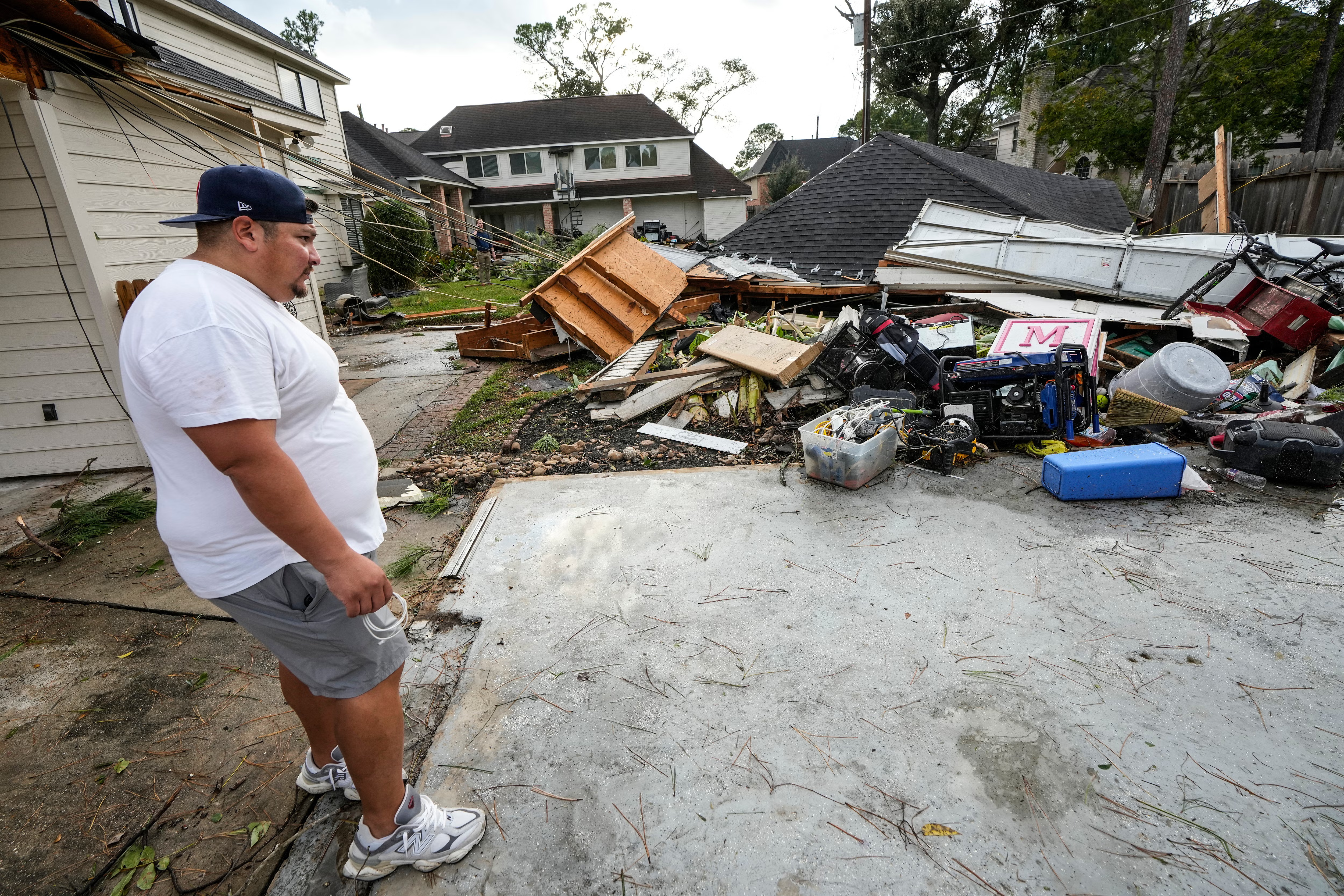 >
>
This raises the stakes for the insurance sector, naturally. Insurers face mounting pressure to accurately assess risk, adjust premiums, and, crucially, manage payouts. After all, a surge in claims from these catastrophic events could shake the stability of even the most established companies. Yet, pricing risk accurately in a climate that is fundamentally changing is a huge undertaking. Traditional actuarial models rely on historical data. But can the past reliably predict a future where weather patterns are becoming increasingly unpredictable? It is unclear.
One area where the industry could innovate more aggressively is in proactive risk mitigation. Think beyond simply offering policies to partnering with communities on resilience projects. Could insurers, for example, offer discounted premiums to homeowners who invest in reinforced roofing or flood-proofing measures? Some do, but the scale feels small relative to the overall threat. In any case, it is in their direct interest to do so.
Beyond insurance, the Houston tornado brings into sharp focus the need for resilient communities. Building codes, urban planning, and emergency response systems all play a role. Are we truly learning from each event, updating our approaches, and investing in infrastructure that can withstand increasingly volatile weather?>
Look at the building materials used in affected areas. Are they the most resistant to high winds and flooding? Are there incentives for homeowners to use more robust materials during construction or renovation? Similarly, how effective are the early warning systems? Did residents receive ample notification, enabling them to take necessary precautions? These are important considerations.
There is also the issue of social equity. Disasters often disproportionately impact vulnerable populations. Lower-income communities may lack the resources to adequately prepare for or recover from events like the Houston tornado. This challenge adds another layer of complexity, demanding solutions that address both the physical and social dimensions of resilience.
It’s worth noting the role of technology. Predictive modeling, using AI and machine learning, is becoming increasingly sophisticated. This technology might give us the ability to forecast extreme weather patterns with greater precision. This could allow communities to prepare more efficiently and reduce the impact of natural disasters. Also, satellite imagery and drone technology play an increasing part in damage assessment, helping insurance companies process claims more efficiently and swiftly.
The frequency of such events is testing the limits of government aid. Federal disaster relief programs play a vital role, but are they sustainable in the long run? The increasing demand may strain resources and necessitate a reassessment of funding priorities. Are there alternative models for disaster relief that could supplement or even replace the existing system? Perhaps, but any alternative would require massive political will to implement.
The narrative around climate change and extreme weather events can often feel overwhelming and even fatalistic. Still, it’s important to maintain a sense of agency. By demanding smarter policies, investing in resilient infrastructure, and supporting innovative solutions, we can lessen the human and economic toll of these disasters.
Stories like the one out of Houston shouldn’t be viewed in isolation. Instead, these events should be considered a call to action. These events are indicative of a larger trend that needs focused solutions. We need solutions that not only mitigate risk but also foster stronger, more resilient communities capable of weathering whatever comes their way. The future depends on it.

![[post_title]](https://samony.com.ng/wp-content/uploads/2025/12/Warriors-sign-Seth-Curry-for-remainder-of-season.jpeg "Warriors sign Seth Curry for remainder of season")
![[post_title]](https://samony.com.ng/wp-content/uploads/2025/12/1764745476_Ukraine-Russia-war-latest-Trump-envoys-fail-to-secure-peace-deal.jpeg "Ukraine-Russia war latest: Trump envoys fail to secure peace deal after Putin tells Europe he’s ready for war")
![[post_title]](https://samony.com.ng/wp-content/uploads/2025/12/1764744909_FG-Deploys-240-Solar-Powered-E-Tricycles-To-12-Universities.jpg "FG Deploys 240 Solar Powered E- Tricycles To 12 Universities :")
![[post_title]](https://samony.com.ng/wp-content/uploads/2025/12/1764744691_2027-Nasarawa-APC-governorship-aspirant-vows-to-prioritise-power-agriculture-if.jpg "2027: Nasarawa APC governorship aspirant vows to prioritise power, agriculture if…")
![[post_title]](https://samony.com.ng/wp-content/uploads/2025/12/1764744746_Chukwueze-Scores-Two-Iwobi-One-as-Nigerian-Duo-Nearly-Spark.jpeg "Chukwueze Scores Two, Iwobi One as Nigerian Duo Nearly Spark Famous Fulham Comeback")

![[post_title]](https://samony.com.ng/wp-content/uploads/2025/12/The-young-man-involved-in-the-attempted-Christmas-Day-bombing.jpeg "Nigerian Terrorism: Ideology’s Grip on Affluent Minds")
![[post_title]](https://samony.com.ng/wp-content/uploads/2025/12/1764747077_Over-15-years-Man-visits-secondary-school-to-check.jpg "Planting Seeds of Purpose: How Early Climate Action Shapes Lifelong Commitment")
