

![[post_title]](https://samony.com.ng/wp-content/uploads/2025/11/1764441676_Line-of-Duty-star-warns-twisted-scammer-is-impersonating-her-1024x538.jpg?lm=692B3E4D)
Celebrity Impersonation Scams: A Disturbing Trend Targeting Charity
Vicky McClure, the Line of Duty star, recently alerted her fans to a particularly odious scam. Someone is impersonating her via email, soliciting donations for dementia awareness – a cause she passionately supports. This isn’t just a random act; it’s a calculated strike against a vulnerable community and a celebrity known for her genuine efforts. It’s worth pondering, why this specific combination?
We’ve seen celebrity impersonation scams evolve over the years. Remember those early phishing attempts promising riches from a supposedly stranded royal? Now, they’ve become far more sophisticated, preying on people’s empathy and trust. They latch onto current events, exploit trending charitable causes, and leverage the carefully cultivated image of public figures. Scammers understand that a familiar name can open wallets faster than any sob story.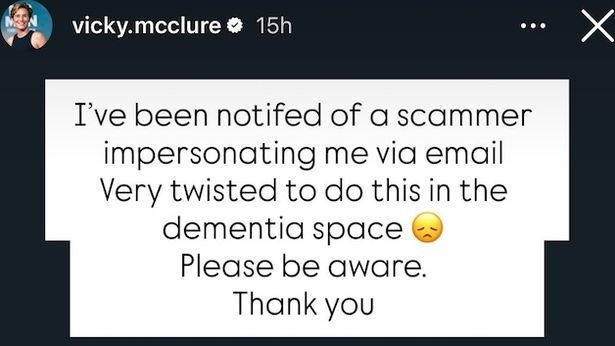 >
>
Consider the strategy at play here. McClure has a strong reputation, particularly in the UK. Dementia is a cause that resonates deeply with many, given the aging population and increasing awareness of the disease. The scammer isn’t just randomly picking a celebrity; they’re choosing one whose reputation aligns perfectly with the cause they’re exploiting. That’s where the real trickery lies.
The email itself, as shared by McClure, sounds legitimate, employing language intended to tug at heartstrings. It speaks of awareness campaigns, supporting families, and creating spaces for truth and action. The call to action – volunteers, sponsors, donors – feels authentic. It’s a well-crafted narrative designed to bypass our skepticism.
But here’s a challenge: vigilance. It’s easier said than done. These scammers are getting increasingly clever. They mimic email addresses, replicate website designs, and even use AI to generate personalized messages that sound remarkably genuine. How can the average person, even a tech-savvy one, distinguish between a real request and a cleverly disguised fraud? >
>
There are some steps we can take. Always double-check the sender’s email address. Does it precisely match the official domain of the charity or celebrity? If donating, go directly to the charity’s official website instead of clicking on links in emails. Independently verify any claims made in the email. A quick Google search can often reveal if a celebrity or organization has issued a warning about a scam.
It’s tempting to assume that only the gullible fall for these tricks. Yet, that thinking is dangerous. Sophisticated scams are designed to exploit our inherent trust in authority figures and our desire to help others. Even the most discerning individuals can be caught off guard.
This incident with Vicky McClure highlights a larger problem: the growing sophistication of online scams and the vulnerability of charitable giving. It forces us to question the platforms that enable these scams to thrive. Social media companies and email providers need to ramp up their efforts to detect and remove fake accounts and fraudulent content. Law enforcement agencies must prioritize investigating and prosecuting these crimes.
Looking at it from another angle, celebrities also have a role to play. McClure’s quick response in alerting her fans is commendable. Public figures need to be proactive in monitoring their online presence and warning their followers about potential scams. They can also partner with charities to raise awareness about safe giving practices.
Still, the ultimate responsibility lies with each of us to be skeptical and informed. We must treat every online request for money, no matter how compelling, with caution. Remember the old adage: if it sounds too good to be true, it probably is.
In any case, this scam targeting Vicky McClure and the dementia community serves as a stark reminder of the darker side of the internet. It’s a call to action for individuals, celebrities, tech companies, and law enforcement to work together to combat online fraud and protect those who are most vulnerable. These impersonation schemes are a grim reminder of how quickly good intentions can be twisted into something harmful. We must adapt to safeguard against them.

![[post_title]](https://samony.com.ng/wp-content/uploads/2025/11/1764441676_Line-of-Duty-star-warns-twisted-scammer-is-impersonating-her-300x158.jpg?lm=692B3E4D "Vicky McClure Scam: Charity Fraud Exploits Celebrity Trust")
![[post_title]](https://samony.com.ng/wp-content/uploads/2025/11/Tinubu-Nominates-Ex-INEC-Chair-Fani-Kayode-30-Others-As-Ambassadors-300x169.jpg?lm=692B3EE5 "Nigeria’s Ambassadorial Nominees: Who Made Tinubu’s List?")
![[post_title]](https://samony.com.ng/wp-content/uploads/2025/11/Preview-Levante-vs-Athletic-Bilbao-prediction-team-news-lineups.net2Fuploads2F20252F092Fimago1065906273-300x171.webp?lm=692B3A8A "Levante vs. Bilbao: Relegation Desperation Meets Bilbao’s Injury Crisis – Gonna Be Tense!")
![[post_title]](https://samony.com.ng/wp-content/uploads/2025/11/Katie-Millers-CNN-appearance-descends-into-shouting-match-as-she-300x200.avif?lm=692B3AB0 "Katie Miller CNN Clash: Media Bias and Political Echo Chambers")
![[post_title]](https://samony.com.ng/wp-content/uploads/2025/11/Jateny-At-This-Point-Burna-Boy-Should-Just-Come-Out-300x166.jpeg?lm=692B3BF5 "Burna Boy’s US Tour: Fan Disappointment and Afrobeats’ Global Test")
![[post_title]](https://samony.com.ng/wp-content/uploads/2025/11/A-Penny-That-Doubles-Every-Day-Or-1-Million-Dollars-300x157.jpg?lm=692B3A1F "Exponential Growth: The Patient Path to Wealth, Lessons from a Grain of Rice")

![[post_title]](https://samony.com.ng/wp-content/uploads/2025/11/1764441401_Nigerian-Gospel-Singer-Gaise-Baba-Announces-Fathers-Passing.jpeg?lm=692B3D39 "Gaise Baba’s Loss: Grief, Legacy, and Community in Nigeria")
![[post_title]](https://samony.com.ng/wp-content/uploads/2025/11/The-Super-Mario-Galaxy-bundle-for-the-Switch-is-still-1024x535.png?lm=692B3D8D "Nintendo’s Super Mario Galaxy Switch Deal: A Sign of Things to Come?")
![[post_title]](https://samony.com.ng/wp-content/uploads/2025/11/Tinubu-Nominates-Ex-INEC-Chair-Fani-Kayode-30-Others-As-Ambassadors-1024x576.jpg?lm=692B3EE6 "Nigeria’s Ambassadorial Nominees: Who Made Tinubu’s List?")
