![[post_title]](https://samony.com.ng/wp-content/uploads/2025/11/Expert-reveals-how-to-safely-deep-fry-a-turkey-for-1024x683.jpeg?lm=6928240B)
Deep-Fried Turkey: A Recipe for Disaster? Analyzing the Explosive Chemistry
Deep-frying a turkey promises succulent, juicy meat, making it a Thanksgiving centerpiece contender. Yet, this cooking method comes with risks. Every year, stories circulate about deep-frying disasters – property damage, injuries, even fatalities. The culprit? Often, a frozen turkey plunged into hot oil. But what exactly turns this culinary endeavor into an explosive event?
Having spent years examining the behavior of different compounds, including those in our food, I’ve developed a healthy respect for food chemistry. The science behind the “exploding turkey” boils down to a simple principle: density. It’s all about the differences in density between oil and water, and, crucially, the density changes water undergoes as it shifts between its solid, liquid, and gaseous states.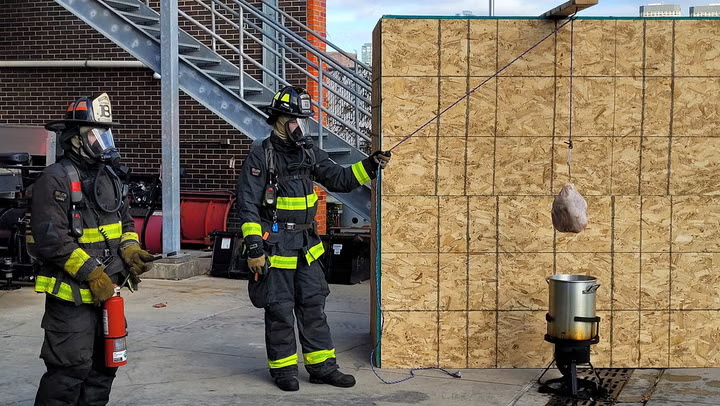 >
>
Density, at its core, is the mass of a substance occupying a given volume. Think of holding an ice cube and a marshmallow. Similar in size, but the ice cube is noticeably heavier – that’s density in action. Two critical density differences come into play here. First, water is denser than oil. Water molecules pack together more tightly than oil molecules. Moreover, water molecules contain oxygen, which is heavier than the carbon that dominates oil composition. This explains why oil floats on water.
Second, the density of a substance alters with its state. We see this daily – ice floats in water. That’s because solid ice is less dense than liquid water. And when water transitions to steam, the change is dramatic. Steam occupies roughly 1,700 times the volume of the original liquid water. Remember the whistling kettle? That’s expanding steam forcing its way out.
Now, consider the frozen turkey. It’s primarily meat, which contains a significant amount of water, typically ranging from 56% to 73%. Thawing a frozen bird reveals just how much water is trapped inside.>
Deep-frying involves heating oil to around 350°F (175°C), well above water’s boiling point of 212°F (100°C). So, when a frozen turkey meets hot oil, the ice on the surface instantly vaporizes into steam. That initial surface-level reaction isn’t usually the problem. The trouble begins when the entire turkey is submerged. The ice within absorbs heat and melts, forming liquid water. This water, being denser than the oil, sinks to the bottom of the fryer.
Here’s where the situation escalates. The submerged water keeps absorbing heat, eventually flashing into steam. This transition creates a massive volume expansion – that 1,700-fold increase again. Now, imagine this rapid expansion happening at the bottom of a fryer filled with scalding oil. The steam, now far less dense than the oil, surges upwards. The result? A violent eruption. The expanding steam forces the hot oil out of the pot, creating a dangerous, sputtering mess.
And, it gets worse. Splattered oil meeting a burner or open flame ignites quickly. Burning droplets then light nearby oil molecules, leading to a rapid, uncontrolled fire. From my experience, these kinds of fires are incredibly difficult to extinguish and spread quickly.
Given these facts, should you ditch the deep-fried turkey altogether? Not necessarily. Yet, caution is essential. Make sure your turkey is completely thawed. Dry the turkey thoroughly – inside and out – to remove as much excess water as possible. This minimizes the risk of a steam explosion.
It’s worth noting that even small amounts of water in hot oil can cause splattering. If you’ve ever added a wet ingredient to a hot pan and watched oil erupt, you’ve witnessed the science in action.
So, this Thanksgiving, should you brave the fryer? That’s your call. At least now you understand the explosive potential and how to mitigate the risk. A properly prepared, thawed turkey, along with strict adherence to safety guidelines, can make for a delicious, and hopefully uneventful, holiday meal. Just remember, a little understanding of chemistry can go a long way in the kitchen.




![[post_title]](https://samony.com.ng/wp-content/uploads/2025/12/1764867688_Gen-Z-admit-to-overthinking-in-winter-as-half-use-300x158.png?lm=6931BE6C "Gen Z’s Winter Overthinking: Tech Dependence vs. Grounding Solutions")
![[post_title]](https://samony.com.ng/wp-content/uploads/2025/12/Iran-Sends-Delegation-To-World-Cup-Draw-After-Threats-To.jpg?lm=6931BEBA "Navigating Geopolitics: Lessons from Iran’s World Cup Dance and the Ever-Present Data Game")
![[post_title]](https://samony.com.ng/wp-content/uploads/2025/12/1764867072_Lego-announces-NASA-Artemis-SLS-rocket-set-to-lift-off-300x169.jpg?lm=6931BC04 "LEGO’s Artemis: More Than a Toy, a Gateway to STEM Engagement?")

![[post_title]](https://samony.com.ng/wp-content/uploads/2025/12/1764869561_Wizkid-Set-to-Host-GOAT-Concert-in-Lagos-This-December.jpeg?lm=6931C5BB "Wizkid’s Lagos Show: True Homecoming or Calculated Move?")